Choosing a PIM in 2026 comes down to one honest question. Do you need a broad data platform, or a focused product catalog tool?
That is the heart of the Pimcore vs Akeneo decision. Both are strong, and both are widely deployed.
At Webkul, we build connectors and integrations for both platforms. So this comparison stays neutral, because we have no reason to push one over the other.
Instead, we want to help you choose well. Therefore, we will map each platform to the use cases where it genuinely shines.
This Pimcore vs Akeneo guide targets solution architects, PIM decision-makers, and developers evaluating options. Let us start with what each product actually is.
What is Pimcore?
Pimcore is a consolidated open-source Data & Experience platform. It combines PIM, MDM, DAM, DXP/CMS, and an eCommerce framework in one codebase.
Because everything lives together, Pimcore handles multi-domain, multi-channel data management. As a result, product data and digital assets link tightly inside a single system.
The current platform version is 2026.1.x. It runs on PHP 8.4/8.5 and Symfony 7.4.
Its data model centers on DataObject classes. Developers define these classes, so the schema stays flexible.
Supporting structures extend that model. For example, Field Collections allow multiple instances per field, while Object Bricks add one instance per type with full inheritance.
There is also a Classification Store for arbitrary key/value attributes. Meanwhile, Localized Fields handle multi-language translation.
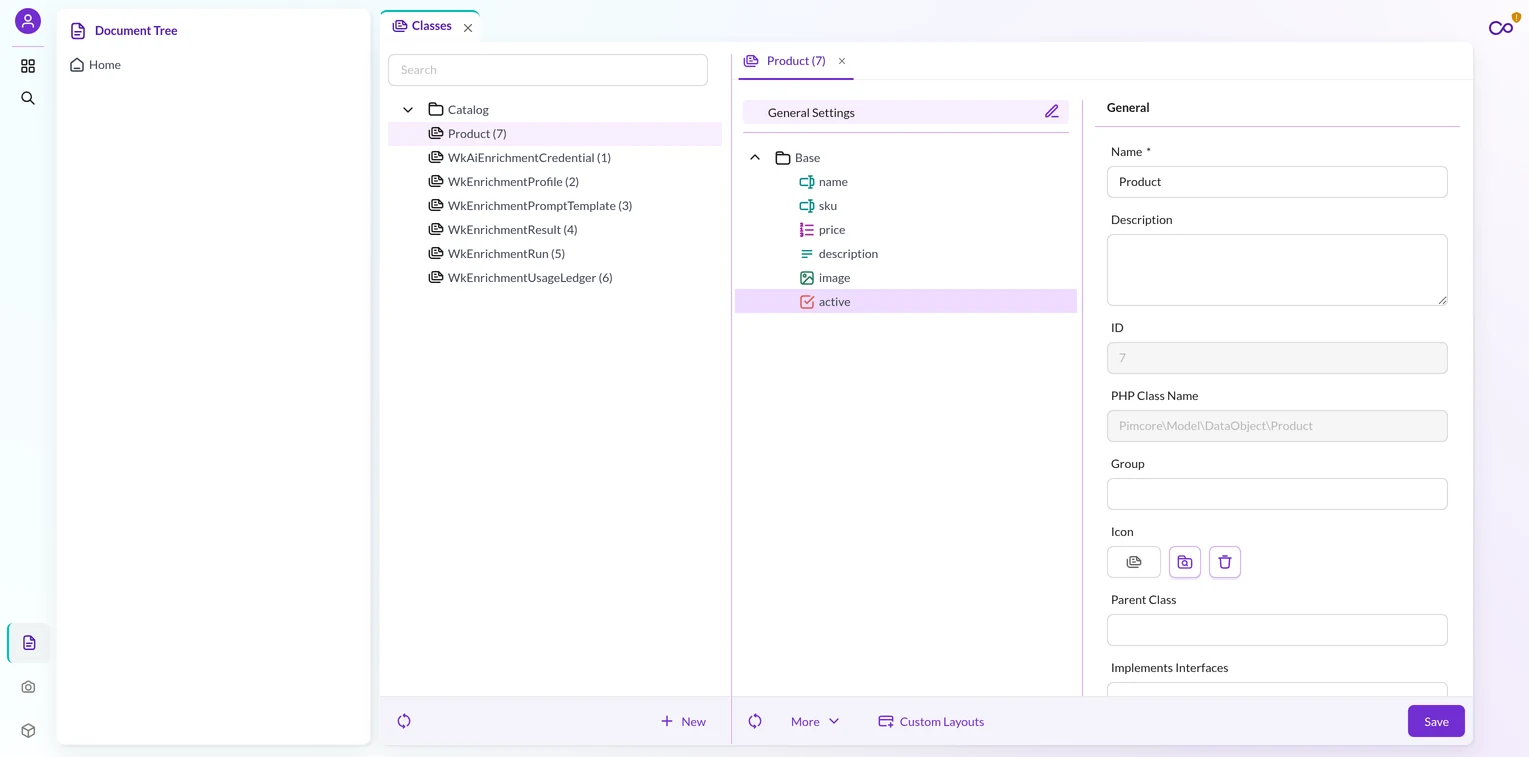
Speaking of the UI, Pimcore Studio replaced the old ExtJS classic interface. Pimcore no longer ships the ExtJS AdminBundle.
If you want to go deeper on the model, Webkul has written practical guides. For instance, see our walkthrough on data objects in Pimcore and how to create a class and data object in Pimcore.
What is Akeneo?
Akeneo is a Product Cloud platform purpose-built for product catalogs, syndication, and product experience management. Unlike Pimcore, it does not include CMS or comprehensive DXP capabilities.
Instead, it focuses on Product Experience and integrates with external CMS, DAM, and eCommerce systems. So its identity stays catalog-centric.
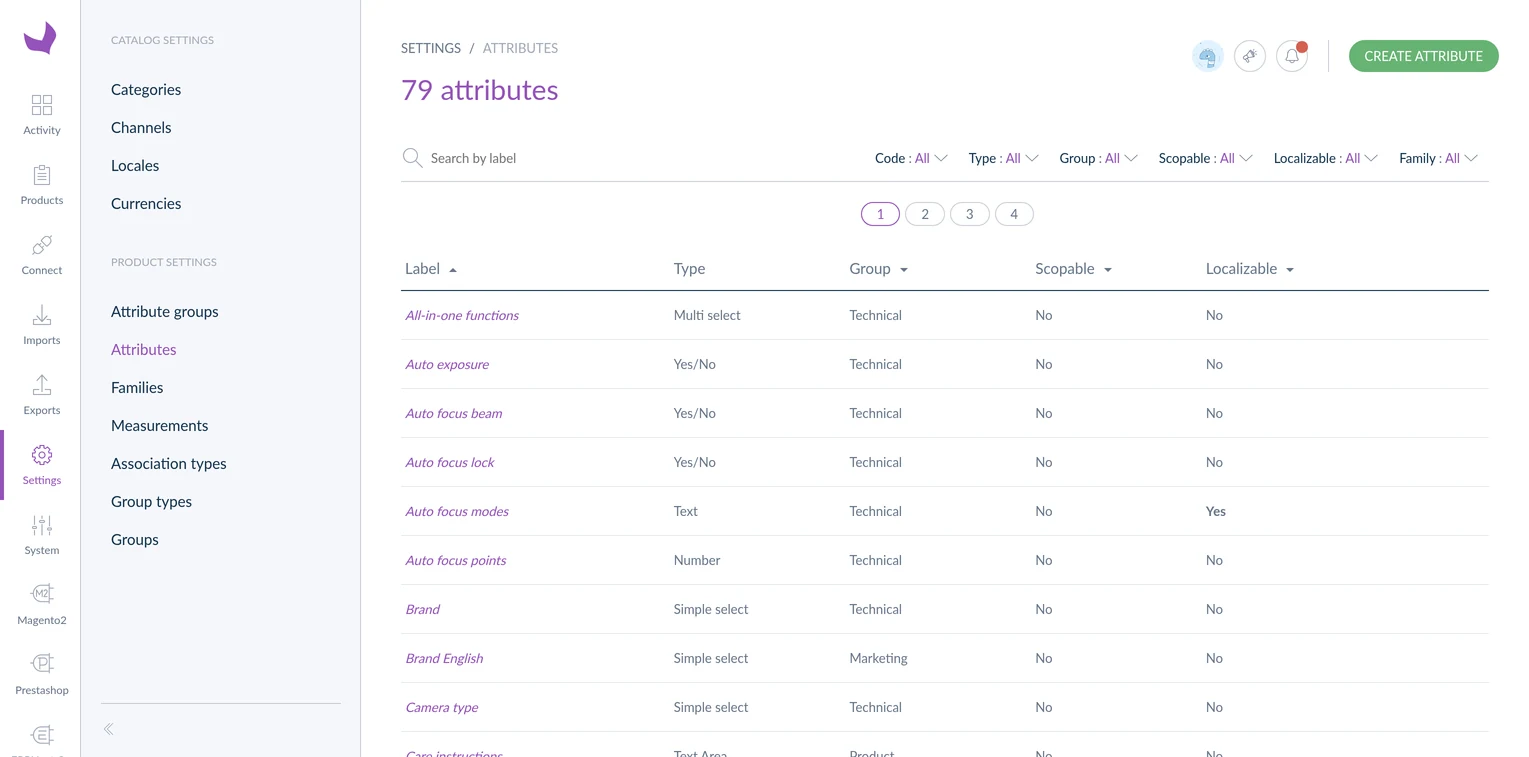
Its core data model is structured and catalog-first. Families act as product prototypes, and Attributes carry data types and channel scope.
Other building blocks round this out. Attribute Groups organize fields, while Product Models and variants handle variations.
Reference Entities model related objects like brands, ranges, and manufacturers. However, they ship in Akeneo Enterprise Edition.
So verify their availability in the Serenity cloud tiers before you commit.
Beyond that, Channels define scope and Locales handle languages. Together, these pieces keep the schema catalog-shaped.
Akeneo also ships a native Asset Manager. It is a connected module, more focused than Pimcore’s integrated DAM, and it lives inside the PIM rather than standalone.
On top of that, Data Quality Insights scores product data. It measures enrichment and consistency, and it checks spelling in multiple languages.
For 2026, Akeneo’s Serenity cloud adds AI features. These include “Ask Ziggy,” AI-generated descriptions, and attribute extraction from assets.
One version note matters here. Akeneo v7.0, the latest traditional release, is supported through September 30, 2026.
Pimcore vs Akeneo at a glance
Before the deep dive, here is a quick side-by-side. The table keeps each cell short on purpose.
| Dimension | Pimcore | Akeneo |
|---|---|---|
| Product scope | Platform: PIM, MDM, DAM, DXP, commerce | Product Cloud, catalog-focused |
| Data model | Developer-defined classes, bricks, stores | Families, attributes, reference entities |
| DAM | Native, first-class assets | Connected Asset Manager module |
| APIs | REST + GraphQL (Data Hub) | REST (primary) + GraphQL |
| Extensibility | Symfony bundles, custom endpoints, Studio plugins | App Store ecosystem, custom API connectors |
| Editions | Community, Professional, Enterprise, PaaS | Community, Growth, Advanced, Premium |
| Hosting | Self-hosted, PaaS, Docker, Kubernetes | Self-hosted CE, SaaS (Serenity), PaaS |
| Learning curve | Steeper, developer-led | Friendlier, business-user-friendly |
Both platforms scored evenly on data quality and channel publishing in Pimcore’s own comparison. That said, the fit still depends on your use case.
Now let us break down the dimensions that usually decide the Pimcore vs Akeneo choice.
Pimcore vs Akeneo: data model & flexibility
This is where the two philosophies diverge most. Pimcore gives developers a nearly blank canvas.
You define DataObject classes in the class editor. Then you add custom fields, bricks, classification stores, and relations.
Because the schema is developer-driven, Pimcore adapts to almost any domain. For example, it can model products, customers, suppliers, and stores in one system.
Our class settings in Pimcore guide shows how granular that control gets. In short, flexibility is Pimcore’s core strength.
Akeneo takes a more opinionated path. Its structured schema uses families, attributes, and reference entities.
Because the model is catalog-shaped from day one, teams onboard faster. Business users configure attributes without writing code.
However, that structure trades some flexibility for speed. If your data is pure product catalog, Akeneo fits naturally.
So the split is clear. Choose Pimcore for unlimited modeling, and Akeneo for fast, catalog-focused setup.
DAM & assets
Digital asset handling is a genuine differentiator here. Pimcore treats assets as first-class citizens.
Assets link directly to product data inside the same platform. Moreover, Pimcore DAM supports extensive format preview (200+ formats) and auto-generates channel-specific outputs.
Because the DAM is native, product-to-asset linkage stays tight. Pimcore’s own comparison scores this 5/5 against Akeneo’s 4/5.
Akeneo ships an Asset Manager too. It is natively integrated with the PIM, not a bolt-on.
It also brings AI-powered organization, keyword tagging, and transformations. Still, it is more focused than Pimcore’s integrated DAM rather than a full DAM platform.
Therefore, teams with heavy media needs often lean Pimcore. Meanwhile, teams with standard product imagery find Akeneo’s Asset Manager sufficient.
API & headless integration
Both platforms are API-first, which matters for composable stacks. However, their surfaces differ in scope.
Pimcore exposes REST and GraphQL through its Data Hub. On top of that, Symfony bundles let you build unlimited custom endpoints.
The Data Hub feeds headless frontends directly. For instance, React, Vue, and PWAs can consume Pimcore data cleanly.
Akeneo also offers both REST and GraphQL APIs. That said, Akeneo documents REST as the primary, stable API for third-party integrations.
Its GraphQL API is available and operational in 2026. Even so, Akeneo emphasizes REST for proven production integrations.
In practice, both APIs are integration-ready. Because Webkul builds connectors on both, we can confirm the REST surfaces are solid.
Our Pimcore Magento 2 connector is one example of that API-driven integration work.
Extensibility & hosting
Extensibility follows each platform’s identity. Pimcore extends through code, and Akeneo extends through apps.
With Pimcore, developers write Symfony bundles, controllers, and event subscribers. They can also build Studio plugins for custom UI.
This depth is powerful, but it demands PHP and Symfony skills. Therefore, Pimcore expects dedicated developer resources.
Akeneo leans on its App Store instead. It offers 138 apps in the Akeneo App Store spanning eCommerce, marketplaces, and syndication.
These apps cover Shopify, Adobe Commerce, Amazon, and more. Developers can still build custom API-based connectors when needed.
Hosting options also differ in breadth. Pimcore runs self-hosted on any cloud, plus PaaS, Docker, Kubernetes, and on-premise.
Akeneo offers self-hosted Community Edition and SaaS via Serenity. Additionally, its Flexibility PaaS option allows custom code.
So Pimcore favors teams wanting full deployment control. In contrast, Akeneo’s Serenity SaaS suits teams wanting managed, monthly-updated cloud.
Pimcore vs Akeneo: licensing & cost
Licensing is often the deciding factor, so let us be precise. Neither vendor publishes every commercial figure.
Pimcore shifted from GPLv3 to the Pimcore Open Core License (POCL) in version 2025.1. As a result, developers can keep custom work private while core code stays open.
The Community Edition is free under POCL. It suits non-production use, nonprofits, or companies under EUR 5M revenue.
Notably, Community Edition already includes PIM, MDM, DAM, and DXP capabilities. It also bundles Studio, Data Hub, Data Importer, and the Quill editor.
Professional adds the TinyMCE editor, while Enterprise adds workflow, Copilot, webhooks, and more. Professional Edition costs $9,900/year.
Enterprise ($29,900/year listed, but negotiable) and Enterprise PaaS pricing require a sales contact. So budget a conversation for the top tiers.
Akeneo’s Community Edition is free and open-source under OSL-3.0. Beyond it, the tiers are Growth, Advanced, and Premium.
Growth starts at $0 annually for SaaS onboarding. Advanced and Premium, though, are quote-only, so contact Akeneo sales for figures.
One timing fact deserves attention. Akeneo v7.0 support terminates September 30, 2026; however, Community Edition users can continue receiving security patches through GitHub releases.
In short, both offer a capable free tier. Yet top-end pricing on either side often stays negotiated.
Also worth noting: Pimcore is not no-code. Its Developer Academy costs EUR 449/year, and productive use needs PHP and Symfony expertise.
Pimcore vs Akeneo: which should you choose?
There is no universal winner in the Pimcore vs Akeneo debate. Instead, the right pick depends on scope, team, and roadmap.
Use these decision cues to narrow it down quickly.
Choose Pimcore when:
- Data spans multiple domains. You need PIM plus MDM, DAM, DXP, or commerce in one platform.
- Assets are central. Tight product-to-asset linkage and 200+ format previews matter to you.
- Modeling is complex. Custom classes, bricks, and deep localization are requirements, not extras.
- Developers are available. You have PHP/Symfony skills and want full deployment control.
- Integration must be limitless. Custom REST and GraphQL endpoints are on your roadmap.
Choose Akeneo when:
- The scope is catalog-focused. You want a Product Cloud PIM, not a full platform.
- Speed to value matters. Fast onboarding and AI-assisted data architecture appeal to you.
- Business users lead. A friendly, collaborative interface beats deep customization.
- Pre-built apps win. The Akeneo App Store ecosystem fits a composable stack.
- Supplier onboarding is key. Akeneo’s Supplier Data Manager self-service portal is a native edge.
Because both are enterprise PIMs, implementation is a real project either way. Typically, teams plan 6-18 month rollouts with dedicated IT resources.
So weigh team skills as heavily as features. That single factor often settles the Pimcore vs Akeneo question.
Can Pimcore and Akeneo work together?
Yes, and this reframes the whole comparison. The two are not always either/or.
Both platforms expose REST APIs built for integration. Therefore, you can sync data between them with ETL or API-based flows.
For example, Akeneo can own catalog enrichment while Pimcore powers experience and commerce. Integration services already exist for this pattern.
We should stay honest about maturity, though. A native, bundled Pimcore-Akeneo connector was not confirmed in our sources.
Still, API-based syncing is a proven approach. Because Webkul builds connectors for both ecosystems, bridging them is practical.
If translation is part of your pipeline, tooling helps too. Our Pimcore DeepL bundle shows how AI-assisted localization plugs into a Pimcore stack.
Conclusion
The Pimcore vs Akeneo choice is really about scope. Pimcore is a broad data and experience platform, while Akeneo is a focused, catalog-first Product Cloud.
Pimcore wins on unified modeling, native DAM, localization, and integration flexibility. However, it asks for developer skills and a bigger implementation effort.
Akeneo wins on fast onboarding, a friendly interface, AI-assisted enrichment, and a rich App Store. That said, it stays catalog-focused and relies on external CMS and DAM.
So match the platform to your reality, not to the hype. When data is multi-domain and asset-heavy, Pimcore fits; when the need is a clean, fast product catalog, Akeneo fits.
Because both expose solid APIs, you can also run them together. In many stacks, that hybrid is the smartest path.
Whichever way you lean, integration is where value gets realized. If you need help implementing or connecting either platform, the Webkul team builds connectors and integrations for both.

Be the first to comment.