PIM Data Modeling Services
Webkul delivers scalable PIM data modeling services to structure attributes, product families, variants, and localized fields across UnoPIM, Akeneo, and Pimcore implementations.













Customer Success Story

Miranda Kaloudis structured fashion product attribute models and variant hierarchies using Webkul PIM solutions.

Palmarosa modeled complex cosmetics product families and multi locale attribute rules for fast store deployment.

CPP Brand structured technical specification attributes and part numbers to organize large enterprise product catalogs.
UnoPim
Open Source PIM Software
To manage your product information and data for all channels in UnoPim Open Source Software.

Core PIM Data Modeling Capabilities

PIM Attribute & Family Modeling

PIM Structure & Taxonomy

Data Class & Asset Modeling

Variant & Configurable Product

Multi Language & Locale

ERP & Master Data Alignment
Build scalable catalog structures with our PIM Data Modeling Services
We build a scalable product data model. We structure attributes, categories, product families, variants, and product taxonomy. This creates a consistent framework for product enrichment and omnichannel distribution.
Webkul PIM consultants design flexible catalog schemas for enterprise growth. We ensure strict data governance across all sales channels.

AI-Powered Development Trending
We are pioneers in an AI-first approach to software development, leveraging Large Language Models (LLMs) to build smarter and faster.
By aggressively utilizing state-of-the-art AI coding agents like GitHub Copilot, Claude, and Gemini, we automate module generation, app creation, and custom development.
Combined with our expertise in fine-tuning LLMs for specific business needs, this massively reduces your project costs and accelerates your go-to-market timeline.
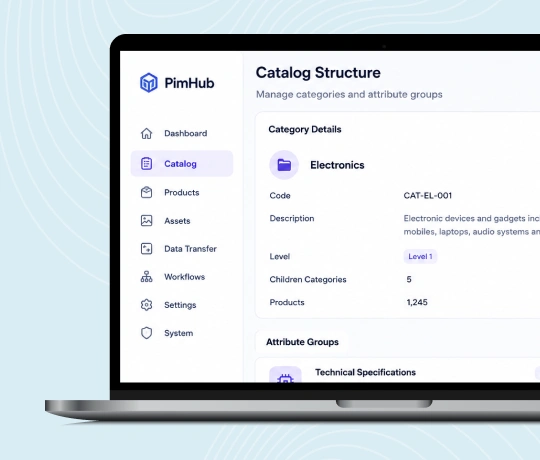
Product Taxonomy & Classification Modeling
Webkul designs structured category trees and attribute family models across UnoPIM, Akeneo, and Pimcore platforms to serve as your catalog’s single source of truth.
- Category Hierarchies: Multi level category trees for fast search filtering.
- Attribute Groups: Organizes technical specs, dimensions, and marketing fields.
- Cross Platform Rules: Standardized classification models built for multi store scale.
Multi Locale & Variant Attribute Architecture
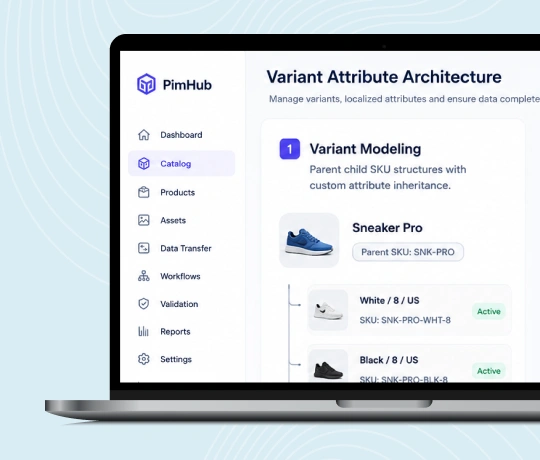
We build multi axis variant structures and localized attribute models to support international Omnichannel Commerce operations and product enrichment.
- Variant Modeling: Parent child SKU structures with custom attribute inheritance.
- Localization: Multi language fields, unit conversions, and regional price rules.
- Completeness Rules: Channel specific validation to verify data before publishing.
Enterprise ERP & Digital Asset Integration Modeling
Connect your PIM data structures with ERP master data streams and Digital Asset Management repositories.
- ERP Mapping: Aligns PIM attributes with SAP, NetSuite, and Odoo databases.
- DAM Asset Links: Connects photos, video files, and PDF datasheets directly to SKUs.
- Data Governance: Role based permissions and attribute editing workflows.


PIM Data Modeling Process
At Webkul, we follow a structured 6 step process to design and deploy PIM data models for UnoPIM, Akeneo, and Pimcore platforms.

Catalog Data Audit

Attribute Mapping

Schema Design

Platform Schema Configure

Data Validation & Testing

Go Live & Maintenance
Why Choose Webkul for PIM Data Modeling?

Multi Platform Mastery

Proven Experience

Accurate Product Governance

Flexible Attribute Architecture

Faster Catalog Expansion
Direct Channel Compatibility
Client Testimonial
Webkul provided outstanding PIM data modeling expertise, helping us organize catalog attributes and product families across multiple sales channels with great precision and speed.

Ecommerce Development Manager Barcodes Inc.
PIM Data Modeling FAQ
PIM data modeling is the process of structuring product attributes, family categories, variant hierarchies, and relationships in a PIM platform to ensure catalog accuracy.
Webkul provides specialized data modeling services for UnoPIM, Akeneo PIM, and Pimcore enterprise platforms.
A well designed PIM data model defines localized attribute fields, regional currency rules, and language scopes to simplify publishing across international markets.
Yes, Webkul maps PIM data attributes directly with ERP systems like SAP, NetSuite, Odoo, and custom databases to maintain a single source of truth.
A typical PIM data modeling project takes 2 to 4 weeks depending on catalog size, product family complexity, and the number of connected channels.