Mistral AI has launched Voxtral TTS, a strong and efficient model that turns text into speech.
With just 4 billion parameters, Voxtral punches way above its weight.
It does more than read text.
Understands tone and emotion, so the voice sounds natural and human-like.
Why Voxtral TTS Feels Different
Most Text to Speech tools sound robotic or flat.
Voxtral captures small details like pauses, tone, excitement, and sarcasm, making speech feel more real.
It sounds like a real person is talking to you, not a machine.
Key highlights of Voxtral TTS
1) It supports 9 languages, including English, French, German, Spanish, Hindi, and Arabic.
2) Can mimic a person’s voice using just 3–5 seconds of reference audio
3) Excellent at emotion and style control
4) Very low latency — great for real-time use
5) Zero-shot cross-lingual ability (e.g., generate English text in a French voice, or vice versa)
How It Actually Works :
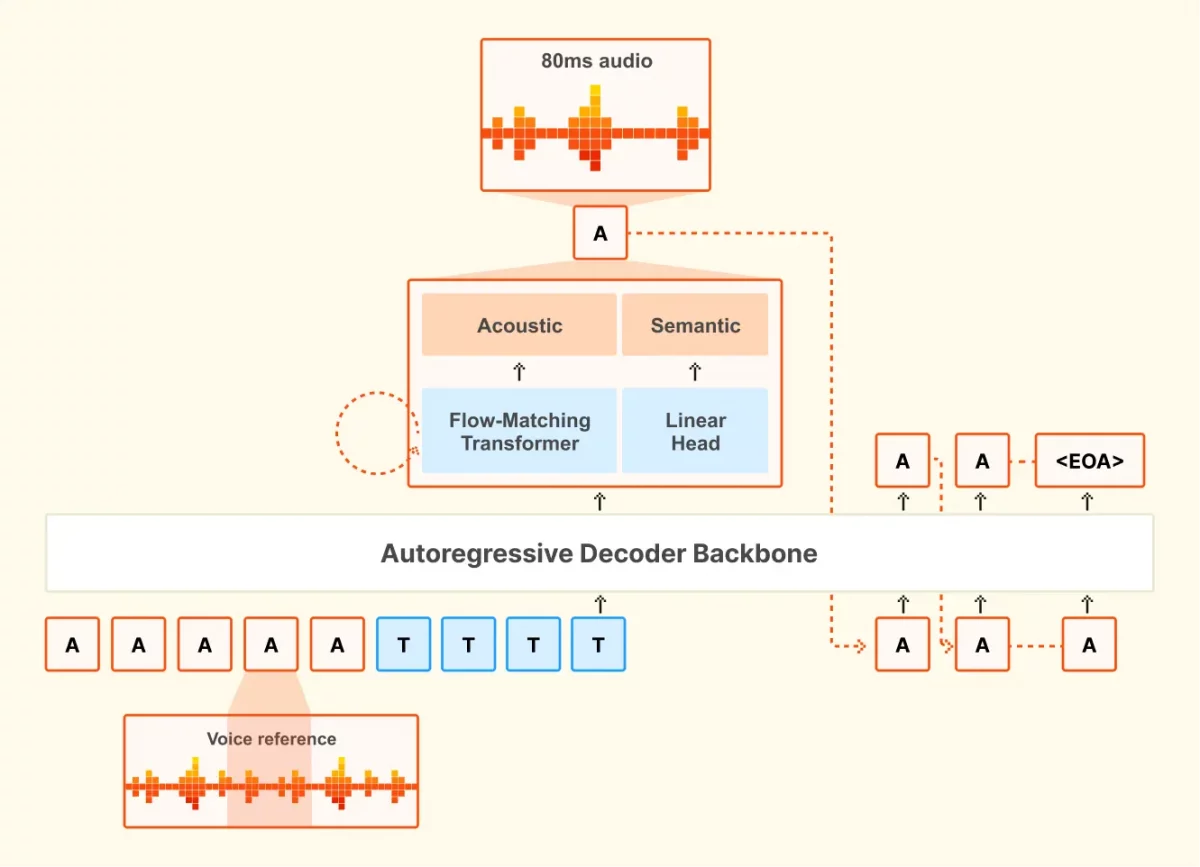
Image Source : mistral.ai/news
Voxtral TTS is built on a transformer-based, autoregressive, flow-matching model.
1) A 3.4B parameter transformer backbone for predicting semantic tokens.
2) A 390M parameter flow-matching acoustic transformer for generating acoustic representationsral-sounding audio patterns.
3) A 300M parameter neural audio codec to produce the final waveform.
You just give it a short voice sample + the text you want spoken, and it does the magic.
Use Cases of Voxtral TTS :
1) Build realistic Artificial Intelligence customer support agents
2) Create voiceovers for marketing with custom tones.
3) Do real-time translation while keeping the original speaker’s voice style.
4) Make audiobooks or virtual assistants that actually sound expressive.
How to Try Voxtral TTS :
1) Head over to Mistral Studio — you can play with it live right in the browser.
2) The open models are available on Hugging Face (under CC BY NC 4.0 license) if you want to run them yourself.
3) For production use, the API is quite affordable at around $0.016 per 1,000 characters.
Conclusion
Voxtral TTS is one of the most impressive lightweight voice models I’ve seen recently.
It’s fast, emotionally aware, multilingual, and surprisingly good at cloning voices with very little audio.
You can use Voxtral for voice apps, translation, or voiceovers.
It is a good and low-cost choice.
Want to Build AI-powered solutions visit Webkul!

Be the first to comment.