Most catalogs are held together by spreadsheets and good intentions, which works until you add a second sales channel and the two stop agreeing.
A Product Information Management system fixes that by holding one trusted copy of every product record for each channel to read from.
PIM software lets your team enrich that record once and publish it everywhere, instead of editing the same description in four systems.
Top 7 Open Source PIM Systems Compared
The table below sets the seven platforms side by side, with the license each one ships under and the business size it suits.
Narrow it down to two or three, then read the sections below to see where each one helps and where it gets in the way.
| PIM | License | Free Version | Deployment | Best For | Key Strength |
|---|---|---|---|---|---|
| UnoPim | MIT | Yes | Self-hosted | Growing catalogs | AI-assisted PIM |
| Akeneo | OSL-3.0 | Yes | Self-hosted | SMBs | Product enrichment |
| Pimcore | POCL | Community Edition | Self-hosted | Complex data | PIM + DAM + MDM |
| AtroPIM | GPL-3.0 | Yes | On-premise/SaaS | Manufacturers & distributors | Flexible data model |
| OpenPIM | Apache-2.0 | Yes | Self-hosted | Smaller teams | Lightweight PIM |
| AesirX | GPL-3.0 | Yes | Self-hosted | Product teams | Easy catalog management |
| LibrePIM | OSL-3.0 | Yes | Self-hosted | Akeneo CE users | Long-term Akeneo CE support |
Why Businesses Choose an Open Source PIM System
Closed PIM tools decide what you may change, which turns into a problem the moment your product data stops fitting the vendor’s model.
Open source lifts that ceiling, because the code is yours to change when a supplier feed does not match the default model.

Full code access also lets you audit how product data is stored, and an active community keeps the platform moving without a vendor roadmap.
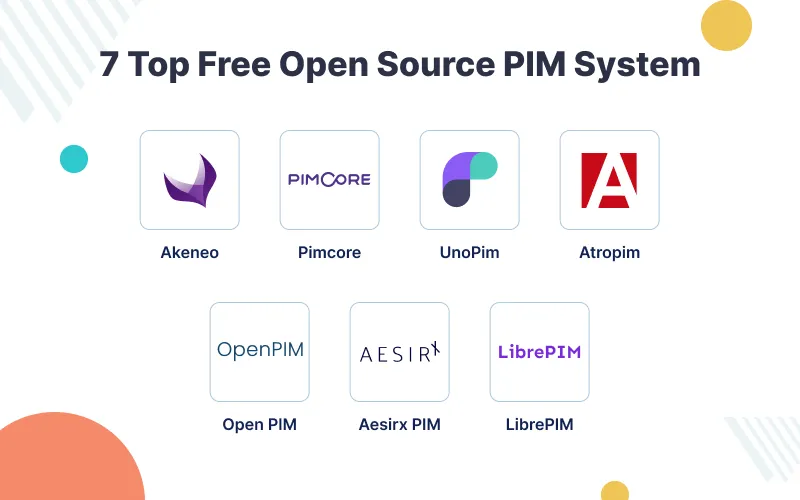
7 Best Free Open Source PIM Systems Reviewed
Choosing a PIM is harder than it looks, because they all describe themselves in the same words and only differ once you load real catalog data.
All seven are free to start with, though two carry licensing terms that matter a lot to a commercial business.
1. UnoPim: Open Source PIM With Agentic AI
UnoPim is a fully open source PIM system with Agentic AI built in, released under the permissive MIT license.
It gives a catalog team one place to build product data and push it out to every sales channel.

It runs on Laravel and PHP, so a team that already writes PHP can extend it without learning a new stack.
Agentic PIM handles routine catalog work through AI-assisted commands, cutting the manual effort behind bulk updates.
Built to Handle 10 Million+ SKUs
UnoPim is documented as handling 10 million or more SKUs, well past the catalog size most growing businesses will reach.
That headroom matters because PIM performance trouble shows up late, once the catalog is too big to move easily.
Key Features:
- User Friendly and Simple: A clean interface that catalog staff can pick up without formal training.
- Agentic PIM: AI-assisted commands take over repetitive enrichment and bulk update work.
- Organized and Lightweight: Concentrates on core product data work instead of bundling unrelated modules.
- Cost Effective: The MIT license means no per-user fee and no cap on catalog size.
- Adaptable and Scalable: Grows with the catalog and bends as your data model changes.
2. Akeneo: Established PIM With a Community Edition
Akeneo has been a leading name in product information management for years, and its Community Edition is free under OSL-3.0.
A paid Enterprise Edition sits alongside it, but this section covers only the open source edition.

There is a catch worth knowing first, because Akeneo has shifted its focus to Serenity, its SaaS product.
In its official post on the shift to SaaS, CEO Fred de Gombert said no new PaaS or on-premise versions would ship.
Akeneo PIM v7.0 shipped in March 2023, and the published support dates run to 30 September 2026 for the PaaS and on-premise editions.
If you are planning a self-hosted Akeneo build now, that date is the first thing to check against your roadmap.
Teams already on the Community Edition can bring in Akeneo development support to plan an upgrade or a move away.
Key Features:
- Active Community Support: One of the largest PIM communities, so answers and extensions are easy to find.
- Customizable and Adaptable: The data model bends to match how your business really structures products.
- Integration Capabilities: Connects to eCommerce platforms, ERPs, and CRMs through documented APIs.
- Fully Open Source: The OSL-3.0 license lets you modify and redistribute the Community Edition.
3. Pimcore: PIM, DAM, and MDM in One Platform
Pimcore is more than a PIM, because the same platform also covers Master Data Management and Digital Asset Management.

That breadth suits companies whose product data would otherwise need two or three separate systems kept in step.
The licensing deserves a careful read before you commit, because Pimcore moved its Community Edition off GPLv3 to the Pimcore Open Core License.
Version 2024.4 was the last GPLv3 release, and from Platform Version 2025.1 the Community Edition ships under POCL instead.
POCL keeps it free for non-production use, for academic and non-profit work, and for companies earning under EUR/USD 5 million a year.
Above that line, production use needs a Professional or Enterprise license, so check where your business sits first.
Teams weighing that decision can bring in Pimcore development services to size the work before committing to a license tier.
Key Features:
- All in One Platform: Combines PIM with content management and eCommerce in a single system.
- Content Management Integration: Handles product copy, images, and video alongside the data itself.
- eCommerce Features: Ships with catalog and checkout tooling for online retail.
- Flexible Framework: The data model is adaptable enough for genuinely custom PIM builds.
4. AtroPIM: Flexible Data Model for Manufacturers
AtroPIM is GPL-3.0 licensed and built around a data model you reshape yourself, which suits catalogs that resist a fixed structure.

It works as a central hub for simple and complex product data, from the first supplier import to the finished record.
Manufacturers and distributors fit best, since their catalogs carry deep technical attributes that lighter PIM tools handle badly.
Key Features:
- Organize Products and Categories: Product families group items into a structure that matches your catalog.
- Manage Attributes: Attributes sit in tabs and groups, so long specification lists stay readable.
- Channels and Product Catalogs: Build separate catalogs per channel, per version, or per supplier.
- Open Source PIM System: GPL-3.0 licensed, with an active community behind its development.
5. OpenPIM: Lightweight PIM With No Paid Tier
OpenPIM takes a different line, because there is no paid edition waiting for you to outgrow the free one.

The whole project is Apache-2.0 licensed, covering core product information management without a suite of extras around it.
That suits smaller teams who want a PIM that does one job well, not a platform to grow into.
Key Features:
- Customizable Options: Adapts to specific business requirements without core changes.
- Supportive Community: An active community handles questions and ongoing development.
- Enhanced Features: Modules and plugins extend the core when you need more from it.
- System Integration: Connects to ERP, CRM, and eCommerce systems through its API.
6. AesirX PIM: JavaScript-Based Product Data Hub
AesirX PIM is a GPL-3.0 licensed platform for centralizing product data and pushing it out to whichever channels need it.
It is built on a JavaScript stack, giving non-technical staff a simple interface and developers a full API to work against.

It has the smallest community on this list, so weigh that against how much outside help you expect to need.
Key Features:
- Centralize Product Data: Attributes, SKUs, and media files all live in one hub.
- Multi-Channel Publishing: Formats and distributes records consistently across storefronts.
- Developer-Friendly API: An open API connects the system to existing platforms and databases.
- Open Source PIM System: Full code access supports custom front-ends and complete data control.
7. LibrePIM: Long-Term Support Fork of Akeneo CE
LibrePIM is a community fork of Akeneo PIM Community Edition, created to keep the on-premise version maintained after Akeneo turned toward SaaS.
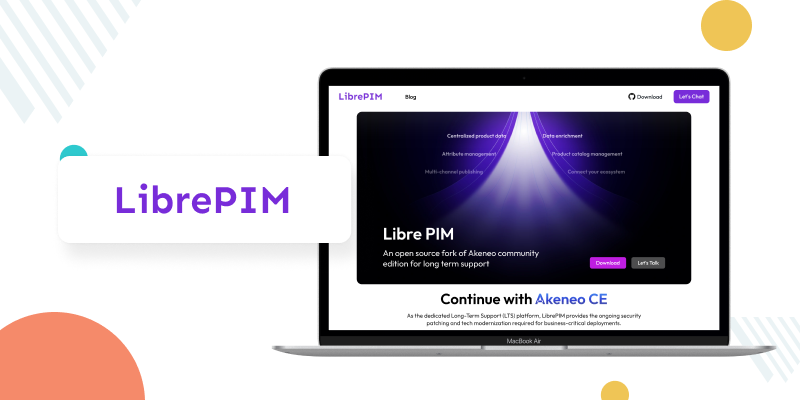
It carries the same OSL-3.0 license as the Akeneo code it forked, and its value is continuity rather than new features.
If you run Akeneo CE and the September 2026 support date worries you, this is the most direct route to a maintained release.
Key Features:
- Security Fixes: Regular patching of the core application and its dependencies.
- Technology Updates: Keeps PHP, MySQL/MariaDB, and Elasticsearch versions current.
- Bug Fixes: Community maintainers resolve significant defects to keep releases stable.
- Migration Help: Documented guidance for moving across from Akeneo Community Edition.
- Simple Setup: Installs through Composer in a workflow Akeneo teams already know.
- Community Documentation: Guides covering installation, upgrades, builds, and contributions.
- Open Contribution: Developers, users, and writers all help keep the fork maintained.
- Fully Open Source: Free to modify and redistribute under the OSL-3.0 license.
Final Thoughts on Choosing an Open Source PIM
All seven platforms manage product data well, so the decision comes down to licensing terms and the engineering time you can spare.
Two need extra care, since Pimcore’s POCL sets a revenue limit and Akeneo’s on-premise support ends in September 2026.
UnoPim is worth a close look if you want an MIT license alongside Agentic PIM features that cut the manual grind from catalog work.
If you have questions about any of these, our support team can help, and we also provide end to end development services.

Be the first to comment.