


















The way people interact with the internet is evolving. Websites are no longer accessed only by human visitors and traditional search engine crawlers.
AI Driven systems and autonomous agents are increasingly discovering information, researching products, comparing services, and interacting with online platforms.
From finding the right product to retrieving business information and accessing digital services, AI agents are becoming an important part of the modern web.
This shift raises an important question for every website owner, developer, and ecommerce business.

Is your website ready for AI agents?
Having a well-designed website, quality content, and traditional SEO optimization does not necessarily mean that AI agents can discover, understand, and interact with it effectively.
Websites also need accessible content, meaningful structure, machine-readable information, discoverable resources, and suitable interfaces for automated interactions.
This is where AI Agent Readiness comes into the picture.
To help businesses understand their website’s readiness for this evolving web environment, Webkul has built AgentScan, a free AI agent readiness checker that evaluates websites across multiple technical and content-related dimensions.
In this guide, we will explore what AI agent readiness means, why it matters, the key elements of an AI-ready website, and how you can evaluate your website using AgentScan.
What Is AI Agent Readiness?
AI agent readiness refers to how effectively a website can be discovered, accessed, understood, and interacted with by AI agents, large language models (LLMs), and automated systems.
Traditional websites are primarily designed to deliver information through visual interfaces for human visitors. AI agents, however, may retrieve and process website information programmatically.
They need to understand:
- What the website offers.
- Which pages and resources are available.
- What products or services are provided.
- How information is structured.
- Whether important content is accessible.
- Which capabilities or interfaces are available for interaction.
For example, consider an ecommerce website with thousands of products. Human visitors can browse product images, descriptions, prices, and categories through the storefront.
However, if important product information is available only after JavaScript execution, or if product data lacks meaningful structure, some automated systems may struggle to retrieve and interpret the same information.
An AI-ready website makes important information accessible and understandable through appropriate technical structures and machine-readable resources.
AI agent readiness is about reducing the gap between what a website presents to humans and what automated systems can actually discover and understand.
Why Is AI Agent Readiness Important?
The growth of AI-powered search, conversational interfaces, and autonomous agents is introducing new ways for users to interact with online information.
Instead of manually browsing multiple websites, users may increasingly rely on AI systems to research products, compare services, find answers, and perform supported tasks.
For websites, this creates an additional consideration: making their information accessible and understandable to these systems.
Here are some important reasons why AI agent readiness matters.
1. Improve Website Discoverability
AI agents need to discover relevant website resources before they can retrieve information.
Discovery files and accessible website URLs help communicate the structure and availability of website resources.
Important elements include:
- robots.txt
- XML sitemaps
- llms.txt
- Well-known discovery endpoints
- Publicly accessible website pages
A well-organized discovery structure makes it easier for compatible automated systems to locate relevant resources.
2. Make Important Content Accessible
A website may look perfect in a browser but still present challenges to systems that retrieve its initial HTML response.
If essential information is loaded only through client-side JavaScript, certain crawlers and retrieval systems may not receive the same content as human visitors.
Important information should be accessible wherever possible without requiring extensive client-side execution.
This includes:
- Page titles and headings.
- Product names and descriptions.
- Business information.
- Category descriptions.
- Pricing and availability.
- Article and documentation content.
Server-rendered HTML and meaningful content structures provide a stronger foundation for automated content retrieval.
3. Improve Machine Understanding Through Structured Data
Structured data helps automated systems understand the meaning of information on a website.
For example, ecommerce websites can use Product and Offer schema to communicate:
- Product names.
- Product descriptions.
- Prices and currency.
- Availability.
- Product identifiers.
Other useful schema types include Organization, WebSite, WebPage, Article, and BreadcrumbList.
Correctly implemented structured data makes important information more machine-readable and supports better content interpretation.
However, structured data alone does not guarantee that an AI system will recommend or select a website.
4. Improve AI Crawler Accessibility
Even well-structured content cannot be retrieved if automated systems cannot access it.
Websites should review whether important resources are unintentionally restricted through:
- robots.txt directives.
- Firewall configurations.
- Cloudflare security challenges.
- Server access restrictions.
- Authentication requirements.
- Incorrect HTTP responses.
Website owners should also understand which crawlers they intend to permit rather than allowing every automated system without consideration.
5. Prepare Website Capabilities for Agent Interactions
AI agent readiness extends beyond content discovery.
As the agentic web evolves, websites may need to expose suitable interfaces that allow authorized systems to access information and perform supported operations.
Relevant technologies and resources include:
- Model Context Protocol (MCP).
- OpenAPI specifications.
- Agent discovery resources.
- Documented API endpoints.
- Structured action interfaces.
For example, an ecommerce platform may expose documented interfaces for retrieving product information or checking inventory.
Sensitive operations such as placing orders, accessing customer data, and processing payments must continue to use appropriate authentication, authorization, and transaction safeguards.
What Makes a Website AI Agent Ready?
AI agent readiness is not determined by one technical configuration. It involves multiple areas of website accessibility, structure, discoverability, and functionality.
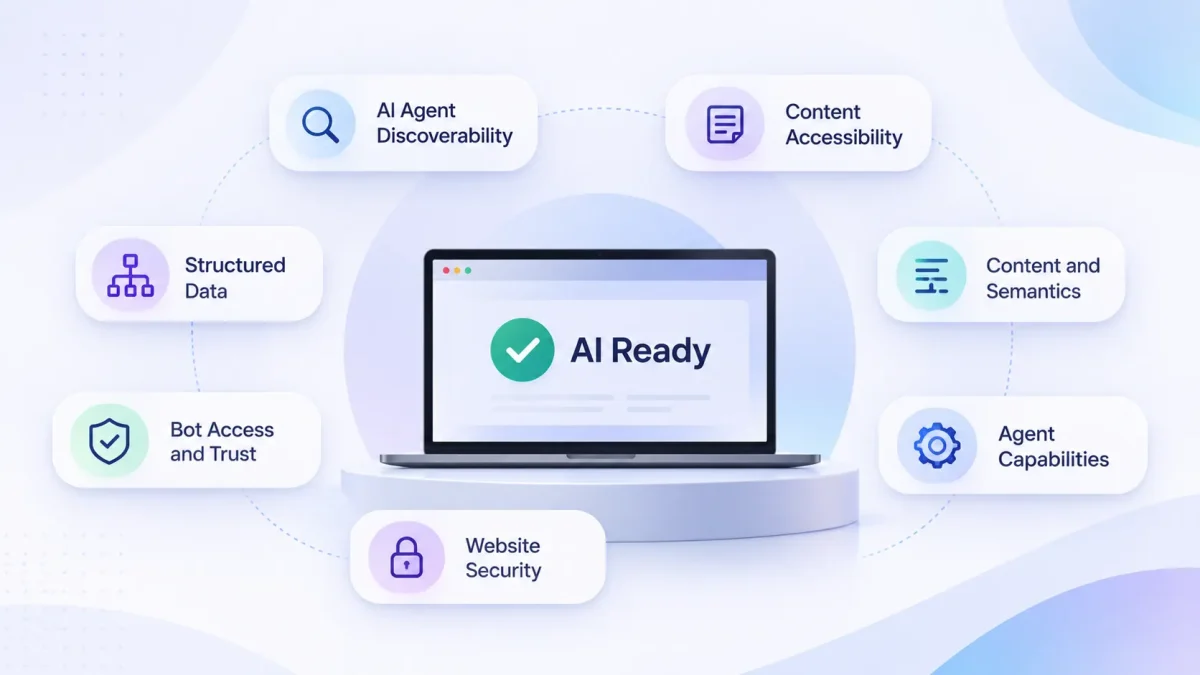
Let’s explore the important dimensions of an AI-ready website.
1. AI Agent Discoverability
Discoverability determines whether relevant website resources can be located by compatible automated systems.
Important checks include:
- Availability of robots.txt.
- XML sitemap accessibility.
- llms.txt availability.
- Valid discovery file content.
- Accessible website URLs.
- Relevant well-known discovery resources.
2. Content Accessibility
Content accessibility evaluates whether important website information can be retrieved without unnecessary rendering or access barriers.
Important checks include:
- Server-rendered content.
- Accessible headings and descriptions.
- Important information in initial HTML.
- Public page accessibility.
- Content availability without JavaScript.
3. Structured Data
Structured data allows machines to identify entities, relationships, and important attributes.
Important checks include:
- JSON-LD availability.
- Schema syntax validation.
- Organization information.
- Product and Offer properties.
- Article and webpage metadata.
- Missing or incomplete structured data fields.
4. Content and Semantics
A website should have a logical content structure that helps both visitors and automated systems understand its information.
Important checks include:
- Meaningful H1, H2, and H3 hierarchy.
- Semantic HTML elements.
- Main content landmarks.
- Descriptive links and buttons.
- Relevant image alternative text.
- Clear content organization.
5. Bot Access and Trust
This dimension evaluates whether relevant automated systems can access website resources.
Important checks include:
- Robots directives.
- HTTP response accessibility.
- Crawler restrictions.
- TLS configuration.
- Relevant website trust signals.
6. Agent Capabilities
Agent capabilities evaluate whether a website exposes machine-readable interfaces that can support automated interactions.
Important checks include:
- MCP endpoint availability.
- OpenAPI documentation.
- Agent discovery resources.
- Publicly discoverable capabilities.
- Documented service interfaces.
7. Website Security
Security is an essential foundation for any website that supports automated access or interactions.
Important checks include:
- HTTPS availability.
- HTTP security headers.
- Strict-Transport-Security.
- Baseline security configurations.
Additional AI Readiness Requirements for Ecommerce Websites
Ecommerce websites have additional requirements because AI agents may need to understand products, compare offerings, retrieve commerce information, and interact with supported services.
Three additional dimensions become important.
8. Product Data
Product data readiness evaluates how effectively product information can be retrieved and interpreted.
Important checks include:
- Product names and descriptions.
- Product structured data.
- Pricing and currency.
- Product availability.
- Product identifiers and attributes.
9. Operability
Operability evaluates whether relevant website functionality and service interfaces can be discovered and accessed.
Important checks include:
- Accessible website functionality.
- Discoverable service interfaces.
- Machine-readable operational information.
- Relevant endpoint accessibility.
10. Agentic Commerce
Agentic commerce focuses on the ability of commerce platforms to support authorized interactions through AI-driven systems.
Important checks include:
- Commerce-related agent capabilities.
- Product discovery and retrieval.
- Machine-readable commerce interfaces.
- Support for authorized agent interactions.
These additional dimensions help ecommerce businesses evaluate their websites beyond conventional SEO and basic content accessibility.
A Free AI Agent Readiness Checker
Understanding AI agent readiness is important, but identifying exactly where a website stands can be challenging.
To make this process easier, Webkul has developed AgentScan, a free AI agent readiness checker designed to evaluate how effectively websites can be discovered, accessed, understood, and interacted with by AI agents and LLM-based systems.
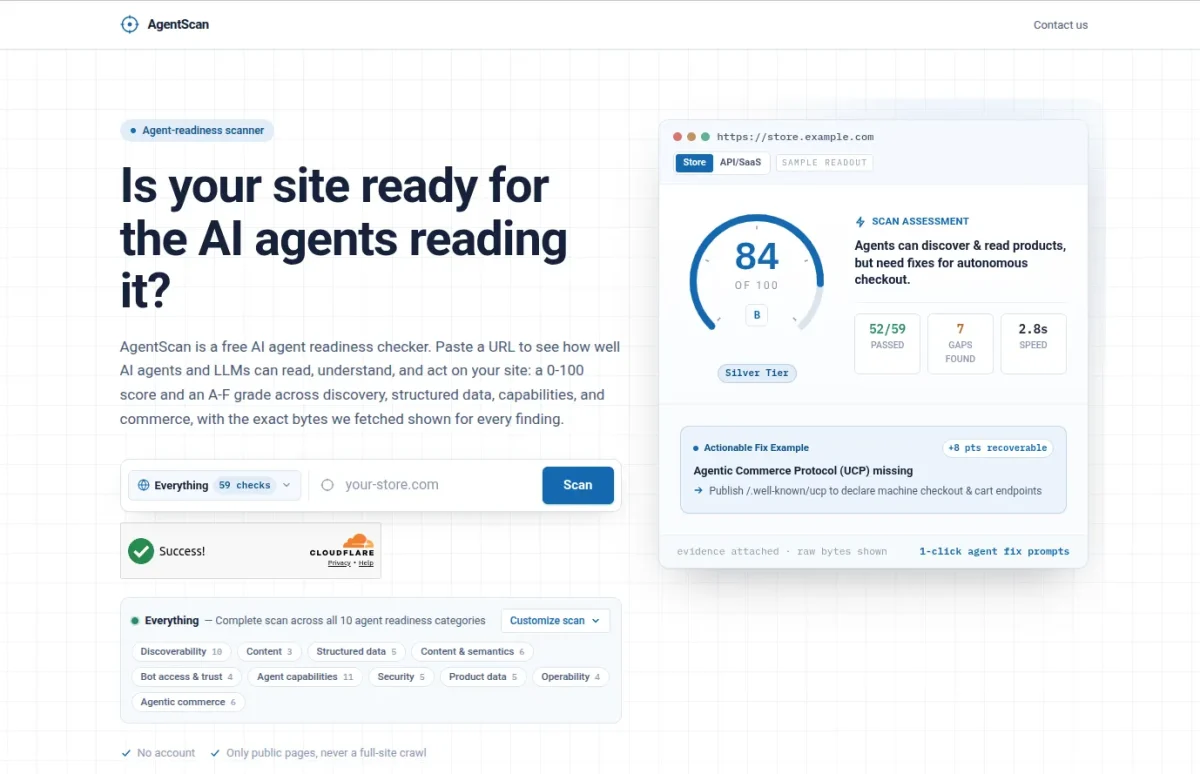
AgentScan examines publicly accessible website resources and provides technical findings, readiness scores, and practical recommendations.
Rather than relying on assumptions or a generic SEO score, the tool evaluates actual website resources and connects its findings with technical evidence.
Try AgentScan: https://ai-agentchecker.webkul.com/
What Can You Do with AgentScan?
1. Evaluate Your Website Across 10 Readiness Categories
AgentScan provides an assessment across 10 AI agent readiness dimensions.
These include:
- Discoverability
- Content accessibility
- Structured data
- Content and semantics
- Bot access and trust
- Agent capabilities
- Security
- Product data
- Operability
- Agentic commerce
For non-ecommerce websites, the seven universal categories provide the core assessment. Ecommerce websites can additionally evaluate product data, operability, and agentic commerce.
2. Get an AI Agent Readiness Score
AgentScan provides an overall readiness score from 0 to 100, along with an A-to-F grade.
This helps website owners understand their current technical readiness and identify areas that need improvement.
The score is based on the checks performed during the assessment. It should be understood as a technical readiness indicator, not a guarantee of AI search visibility or recommendations.
3. Review Evidence-Based Technical Findings
One of the important aspects of AgentScan is its evidence-based assessment approach.
Findings are connected to the publicly accessible resources retrieved during the scan.
Depending on the check, the evidence may include:
- Raw HTML responses.
- HTTP response headers.
- Discovery file contents.
- JSON-LD markup.
- Public endpoint responses.
This allows developers and website owners to investigate the actual technical conditions behind individual findings.
4. Understand Why a Check Failed
Simply identifying an issue is not enough. Website owners need to understand what went wrong.
AgentScan provides explanations for failed checks and distinguishes between an actual failure and a check that could not be verified because a resource was unavailable or blocked.
This helps developers investigate issues without treating every unverified result as a confirmed website problem.
5. Get Practical Recommendations and Fix Instructions
AgentScan helps users move from identifying issues to implementing improvements.
Depending on the check, recommendations may include:
- Step-by-step manual instructions.
- Copy-and-paste prompts for AI coding agents.
- Generated files for supported fixes.
Developers can use these recommendations to address identified issues and run another assessment to verify the changes.
6. Customize Your Website Readiness Assessment
Different websites have different requirements.
A content-focused website may prioritize discoverability, content accessibility, structured data, and bot access.
An ecommerce website may also need to evaluate product information, operability, and agentic commerce.
AgentScan allows users to select relevant assessment categories instead of relying on the same assessment configuration for every website.
How to Check Your Website’s AI Agent Readiness Using AgentScan
Getting started with AgentScan is straightforward. Follow these steps to evaluate your website.
Step 1: Visit AgentScan
Open https://ai-agentchecker.webkul.com/ to access the free AI agent readiness checker built by Webkul.
Step 2: Enter Your Website URL
Enter the public URL of the website you want to evaluate.
Step 3: Select Assessment Categories
Choose the complete assessment or select individual categories according to your website requirements.
Step 4: Start the Scan
Click the Scan button. AgentScan retrieves publicly accessible website resources and evaluates the selected readiness checks.
Step 5: Review Your Readiness Score
Once the assessment is complete, review your overall score out of 100 and your corresponding A-to-F grade.
Step 6: Explore Individual Findings
Examine individual checks to understand the evidence, identify missing configurations, and review the technical issues affecting your website.
Step 7: Implement Recommended Fixes
Use the recommendations, implementation instructions, and supported generated files to address the identified issues.
Step 8: Scan Your Website Again
After implementing improvements, run another assessment to evaluate the changes.
This process helps website owners move from identifying technical gaps to making measurable improvements in AI agent readiness.
AI Agent Readiness vs Traditional SEO
Traditional SEO and AI agent readiness share several technical foundations, but they have different objectives.
Traditional SEO focuses on improving how search engines discover, crawl, index, and rank website content.
AI agent readiness adds another consideration: whether automated systems can retrieve, interpret, and interact with website information.
| Area | Traditional SEO | AI Agent Readiness |
|---|---|---|
| Discovery | Search engine crawling | Agent and crawler discovery |
| Content | Indexable page content | Accessible, machine-readable content |
| Structure | SEO-friendly HTML | Semantic HTML and structured information |
| Schema | Search engine structured data | Machine-readable facts and entities |
| Accessibility | Search crawler access | Access for relevant AI agents |
| Capabilities | Primarily content discovery | APIs and agent interaction interfaces |
| Commerce | Product search visibility | Product understanding and agentic commerce |
Both approaches complement each other.
A technically sound website with accessible content and meaningful structure provides a stronger foundation for search engines and AI-powered systems.
However, a high AI readiness score does not guarantee Google rankings, AI citations, recommendations, or conversions.
Is llms.txt Important for AI Agent Readiness?
The llms.txt file is a proposed convention designed to provide LLM-based systems with information about important website resources.
It is generally published like: https://webkul.com/llms.txt
A website can use this file to highlight:
- Website descriptions.
- Important documentation.
- Product information.
- API references.
- Key content resources.
- Relevant website URLs.
For example, a software company can use llms.txt to highlight its product documentation, installation guides, developer resources, and API references.
However, llms.txt is not a universally adopted or mandatory standard. Publishing it does not guarantee that AI systems will access or follow its contents.
It should be considered one part of a broader AI agent discoverability strategy.
AI Agent Readiness for Odoo, Bagisto, and WooCommerce
Different ecommerce platforms have different architectures, customization capabilities, and technical configurations.
For example:
- Odoo: Website and ecommerce configurations, product information, structured data, and available integrations can influence how automated systems access store information.
- Bagisto: Product catalogs, category structures, Laravel-based rendering, APIs, and ecommerce data structures are relevant considerations.
- WooCommerce: WordPress content, product metadata, WooCommerce APIs, structured data, and plugin configurations can influence machine readability and accessibility.
Regardless of the platform, businesses should evaluate the actual website implementation rather than assuming that using a particular ecommerce platform automatically makes a store AI-ready.
The Future of the Web Is Becoming More Agent-Driven
AI agents are introducing new ways for people to discover information and interact with digital services.
As these technologies evolve, websites will need to provide more than visually appealing interfaces. They will also need accessible content, meaningful structures, machine-readable information, and suitable interfaces for automated interactions.
This does not mean traditional SEO is becoming irrelevant.
Instead, AI agent readiness represents an additional technical consideration for website owners, developers, ecommerce businesses, and digital agencies.
Identifying technical gaps early can help businesses prepare their websites for emerging AI-powered experiences.
Check Your Website’s AI Agent Readiness for Free with AgentScan
Is your website accessible, understandable, and discoverable to AI agents?
You do not have to rely on assumptions.
AgentScan, built by Webkul, helps you evaluate your website across 10 AI agent readiness categories.
With AgentScan, you can:
- Get an AI readiness score from 0 to 100.
- Review your overall A-to-F grade.
- Evaluate 10 technical readiness categories.
- Inspect evidence behind individual findings.
- Understand why specific checks fail.
- Get practical recommendations and supported fix instructions.
- Reassess your website after implementing improvements.
Whether you manage a business website, SaaS platform, content website, or ecommerce store, AgentScan helps you understand how effectively your website supports AI agent discovery, content understanding, and interactions.
Start your free AI agent readiness assessment today.
Visit: https://ai-agentchecker.webkul.com/

Be the first to comment.