Introduction
Artificial Intelligence is rapidly evolving from simple chatbots to autonomous systems capable of making decisions, executing tasks, and interacting with business applications.
This shift is giving rise to Agentic Commerce, where AI agents actively participate in the shopping journey instead of merely responding to user queries.
In this blog, we will explore:
- What AI agents are
- What Agentic Commerce means
- OpenAI’s Agentic Commerce Protocol (ACP)
- Google’s Universal Commerce Protocol (UCP)
- Building custom agents for Magento 2
- Real-world use cases and ideas
- The future impact of agent-driven ecommerce
What Are AI Agents?
An AI Agent is a software system powered by Large Language Models (LLMs) that can:
- Understand user goals
- Reason through tasks
- Access tools and APIs
- Take actions autonomously
- Learn from context and feedback
Unlike traditional chatbots that only answer questions, agents can perform multi-step workflows such as:
- Searching products
- Comparing options
- Creating carts
- Placing orders
- Managing inventory
- Handling customer support tickets
An agent essentially acts as a digital employee capable of interacting with various systems to complete a task.
What Is Agentic Commerce?
Agentic Commerce refers to e-commerce experiences in which AI agents actively participate in the buying and selling processes.
Traditional E-commerce Flow:
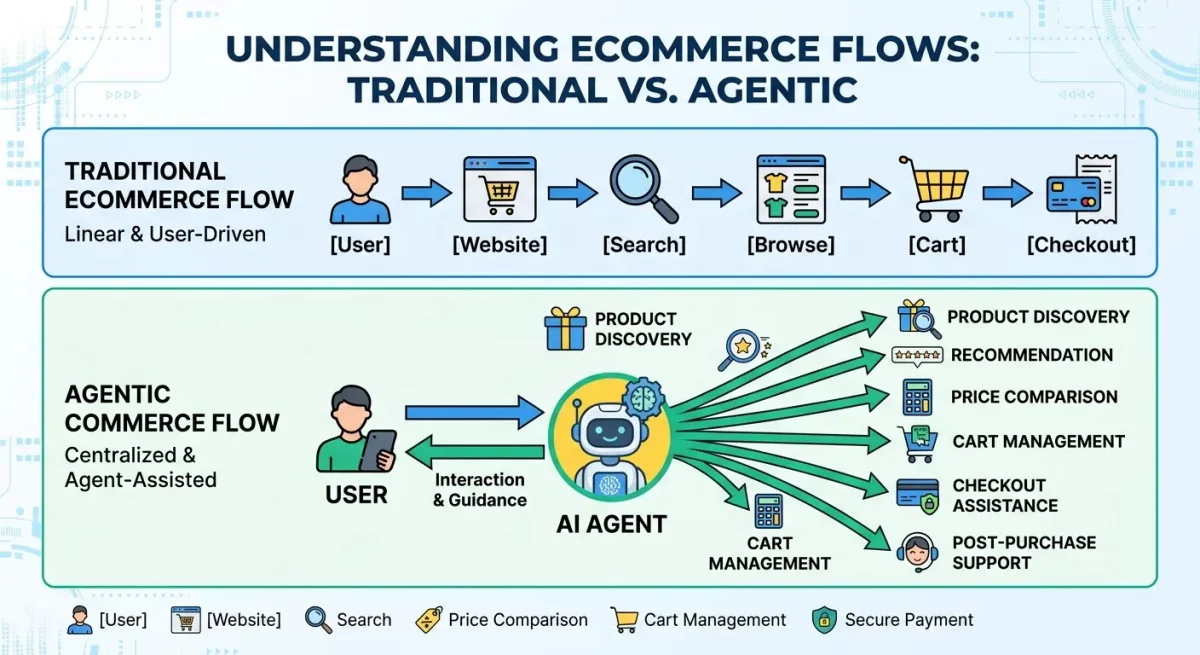
Instead of manually navigating through dozens of pages, customers describe their intent:
Find me a gaming laptop under $1500 with at least 32GB RAM and next-day delivery.
The agent can:
- Search catalog
- Compare products
- Verify stock
- Apply discounts
- Build the cart
- Present recommendations
This significantly reduces friction in the purchasing journey.
Agentic Commerce Standards
As Agentic Commerce continues to evolve, a common set of standards is becoming essential for seamless interaction between AI agents, e-commerce platforms, marketplaces, payment systems, and business services.
Industry leaders are actively developing standardized protocols and frameworks that enable agents to communicate, exchange context, execute transactions, and coordinate actions securely across different systems.
These standards aim to ensure interoperability, trust, security, and consistency, allowing AI-powered shopping assistants, merchant agents, and enterprise systems to work together efficiently within the digital commerce ecosystem.
OpenAI’s ACP (Agentic Commerce Protocol)
OpenAI has been actively working toward enabling agents to interact with transactional tools, storefronts, and external commercial systems. The Agentic Commerce Protocol (ACP) aims to provide a structured framework for managing automated commercial workflows and agent-driven economies, specifically focusing on:
- Agent-to-Agent Communication: Standardizing cross-platform dialogue and messages between shopping assistants, vendor agents, and logistics systems.
- Agent-to-Tool Interaction: Securing API calls and application control for payment gateways, inventory databases, and checkout funnels.
- Task Delegation: Efficiently assigning complex commerce tasks, managing shopping carts, and optimizing backend resource allocation.
- Workflow Orchestration: Defining multi-step, automated commercial sequences from product discovery to payment finalization.
- Context Sharing: Ensuring continuous state management, customer preferences, and real-time knowledge synchronization across the entire purchase journey.
Benefits of ACP Integration
- Standardized Integrations: Consistent interfaces and reusable modules across different retail and service platforms.
- Better Interoperability: Smooth, friction-free operations between diverse AI buying agents and merchant platforms.
- Reduced Development Effort: Less custom code required to connect agents to storefronts, accelerating agent-led commerce development.
- Secure Task Execution: Controlled transactional actions, secure token handling, and robust customer data protection.
ACP for E-Commerce Platforms (e.g., Magento)
For e-commerce platforms like Magento, the Agentic Commerce Protocol acts as the core interaction layer, allowing agents to seamlessly:
- Access Catalog Services: Fetch real-time product details, specifications, images, and pricing.
- Retrieve Inventory: Instantly check live, multi-warehouse stock levels to prevent overselling.
- Create Orders: Automatically place new purchases, apply discount codes, and update order fulfillment statuses.
- Process Customer Requests: Handle returns, service inquiries, refunds, and exchanges autonomously.
- Coordinate Across Multiple Systems: Seamlessly integrate and pass data between frontend storefronts, payment processors, shipping carriers, and CRMs.
The above diagram is organized into three distinct sections:

- Overview of the ACP Framework (Left Section): This section visually breaks down how OpenAI-powered agents are structured for transactional environments using five key pillars—Agent-to-Agent Communication, Agent-to-Tool Interaction, Task Delegation, Workflow Orchestration, and Context Sharing—to ensure a continuous, synchronized commerce experience.
- Strategic Benefits (Top Right Section): This illustrates the core operational advantages of integrating a commerce-specific protocol, highlighting Standardized Integrations, Better Interoperability between buying and selling agents, Reduced Development Effort via reusable modules, and Secure Task Execution to protect sensitive transactional and customer data.
- Real-World Application & Overall Workflow (Middle & Bottom Right Sections): This demonstrates a practical, end-to-end e-commerce workflow (using platforms like Magento). An OpenAI Agent utilizes the ACP framework’s interaction layer to securely fetch data—such as Access Catalog Services and Retrieve Inventory—and execute critical merchant tasks like Create Orders, Process Customer Requests, and Coordinate Across Multiple Systems (Payment, Shipping, and CRM).
Read More
Google’s UCP (Universal Commerce Protocol)
Google’s vision around Universal Commerce Protocol focuses on enabling different AI systems and services to communicate using common standards.
The objective is to create:
- Cross-platform interoperability
- Shared context between agents
- Standardized tool invocation
- Multi-agent collaboration
In the future, an e-commerce ecosystem may involve:
- Shopping agents
- Logistics agents
- Payment agents
- Marketing agents
- Customer support agents
All working together through standardized commerce protocols.

The diagram is organized into four distinct, interconnected sections that illustrate Google’s vision for open AI standards:
- Google Vision & Core UCP Principles: The left panel visually breaks down the four foundational objectives of the UCP framework—Cross-Platform Interoperability, Shared Context Between Agents, Standardized Tool Invocation, and Multi-Agent Collaboration. It demonstrates how a Google-powered agent acts as an anchor for these unified standards.
- Strategic Benefits of UCP Integration: Spanning across the top-right and bottom-left, this section highlights the major architectural advantages of adopting an open protocol. It details how UCP enables scalable AI solutions, reduces vendor lock-in, enhances the end-user experience, and ensures secure, multi-platform communication.
- The Future AI Ecommerce Ecosystem: The right-hand panel maps out a practical, real-world marketplace scenario. It shows a central Google Agent leveraging UCP to seamlessly delegate, synchronize, and orchestrate automated workflows across specialized sub-agents—specifically coordinating Shopping, Logistics, Payment, Marketing, and Customer Support agents to handle an entire retail lifecycle smoothly.
- Overall Ecosystem Workflow: The bottom-right timeline provides a high-level summary of the entire data pipeline, moving from the initial Google Agent prompt, through the UCP Protocol Framework and Unified Interaction Layer, down into the broader Future Digital Economy and Application Ecosystem.
Read More
Understanding the Difference Between ACP and UCP in Agentic Commerce
| Feature | OpenAI Agentic Commerce Protocol (ACP) | Google Universal Commerce Protocol (UCP) |
|---|---|---|
| Primary Goal | Standardized communication between AI agents, tools, and business systems for autonomous task execution. | Standardized commerce layer enabling AI assistants, merchants, retailers, and service providers to participate in commerce transactions. |
| Focus Area | Agent-to-Agent (A2A) and Agent-to-System interactions. | Commerce-specific interactions across the shopping ecosystem. |
| Core Purpose | Allow AI agents to discover capabilities, exchange context, invoke actions, and collaborate securely. | Allow AI-powered shopping experiences to access products, inventory, pricing, checkout, and order management through a common protocol. |
| Ecosystem | AI agents, enterprise systems, SaaS platforms, APIs, automation tools. | Merchants, marketplaces, retailers, payment providers, logistics partners, and AI shopping agents. |
| Communication Model | Agents communicate through defined capabilities, actions, tools, and workflows. | Commerce entities expose products and transactional capabilities through a universal commerce interface. |
| Discovery Mechanism | Agents discover available tools, services, and capabilities dynamically. | AI systems discover merchant catalogs, inventory, offers, fulfillment, and purchasing options. |
| Transaction Support | Supports task execution and workflow orchestration; commerce is one possible use case. | Designed specifically for shopping and transactional commerce workflows. |
| Context Sharing | Rich contextual exchange between agents and services. | Emerging protocols focus on agent interoperability and autonomous workflows. |
| Security | Authentication, authorization, permission-based agent actions. | Secure merchant verification, transaction integrity, customer privacy, and consent management. |
| Typical Use Cases | Customer support agents, workflow automation, business process orchestration, enterprise AI assistants. | AI shopping assistants, product discovery, automated purchasing, checkout orchestration, order tracking. |
| Magento Integration Example | AI agent managing orders, inventory updates, customer support, and backend operations. | AI-powered shopping agent browsing Magento catalogs, comparing products, and completing purchases. |
| Scope | Broad AI agent ecosystem. | Commerce-focused ecosystem. |
| Industry Impact | Creates interoperable AI agent networks across industries. | Creates interoperable AI-driven commerce experiences across retailers and marketplaces. |
| Current Status | AI shopping assistants, product discovery, automated purchasing, checkout orchestration, and order tracking. | Commerce-related context, such as product data, customer intent, pricing, availability, and fulfillment. |
Why Magento 2 Is Ideal for Agentic Commerce
Magento already provides:
- Robust APIs
- GraphQL support
- Product management
- Inventory management
- Order workflows
- Customer management
These capabilities make Magento a perfect backend for AI agents.
Agents can leverage Magento APIs to:
- Search products
- Manage carts
- Create orders
- Update inventory
- Retrieve customer information
- Generate reports
Without requiring major architectural changes.
Building Custom Agents in Magento 2
Custom agents can be built around Magento services and business workflows.
1. Product Discovery Agent
Purpose:
Help customers find products through natural language.
Example:
“Show me black running shoes under $100 with at least 4-star ratings.”
Agent Actions:
- Parse requirements
- Query the Magento catalog
- Apply filters
- Rank products
- Present recommendations
Benefits:
- Better product discovery
- Improved conversion rates
- Reduced search abandonment
2. Cart Optimization Agent
Purpose:
Increase average order value.
Agent Actions:
- Analyze cart contents
- Recommend accessories
- Apply coupons
- Suggest bundles
Example:
The customer adds a smartphone.
Agent suggests:
- Screen protector
- Charger
- Extended warranty
3. Customer Support Agent
Purpose:
Automate support operations.
Capabilities:
- Order tracking
- Return requests
- Refund status
- FAQ responses
- Warranty information
Magento Integration:
- Orders API
- Customer API
- Return management workflows
4. Inventory Management Agent
Purpose:
Assist administrators and warehouse teams.
Capabilities:
- Detect low stock
- Forecast demand
- Trigger replenishment alerts
- Monitor fast-moving products
Example:
The agent identifies products likely to go out of stock within 7 days and notifies the inventory manager.
5. Marketing Campaign Agent
Purpose:
Automate marketing efforts.
Capabilities:
- Segment customers
- Generate campaigns
- Recommend discounts
- Create product descriptions
- Draft email content
Data Sources:
- Order history
- Customer behavior
- Product performance
Custom AI Agents & Solutions We Have Built for Magento
AI Chatbot for Magento
An intelligent conversational assistant integrated with Magento that helps customers discover products, answer queries, track orders, and receive support through natural language interactions.
Capabilities:
- Natural language product discovery
- Customer support automation
- Order status tracking
- FAQ and store policy assistance
- Personalized shopping guidance
WhatsApp AI Bot
A Magento-integrated AI assistant that enables customers to interact with your store directly through WhatsApp for shopping, support, and order management.
Capabilities:
- Product search through WhatsApp
- Order tracking and status updates
- Customer support automation
- Product recommendations
- Lead generation and engagement
AI Semantic Search
An advanced search solution that understands customer intent and context instead of relying solely on exact keyword matching, helping shoppers find products faster.
Capabilities:
- Intent-based product search
- Natural language queries
- Context-aware product discovery
- Semantic and synonym matching
AI Image Search
A visual search solution that allows customers to upload an image and discover similar products available in the Magento catalog.
Capabilities:
- Search using images
- Visual similarity matching
- Product identification
- Image-based product discovery
AI-Powered Content Creation
An AI content generation system that automates the creation of high-quality product and category content across Magento stores.
Capabilities:
- Product description generation
- SEO metadata creation
- Product title optimization
- Feature and specification summaries
- Category content generation
Product Recommendation Engine
An intelligent recommendation system that analyzes customer behavior and catalog data to deliver personalized shopping suggestions.
Capabilities:
- Personalized recommendations
- Cross-sell and upsell suggestions
- Related product recommendations
- Customer behavior analysis
AI Review Translation Agent
A multilingual AI solution that automatically translates customer reviews while preserving the original meaning, sentiment, and context.
Capabilities:
- Review translation
- Sentiment preservation
- Multi-language support
- Content localization
AI OCR (Optical Character Recognition)
An AI-powered document and image processing solution that extracts structured information from images, PDFs, invoices, and product-related documents.
Capabilities:
- Text extraction from images
- Invoice and document processing
- Automated data capture
- Catalog data digitization
New Agent Ideas for Magento 2
Store Operations Assistant
An internal AI assistant for Magento administrators that provides business insights, analytics, operational reports, and answers to business-related questions.
Capabilities:
Natural language querying of Magento data
Sales and revenue analysis
Business reporting
Operational insights
Inventory and order analytics
Smart Purchasing Agent
A customer-side agent capable of:
- Monitoring price drops
- Tracking stock availability
- Creating wishlists automatically
- Purchasing when conditions are met
Supplier Coordination Agent
For B2B businesses.
Capabilities:
- Communicate with suppliers
- Request quotations
- Compare vendor pricing
- Generate purchase orders
Dynamic Pricing Agent
Capabilities:
- Monitor competitor pricing
- Analyze demand
- Recommend price adjustments
Potential Benefits:
- Increased competitiveness
- Higher margins
- Faster response to market changes
Fraud Detection Agent
Capabilities:
- Analyze order patterns
- Identify suspicious behavior
- Flag risky transactions
Benefits:
- Reduced chargebacks
- Improved security
Multi-Store Management Agent
For merchants running multiple Magento stores.
Capabilities:
- Synchronize catalog updates
- Monitor store performance
- Recommend inventory transfers
Technical Architecture
A typical Magento Agentic Commerce architecture may look like:
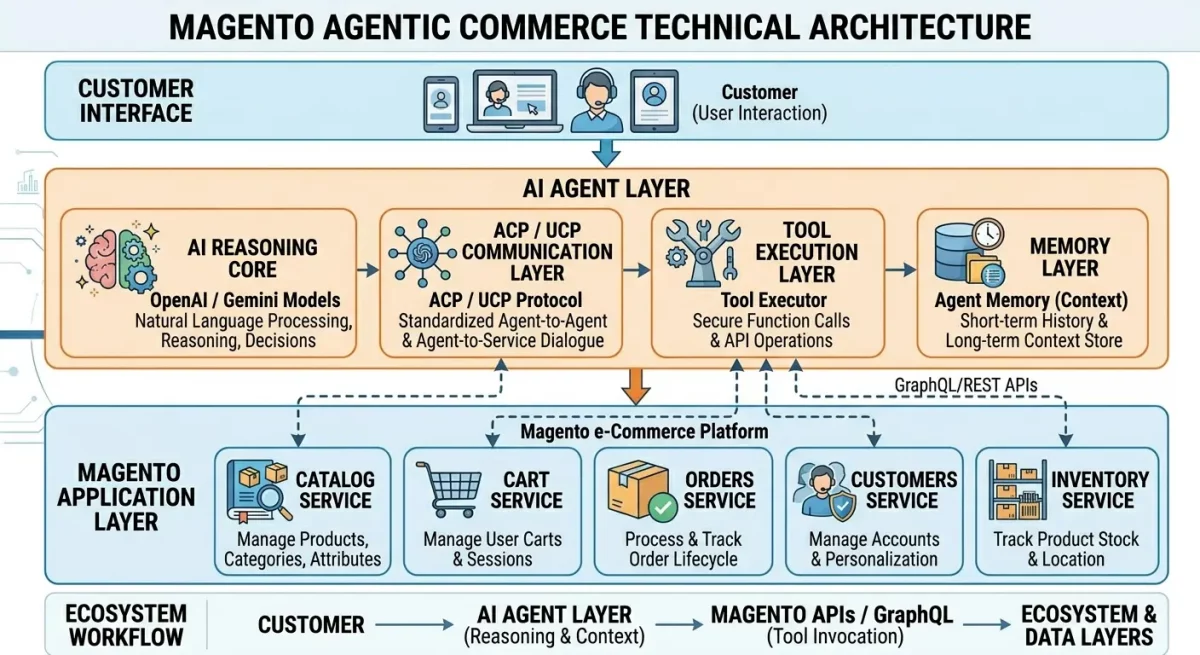
This architecture allows agents to safely interact with Magento while maintaining clear boundaries between AI reasoning and business operations.
Impact of Agentic Commerce
For Customers
- Faster product discovery
- Personalized recommendations
- Reduced shopping effort
- Better support experiences
For Merchants
- Higher conversions
- Increased average order value
- Lower operational costs
- Faster content generation
For Developers
- New integration opportunities
- AI-powered business workflows
- Modular and reusable agent ecosystems
Future of Magento and Agentic Commerce
The next generation of e-commerce will likely be driven by autonomous agents capable of handling increasingly complex business processes.
As protocols such as ACP and UCP mature, Magento stores will be able to participate in broader agent ecosystems where AI systems collaborate across platforms, suppliers, logistics providers, and customer channels.
Businesses that adopt agentic commerce early will be better positioned to deliver personalized, efficient, and intelligent shopping experiences while reducing operational overhead.
Conclusion
Agentic Commerce represents a significant evolution in e-commerce. Instead of customers manually navigating stores and merchants managing repetitive workflows, AI agents can act on behalf of both parties to streamline operations and improve outcomes.
Magento 2 already provides the APIs, extensibility, and architecture needed to support this transformation. By integrating AI agents with Magento services and adopting emerging commerce standards such as ACP and UCP, merchants can build intelligent commerce experiences that go far beyond traditional e-commerce functionality.
The future of e-commerce is not just AI-assisted—it is agent-driven.

Be the first to comment.