In Magento 2 e-commerce, the term vector embedding holds significant weight, influencing how the platform works and improves user experiences.
Understanding this concept of vector embedding to maximize product recommendations, search capabilities, and overall performance.
In this article, we’ll explore the vector, vector embedding, and company that offers vector embedding services, highlighting its crucial role in optimizing the platform.
Also, Magento 2 product recommendation allows you to recommend products to website users for improving the user experience.
What is a Vector?
Vector is a mathematical approach for expressing and organizing data and contains both magnitude and direction.
Vector can be represented by directed line segments(lines having directions) whose length is their magnitude.
The vectorization of data is one of the initial phases in creating an Machine Learning model. In natural language processing, Word2Vec is a well-known ML model.
When data is represented in vector forms, simple and effective to use all toots available in linear algebra for tasks like training models and data augmentation.
The machine can’t comprehend the text or view images.
To train and deploy Machine Learning (ML) and Large Language Model (LLM) models, we need to convert inputs into numerical or machine-understandable language. This involves representing inputs such as text and pictures as vectors and matrices.
What is Embedding?
Embedding is a process of representing data information like texts and images using a set of numbers and vectors.
It works by translating high-dimensional vectors to low-dimensional space it makes easier to work with large amounts of data as input.
The embedding process involves the semantic meanings of input and placing similar inputs together in embedded space allowing for easy comparison and analysis of data.
Before embeddings, one of the most common methods used was one-hot encoding.
One-hot encoding is a method for representing categorical variables. This unsupervised technique maps a single category to a vector and generates a binary representation.
The actual process is simple we create a vector with a size equal to the number of categories in a data set, with all the values set to 0. for example age, name, and height. etc.
How is Vector Embedding created?
Vector embedding is a powerful process that harnesses the power of machine learning and artificial intelligence.
An engineered design model is trained to convert different types of data, like text and images, into numerical representations known as vectors and matrices.
This makes it easier for computers to process and analyze data, which is essential in today’s data-driven world. By using vector embedding, you can improve your data analysis and gain important insights that can help you make better decisions.
The following are the basic steps for training ML models
- Collecting a massive dataset of various data types, including text and images, for embedding purposes.
- It’s important to remove any unnecessary information from your dataset to improve its quality. This can be achieved by reducing noise, normalizing text, and resizing images as per your specific requirements.
- Select a language model to work with the model as per your goals and requirements and pass the processed data into a model.
- As model learns patterns and relationships within the data by adjusting its internal parameters during training.
- As the model learns, it generates numerical vectors that represent the meaning or characteristics of the data. Each data point is represented by a unique vector.
- we can evaluate the quality and effectiveness of the embeddings by measuring their performance on specific tasks.
- After testing performance if the model passes the test we can use the model as per the needs
- When a model fails, it means that the model needs more training before it can be accurate and reliable.
What technologies are used to store vector embeddings?
After vector embeddings are generated, they need to be stored in a system that supports similarity search. In Retrieval-Augmented Generation (RAG) applications, these embeddings are stored in vector-enabled search platforms that can quickly identify content with similar meaning.
Magento 2 uses Elasticsearch or OpenSearch as its search engine. Modern versions of these search platforms support vector storage and vector similarity search capabilities, making them suitable for AI-powered search and RAG-based applications.
Elasticsearch – Supports dense vector fields and vector similarity search, enabling semantic search based on the meaning of a query rather than exact keyword matches.
OpenSearch – Provides vector search capabilities through k-NN and vector engine features, helping retrieve relevant products and content using semantic similarity.
In a typical RAG workflow, documents, product descriptions, or knowledge base content are converted into vector embeddings using an embedding model and stored in Elasticsearch or OpenSearch. When a user submits a query, the query is also converted into an embedding, and the search engine retrieves the most semantically relevant information. This information can then be provided to a Large Language Model (LLM) to generate more accurate and context-aware responses.
Which company supports and provides vector embedding services?
Several AI providers offer embedding models that can convert text, code, images, and other data into vector representations. These embeddings are commonly used for semantic search, recommendations, clustering, similarity analysis, and Retrieval-Augmented Generation (RAG) applications.
1. OpenAI
OpenAI provides high-performance embedding models optimized for search, retrieval, and AI applications.
Models
- text-embedding-3-small – Cost-effective embedding model suitable for semantic search and RAG applications, priced at $0.02 per 1 million input tokens.
- text-embedding-3-large – OpenAI’s most capable embedding model with higher retrieval accuracy, priced at $0.13 per 1 million input tokens
For the latest pricing and documentation information, visit the official OpenAI page:
- Pricing: https://openai.com/api/pricing/
- Documentation: https://platform.openai.com/docs/guides/embeddings
2. Google Gemini
Google provides embedding models through the Gemini API, which can be accessed using Google AI Studio.
Models
- gemini-embedding-001 : A general-purpose embedding model designed for semantic search, retrieval, classification, available for
- gemini-embedding-2 : Google’s multimodal embedding model that can generate embeddings from text, images, audio, video, and documents, available for $0.45 per 1 million input tokens (approximately $0.00012 per image)
For the latest pricing and usage limits, refer to:
Google AI Studio: https://aistudio.google.com/
Embeddings Documentation: https://ai.google.dev/gemini-api/docs/embeddings
Gemini API Pricing: https://ai.google.dev/gemini-api/docs/pricing
3. OpenRouter
OpenRouter provides access to embedding models from multiple providers through a unified API. Some popular embedding models available through OpenRouter include:
- OpenAI: text-embedding-3-small and text-embedding-3-large
- Google: gemini-embedding-001 and gemini-embedding-2
- Mistral: Mistral Embed 2312
- BAAI: BAAI bge-m3
- Qwen: Qwen3 Embedding 8B
Pricing varies depending on the selected embedding model and provider. Some models start at as little as $0.005 per million tokens, while more advanced models have higher token-based pricing.
Documentation: https://openrouter.ai/docs/api/reference/embeddings
Embedding Models Catalog: https://openrouter.ai/models?output_modalities=embeddings
4. Mistral AI
Mistral AI provides powerful embedding models that convert text into high-dimensional vector representations, enabling AI systems to understand and compare the meaning of content.
Mistral Embed: A powerful text embedding model that generates high-quality vector representations of text for AI and machine learning applications, priced at $0.10 per 1 million input tokens.
Pricing: https://mistral.ai/pricing
5. Voyage AI
Voyage AI provides specialized embedding models for both text and multimodal data, enabling to generate vector embeddings from text, images, and video content.
Voyage 3.5 – A high-performance text embedding model designed for semantic search, retrieval, clustering, and RAG workloads, available for $0.06 per 1 million input tokens.
Voyage Multimodal 3.5 – A multimodal embedding model capable of generating embeddings from text, images, and video content for cross-modal search, priced at $0.60 per 1 billion pixels for image inputs.
Embeddings Documentation: https://docs.voyageai.com/docs/embeddings
Multimodal Embeddings: https://docs.voyageai.com/docs/multimodal-embeddings
Pricing: https://docs.voyageai.com/docs/pricing
How are embedding models priced?
Most embedding providers use usage-based pricing, where the cost depends on the amount and type of data processed by the embedding model.
For text embedding models, pricing is typically based on the number of input tokens processed. A token represents a small unit of text, and the total cost depends on the number of tokens sent to the embedding API.
For multimodal embedding models, pricing may vary depending on the input type. Providers can charge separately for processing text, images, audio, video, or other supported content, with pricing based on metrics such as tokens, pixels, frames, or duration.
For example, when product descriptions, customer reviews, knowledge-base articles, images, or Magento 2 catalog data are converted into vector embeddings, the provider charges according to its pricing model.
How Vector Embeddings Enable AI-Powered Features in Magento 2 (Adobe Commerce)?
Vector embedding is a crucial element of Magento 2 that significantly enhances user experience. By utilizing this technology, Magento 2 provides a range of services to users that help to improve their overall experience on the platform.
a) Improved search and product recommendations.
We can use AI tools to analyze the customer’s previous orders and search data. To recommend related products according to the data generated.
b) Enhance personalization and customizability.
We can create AI assistance for Magento 2. To analyze user behavior, search history, and previous order data to recommend products and provide assistance with user tickets and queries.

c) Context understanding.
We can use AI models in a way that will generate context according to the information provided to the model further we can use the information for SEO and marketing of products
d) Better SEO
We can use AI models to generate more SEO-friendly content for better product listing and searchability
e) Language Translation
We can use AI tools to translate product descriptions, and product reviews according to our native language and many more languages.
Before Translation

After Translation

f) Understanding user requirements and generating results based on user requirements.
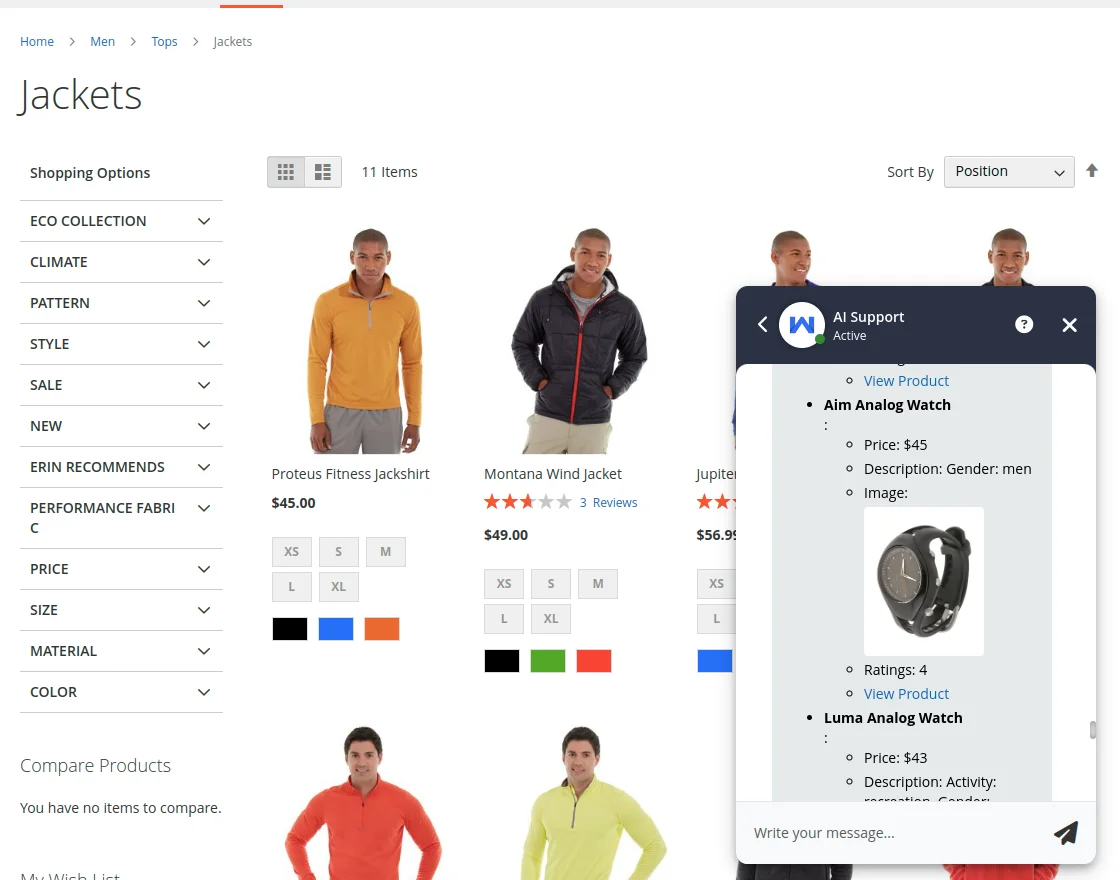
We can use AI tools to create a chatbot to gather user requirements analyse collected information and provide users with a better experience by delivering products according to their needs.
for example:- AI chatbot
Support
If you have any queries please contact us at Webkul Support System.
If you’re looking to create a new project, it’s a great idea to Hire AI developers who can help you build a powerful and scalable online store.

Be the first to comment.