A practical comparison of platforms that support separate merchant stores through native features or official vendor modules.
Building one online store is very different from building a platform that runs hundreds of separate stores.
Each business may need its own products, customers, orders, branding, users, and storefront.
The platform owner still needs one system for managing those stores and maintaining the commerce platform.
That is where multi tenant ecommerce becomes useful.But platforms handle tenancy in different ways.
Some platforms provide a ready SaaS store model, while others provide the tenant layer and require custom SaaS development.
How platforms were selected: Platforms were included if they offer native multi-tenancy or an official vendor module; third-party tenancy plugins were excluded.
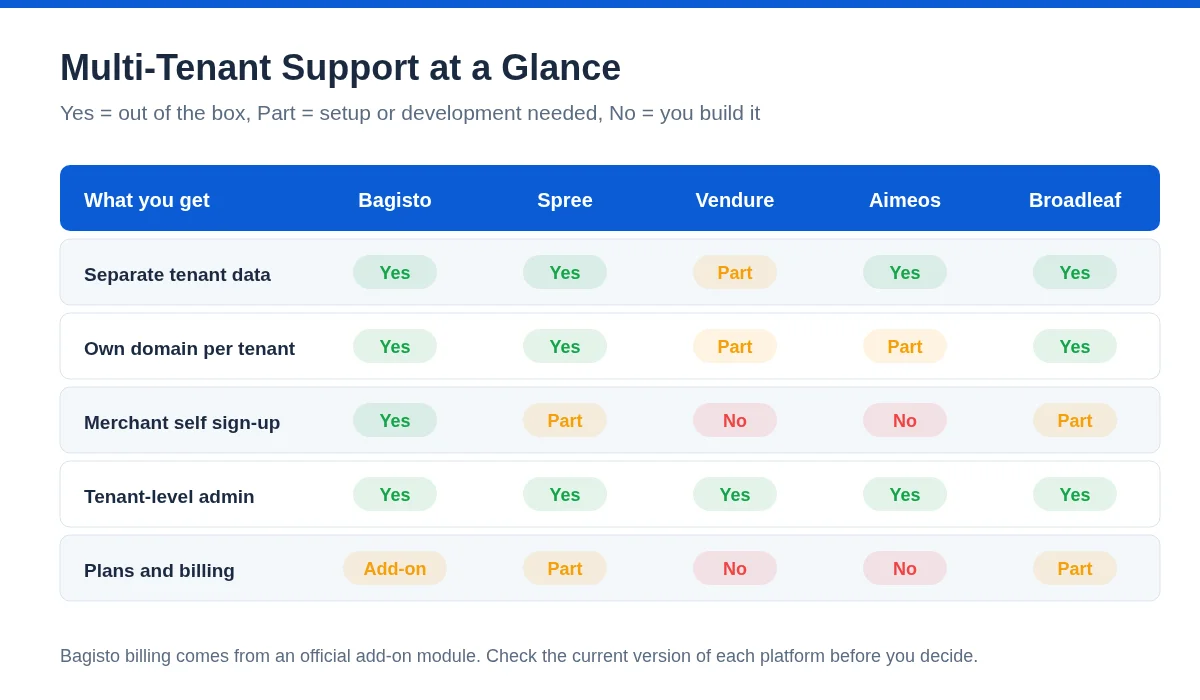
Best Multi Tenant Ecommerce Platforms at a Glance
If you already know the architecture you need, start with this comparison.The table shows how each platform provides multi-tenancy and where it fits best.
Comparison chart of multi-tenant support in Bagisto, Spree, Vendure, Aimeos, and BroadleafThis comparison shows how five ecommerce platforms handle multi-tenancy and the SaaS features they support.
| Platform | Multi-tenant approach | SaaS support | Technology | Best fit |
|---|---|---|---|---|
| Bagisto | Official Multi Tenant Ecommerce solution | Tenant registration, store provisioning, plus an official subscription add-on | Laravel, PHP | SaaS store builders and white-label store networks |
| Spree Commerce | Enterprise multi-tenant module | Tenant storefronts and administration; other SaaS workflows depend on the project | Ruby on Rails | Enterprise SaaS, franchises, dealers, and reseller networks |
| Vendure | Channels in the core platform | Strong tenant building blocks; onboarding and subscription billing usually need development | Node.js, TypeScript | Headless and custom SaaS commerce products |
| Aimeos | Independent Sites within one installation | Multi- site foundation; SaaS onboarding and billing are usually built separately | PHP, Laravel, Symfony, TYPO3 | Complex shop networks and custom PHP applications |
| Broadleaf Commerce | Tenant and Application model | Enterprise tenant management with project-specific SaaS workflows | Java, Spring | Large enterprise commerce ecosystems |
The table provides a starting comparison, but the actual tenant architecture needs closer review before choosing a platform.
Data isolation, tenant onboarding, domains, billing, and administration can work very differently across these platforms.
What Is Multi Tenant Ecommerce?
A multi tenant ecommerce platform lets separate businesses run stores on shared commerce infrastructure.
Each business operates as a separate tenant with its own store, data, users, and settings.A tenant may have its own storefront, products, customers, orders, users, branding, domain, and settings.
The platform owner manages the shared system above those stores.Think of multi-tenancy like an office building where several businesses share common infrastructure.
Businesses share the building and common services, but each company controls its own office and who can access it.
The level of separation depends on the platform architecture.Some systems separate tenant data inside a shared database. Others use different isolation or deployment models.
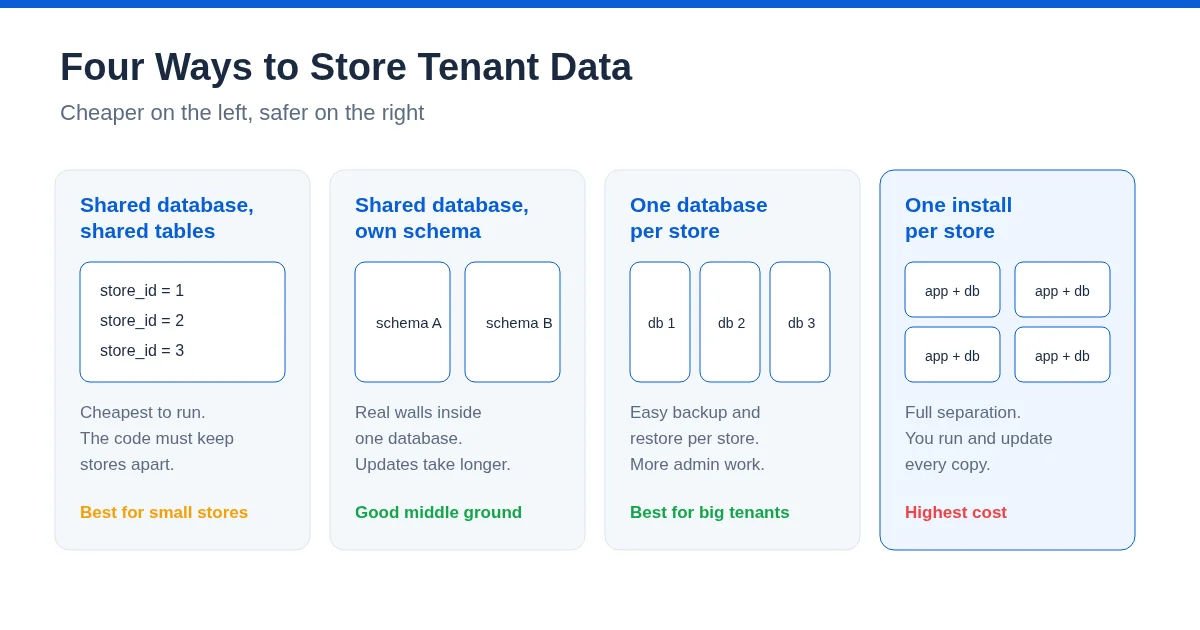
Tenant data can be separated in several ways, from shared tables to one database per tenant.
Multi-Store vs Multi-Vendor vs Multi-Tenant
These terms are often mixed together, but they solve different business problems.
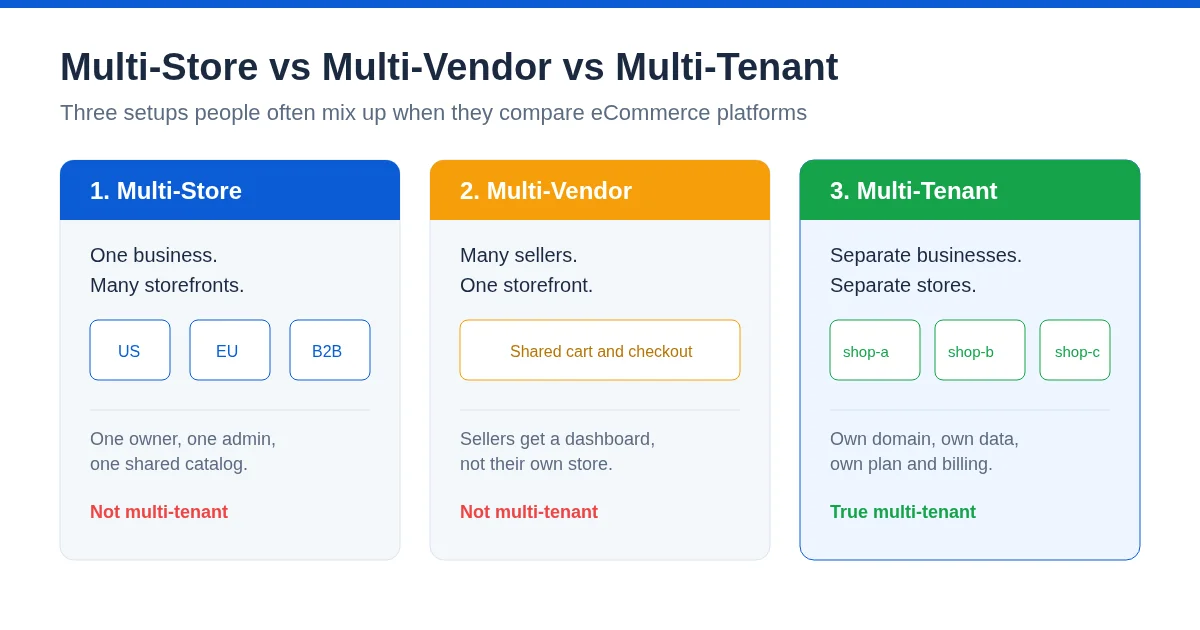
Multi-store, multi-vendor, and multi-tenant models solve three different ecommerce business requirements.
| Model | Who uses it | What it usually means | Example |
|---|---|---|---|
| Multi-store | One business | One company operates several storefronts | A brand with US, UK, and EU stores |
| Multi-vendor | One marketplace with many sellers | Sellers offer products through a shared marketplace | An online marketplace |
| Multi-tenant | Separate businesses | Businesses operate their own stores on shared platform infrastructure | A SaaS ecommerce store builder |
A commerce platform can support more than one of these models.The important question is whether its architecture matches the business you want to build.
What to Look for in a Multi Tenant Ecommerce Platform
Multi-tenancy is more than displaying several storefronts from one backend.
Review these areas before choosing a platform.
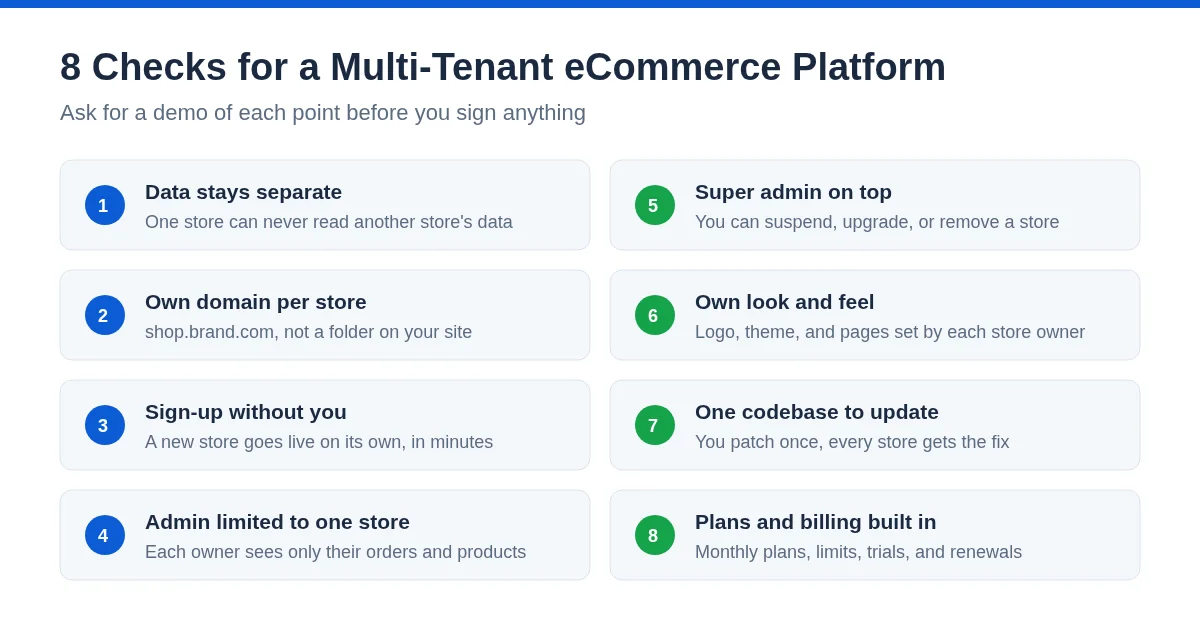
These are the main areas to review before committing to a multi-tenant ecommerce platform.
Tenant data boundaries
Products, customers, orders, users, and settings must stay within the correct tenant boundary.
A merchant should not get access to another merchant’s protected business data.
Tenant administration
Each business needs an admin area with access limited to the stores and data it manages.
Central administration
The platform operator needs higher-level controls for managing tenants and shared platform settings.
Domains and branding
Many SaaS store networks need a different domain, logo, theme, or storefront identity for every tenant.
Tenant provisioning
Some platforms can create a store as part of the merchant registration process.
Others expect an administrator or developer to create the tenant.
This difference matters when you are building a self-service SaaS product.
Plans and billing
Subscription billing is useful for ecommerce SaaS, but billing itself does not make a platform multi-tenant.
Check whether plans, trials, limits, renewals, and recurring payments are included, officially available, or require development.
Updates and maintenance
Consider how platform updates, extensions, themes, and database changes work as the number of tenant stores increases.
5 Multi Tenant Ecommerce Platforms
- Bagisto – Laravel platform with an official multi-tenant SaaS solution
- Spree Commerce – Enterprise multi-tenancy for white-label commerce
- Vendure – Headless multi-tenancy through Channels
- Aimeos – Independent shops through Sites
- Broadleaf Commerce – Enterprise Tenant and Application architecture
1. Bagisto
Bagisto is an open-source ecommerce platform built with Laravel and PHP.
Its official Multi Tenant Ecommerce solution is designed for businesses that want to operate separate merchant stores from one platform.
A merchant can register as a tenant and receive a storefront as part of the documented onboarding flow.
Each tenant also gets its own administration area for managing store operations.
The platform owner gets a super admin layer for managing tenants across the SaaS platform.
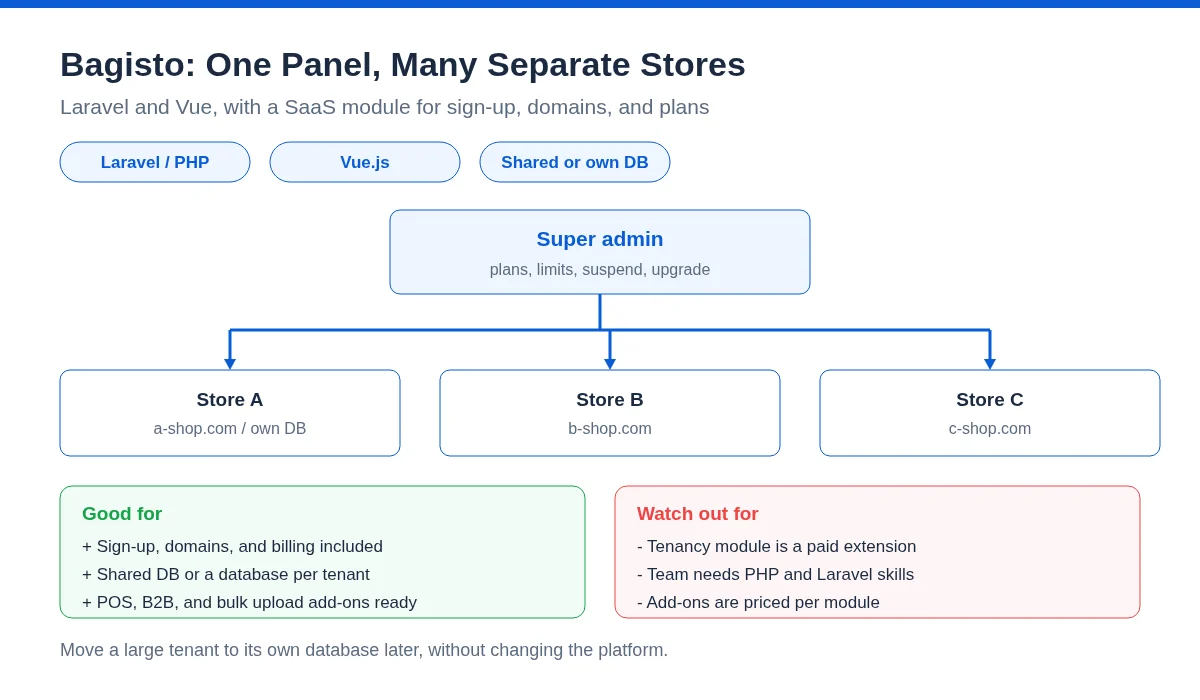
Bagisto places a super admin layer above separate merchant stores for centralized platform management.
How Bagisto handles tenant stores
Bagisto’s current Multi Tenant Ecommerce solution uses a single database architecture.
Tenant stores operate inside the shared platform while access and store data are handled within the tenant model.
Merchants can manage products, categories, customers, orders, invoices, shipments, and other store functions.
Bagisto also supports CNAME mapping so merchants can connect their own domains.
SaaS onboarding and subscription plans
This is one area where Bagisto closely matches the needs of a SaaS store builder.
Tenant registration and storefront provisioning are part of its documented multi-tenant workflow.
Webkul also provides an official SaaS Subscription add-on for the Bagisto multi-tenant solution.
It adds subscription plans, recurring membership fees, trials, and plan-based limits.
The subscription capability is a separate official module and is not included in the base Multi Tenant Ecommerce package.
| Pros | Things to consider |
|---|---|
| Built specifically around separate merchant storefronts. | The multi-tenant capability is a paid solution rather than part of the free Bagisto core. |
| Tenant registration and storefront setup are already part of the SaaS workflow. | The current architecture uses a shared database rather than a separate database for every tenant. |
| Tenants get their own store administration area. | Some SaaS features, including subscription plans, require separate official modules. |
| An official subscription add-on is available for businesses that want to charge merchants. | A Laravel and PHP development team is useful for deeper customization. |
Best for: SaaS store builders, merchant platforms, and white-label store networks that want tenant onboarding and commerce operations in one Laravel ecosystem.
Official sources: Bagisto Multi Tenant Ecommerce documentation and SaaS Subscription module.
2. Spree Commerce
Spree Commerce is an ecommerce platform built with Ruby on Rails.
It offers an open-source Community Edition and commercial Enterprise capabilities.
Spree’s dedicated multi-tenant functionality is part of its Enterprise offering.
It is designed for use cases such as white-label ecommerce SaaS, franchises, dealers, and reseller networks.
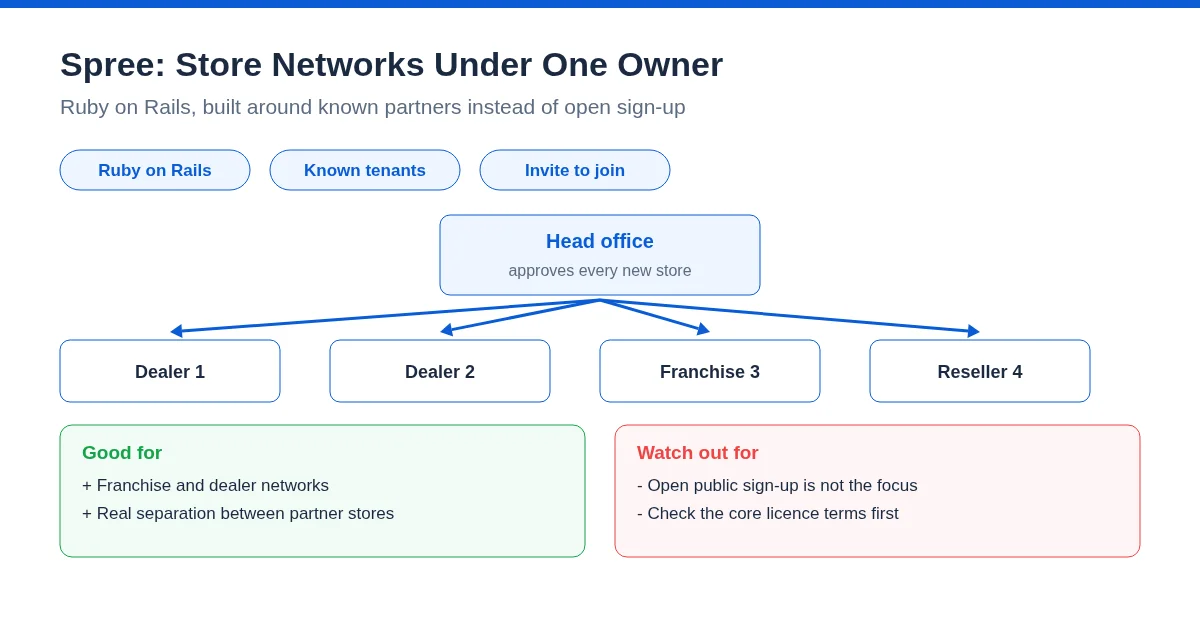
Spree provides enterprise multi-tenancy for dealer, franchise, reseller, and white-label commerce networks.
How Spree handles tenants
Spree’s multi-tenant architecture can operate separate tenant stores from one commerce platform.
Tenants can have their own storefront experience, administration, and API access.
The platform operator keeps central control over the tenant environment.
Spree also supports tenant-level commerce configuration such as catalogs, domains, branding, and administration.
Community vs Enterprise
This distinction should be part of the platform comparison.
The dedicated multi-tenant module is an Enterprise feature and is not part of the standard open-source Community Edition.
Teams should include Enterprise licensing and implementation requirements when estimating project cost.
| Pros | Things to consider |
|---|---|
| Built specifically around separate merchant storefronts. | The multi-tenant capability is a paid solution rather than part of the free Bagisto core. |
| Tenant registration and storefront setup are already part of the SaaS workflow. | The current architecture uses a shared database rather than a separate database for every tenant. |
| Tenants get their own store administration area. | Some SaaS features, including subscription plans, require separate official modules. |
| An official subscription add-on is available for businesses that want to charge merchants. | A Laravel and PHP development team is useful for deeper customization. |
Best for: Rails teams building enterprise white-label SaaS products, franchise networks, dealer portals, or reseller commerce platforms.
Official source: Spree multi-tenant documentation.
3. Vendure
Vendure is a headless ecommerce platform built with Node.js and TypeScript.
Its main multi-tenant building block is called a Channel.
Vendure officially lists multi-tenancy as one of the use cases for Channels.
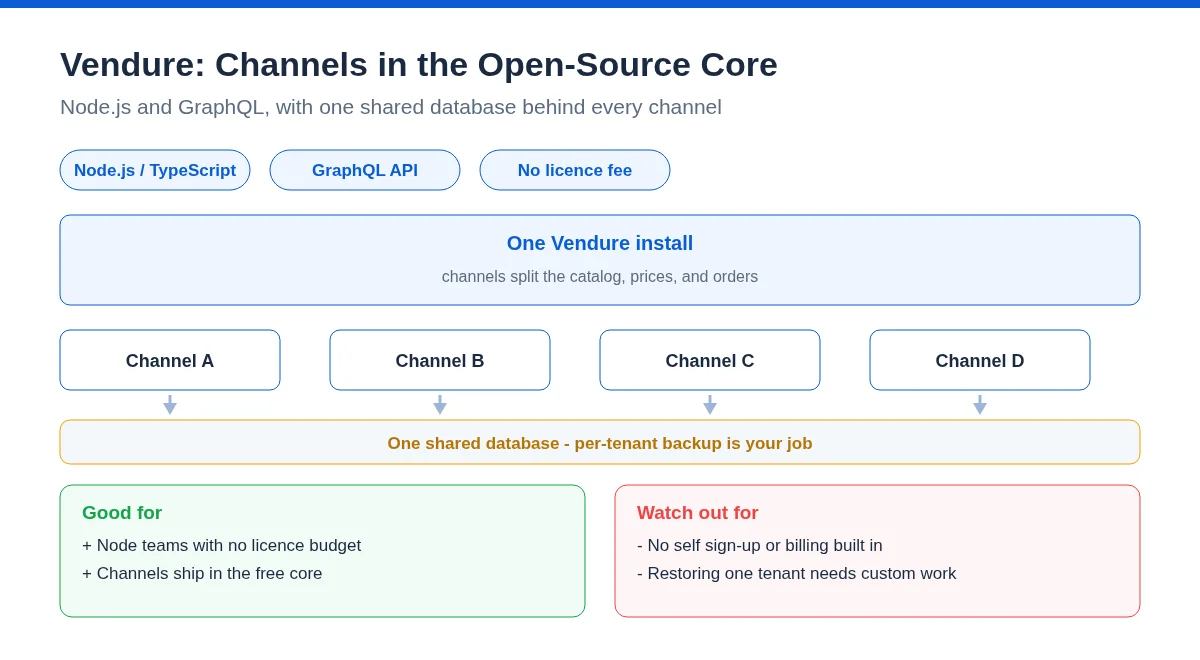
Vendure Channels split catalogs, prices, and orders inside one installation for separate commerce experiences.
How Vendure Channels work
A Channel can represent a separate shop inside one Vendure server.
Products, prices, orders, payment methods, shipping methods, stock locations, promotions, and other entities can be assigned to Channels.
Administrator roles can also be limited to selected Channels.
This gives developers a flexible foundation for building tenant-specific commerce experiences.
Tenant isolation needs planning
A Channel does not mean every part of the Vendure instance becomes completely isolated.
Some entities and settings can remain global or shared across the instance.
Teams should therefore map their tenant data model before development begins.
| Pros | Things to consider |
|---|---|
| Channels are available in the core platform. | Not every platform entity is isolated by Channel. |
| Good fit for API-first and custom storefront projects. | Tenant registration workflows usually need development. |
| Channel-aware roles help restrict administration. | SaaS subscription billing is not a ready-made core feature. |
| Uses TypeScript and Node.js throughout. | The development team must design the tenant boundaries carefully. |
Best for: TypeScript teams that want a headless ecommerce foundation and plan to build their own SaaS onboarding and tenant experience.
Official source: Vendure Channels documentation.
4. Aimeos
Aimeos is a PHP ecommerce framework that can work with Laravel, Symfony, and TYPO3.
It supports multiple independent shops inside one installation.
Aimeos calls these shops Sites.
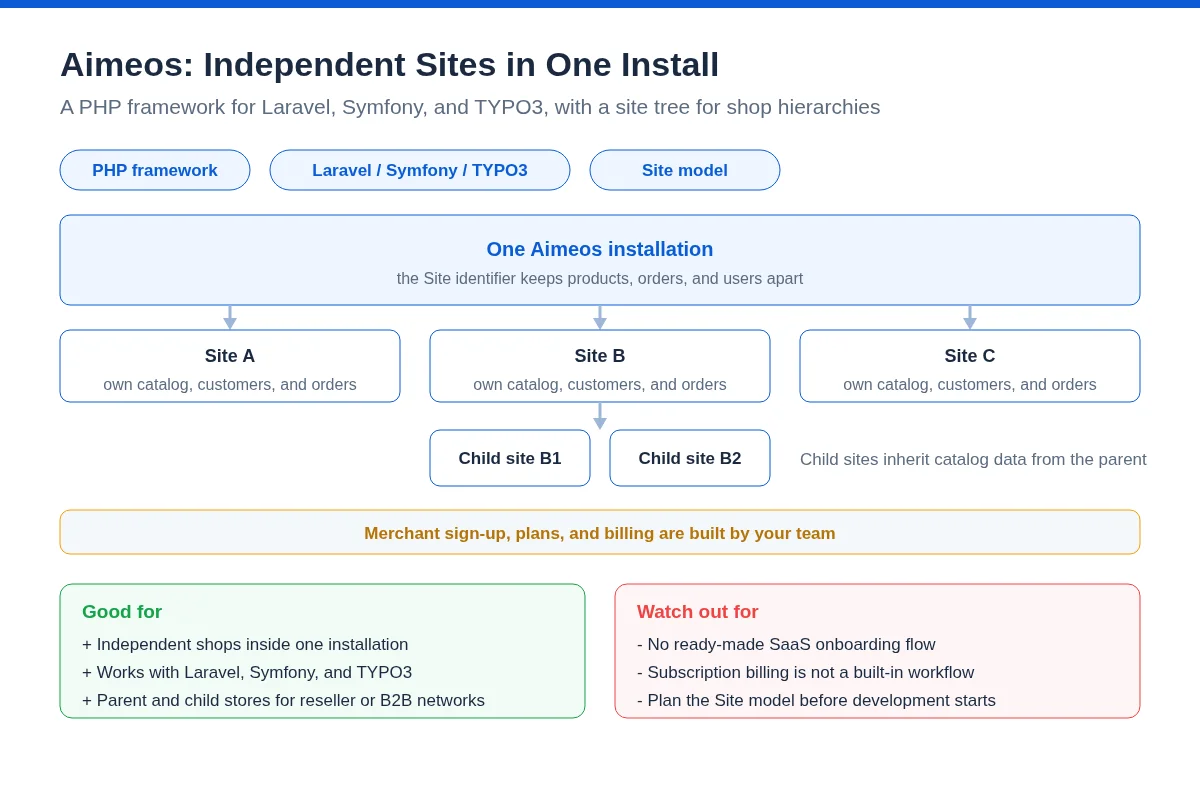
Aimeos supports independent Sites with parent and child structures within a single ecommerce installation.
How Aimeos Sites work
A standard installation starts with one Site.
Teams can create additional top-level Sites for separate shops.
Aimeos uses the Site identifier throughout its architecture to separate data in multi-site and multi-tenant setups.
Administration can also be scoped so users work only with the Sites they are allowed to manage.
Complex store structures
Aimeos can also support parent and child store structures.
This is useful where products, categories, or other commerce data need to be shared through a store hierarchy.
That model can suit reseller networks, B2B platforms, and more complex ecommerce structures.
| Pros | Things to consider |
|---|---|
| Supports independent shops within one installation. | It is more framework-driven than a ready-made SaaS store builder. |
| Works with several popular PHP frameworks. | Merchant self-registration and automated SaaS onboarding usually need custom work. |
| Can handle complex store and site hierarchies. | Subscription billing is not the main built-in tenant workflow. |
| Admin permissions can be limited by Site. | Teams should understand the Aimeos Site model before designing the platform. |
Best for: PHP teams that need independent shops or complex store hierarchies and want control over how the SaaS layer is built.
Official source: Aimeos Sites documentation.
5. Broadleaf Commerce
Broadleaf Commerce takes a more enterprise-focused approach to multi-tenancy.
Its architecture includes explicit Tenant and Application concepts.
A Tenant represents a separate company operating on the Broadleaf platform.
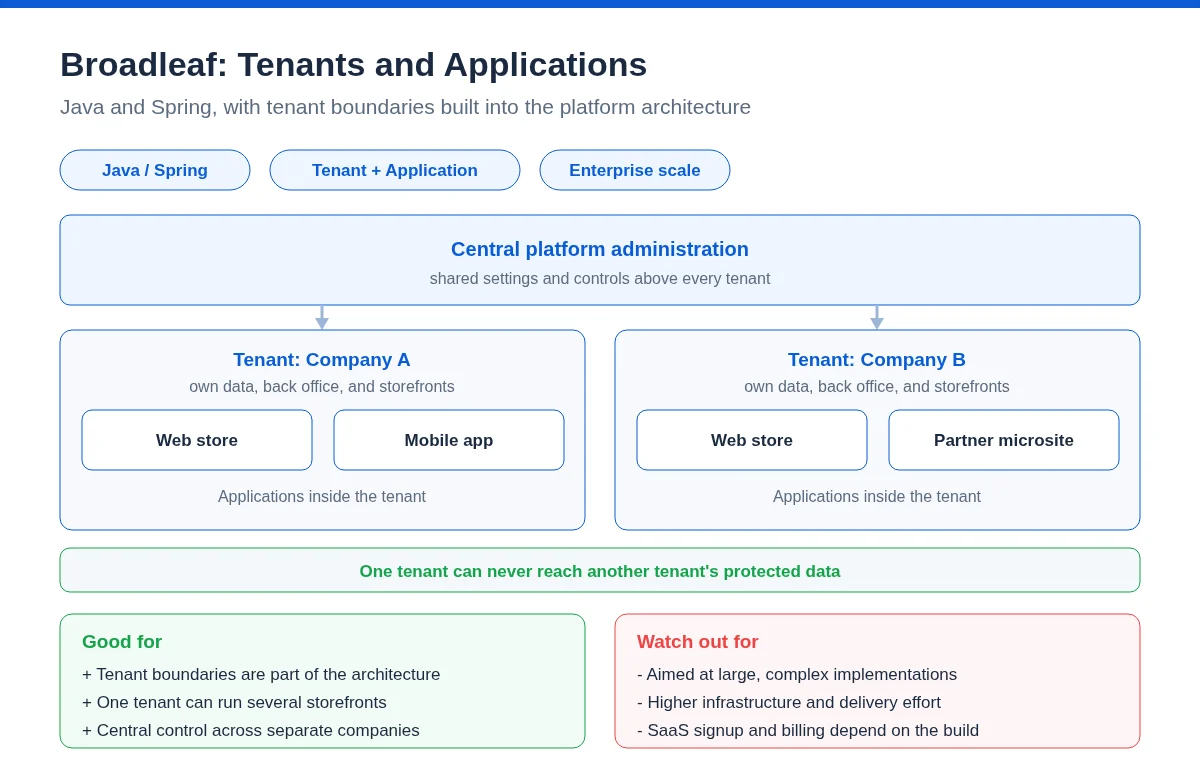
Broadleaf separates companies through Tenants, while each Tenant can operate several commerce Applications.
How Broadleaf handles tenant separation
Broadleaf documents tenants as having their own data, back-office experience, and customer-facing commerce experiences.
Tenant boundaries are used to prevent one company from accessing another tenant’s protected data.
A Tenant can also contain one or more Applications.
An Application may represent a website, microsite, mobile experience, or another commerce frontend.
Enterprise commerce structures
Broadleaf supports centralized platform administration above tenant environments.
Its architecture is designed for commerce models that may need shared, inherited, and tenant-specific structures.
This makes it useful when the tenant model is more complex than giving every business the same storefront template.
| Pros | Things to consider |
|---|---|
| Multi-tenancy is an explicit part of the platform architecture. | The platform is aimed at larger and more complex implementations. |
| Provides strong Tenant and Application concepts. | Implementation and infrastructure requirements can be higher than simpler platforms. |
| Designed for complex enterprise commerce structures. | It may be more platform than a small SaaS product needs. |
| Suitable for businesses that need central control across separate companies. | SaaS signup and billing workflows depend on the wider implementation. |
Best for: Enterprise teams that need strong tenant boundaries and complex commerce structures across large store or client networks.
Official source: Broadleaf multi-tenancy documentation.
Which Multi Tenant Ecommerce Platform Is Right for You?
Start with how merchants will join and use your platform.
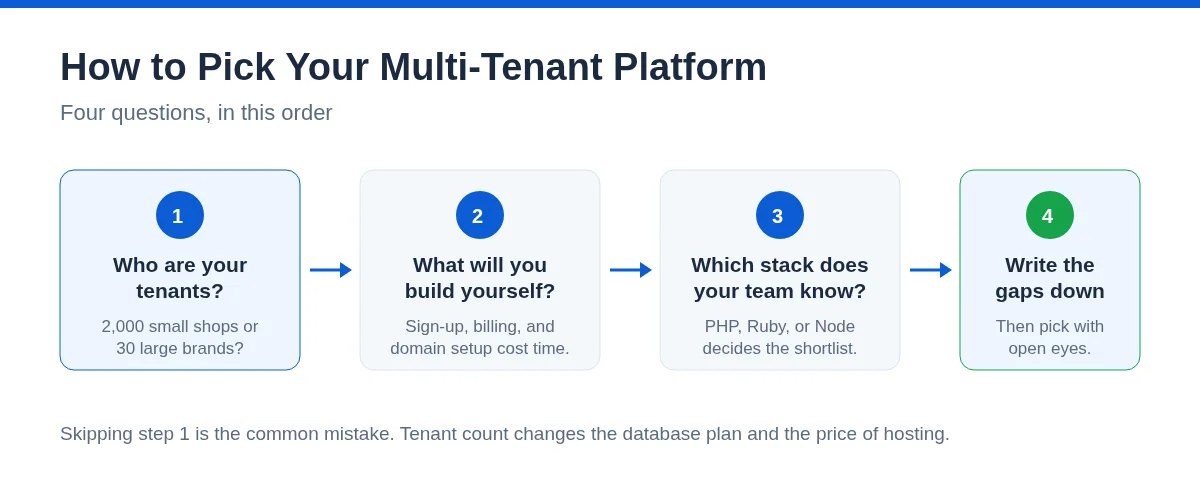
These four questions help narrow the platform shortlist based on your intended SaaS commerce model.
If businesses should register and quickly receive their own ecommerce store, Bagisto is closely aligned with that SaaS model.
Its official multi-tenant workflow covers tenant registration, storefront creation, tenant administration, and platform-level management.
An official subscription module is also available when merchants need to choose paid plans.
Spree Commerce is a strong option for enterprise white-label projects, especially for teams already working with Ruby on Rails.
Vendure suits teams that prefer a headless TypeScript platform and want to build their own SaaS experience around it.
Aimeos is useful when independent shops and complex store hierarchies matter more than ready-made tenant onboarding.
Broadleaf Commerce is better suited to enterprise environments with complex tenant structures and larger implementation requirements.
Questions to Ask Before Choosing a Multi Tenant Ecommerce Platform
Do not choose a platform only because its website mentions multi-tenancy.
Map the complete tenant journey first.
- How is tenant data separated?
- What can a tenant administrator access?
- What can the platform administrator access?
- Can each tenant use its own domain and branding?
- How is a new tenant created?
- Can tenant provisioning be automated?
- Are SaaS plans and recurring billing available?
- Which features need another official module?
- How are platform updates handled across tenants?
- What changes when the platform grows to hundreds or thousands of stores?
The answers will usually tell you more than a simple “multi-tenant” feature label.
What is a multi tenant ecommerce platform?
A multi tenant ecommerce platform lets separate businesses operate individual stores using shared infrastructure, resources, and centralized platform management.
Is multi-store ecommerce the same as multi-tenant ecommerce?
No, multi-store ecommerce serves one business across several storefronts, while multi-tenant ecommerce supports separate businesses on shared infrastructure.
Does multi-tenancy require a separate database for every tenant?
No, multi-tenant platforms can use shared or separate databases, provided tenant access and business data remain properly isolated.
Can a paid module still count as multi-tenant support?
Yes, an official paid module can provide platform-supported multi-tenancy, even when the feature is excluded from the free core.
Which platform is a good fit for an ecommerce SaaS store builder?
Bagisto suits ecommerce SaaS builders needing merchant registration, individual storefronts, tenant administration, subscriptions, and centralized platform management.
Is Bagisto multi-tenant?
Yes, Bagisto offers an official paid Multi Tenant Ecommerce solution supporting merchant registration, storefront provisioning, tenant administration, and domain mapping.
Is Spree Commerce multi-tenant?
Yes, Spree Commerce supports multi-tenancy through its Enterprise offering, allowing separate businesses to operate commerce experiences within shared infrastructure.
Is Vendure multi-tenant?
Yes, Vendure supports multi-tenancy through Channels, which can scope commerce entities and admin roles while some concepts remain shared.
Can Aimeos run separate tenant shops?
Yes, Aimeos supports multiple top-level Sites within one installation, using its Site model to separate shops and commerce data.
Does Broadleaf Commerce support multi-tenancy?
Yes, Broadleaf Commerce supports multi-tenancy through Tenant and Application concepts for separate companies sharing platform infrastructure and commerce capabilities.
Final Thoughts
The right multi tenant ecommerce platform depends on your tenant model, onboarding process, data isolation requirements, and SaaS features.
Bagisto fits SaaS store builders that need merchant registration, storefront provisioning, tenant administration, and optional subscription plans.
Spree suits enterprise white-label projects, while Vendure and Aimeos provide flexible foundations for custom SaaS commerce systems.
Broadleaf is suited to larger enterprise environments with complex tenant and application structures.
Choose the platform that matches your tenant workflow and limits the amount of custom development your team needs.

Be the first to comment.