Laravel eCommerce GST extension is an addon which is used to add the Indian Goods and Services Tax structure.
Using it, the Store admin can add the GST to their Bagisto store products. This extension enhances the efficiency of business operations and ensures compliance with GST regulations.
It assists in identifying the relevant product taxes based on the production state.
Furthermore, you may explore the Laravel Customer Credit Extension, which allows customers to accumulate credit points and utilize them for their purchases.
Features
- The admin has the ability to input their preferred GSTIN Number.
- They can also choose the State for tax purposes.
- The extension includes a feature that automatically distinguishes between IGST, CGST, and SGST depending on whether the transaction is within the home state or not.
- The admin can set the GST rate from the backend and has the option to enter multiple GST rates at once.
- There’s a function that allows the admin to determine the product price by including or excluding GST, or by selecting it during the product editing or adding process.
- A button is available to show or hide the GST inclusion details on the storefront.
- The store admin can choose to include or exclude GST for each product individually.
- Additionally, there’s a field for entering the HSN code in the product editing settings.
- The admin can also set or modify specific GST rates while adding or editing products.
- The automatic application of SGST and CGST for intra-state transactions, along with IGST for inter-state transactions, is determined based on the provided address.
- GST is applied only when the billing address belongs to India, so international orders remain unaffected.
- A dedicated Settings>GST section lists every product that has GST assigned, with search, filter, sort and export options.
- The admin can assign the GST rate, HSN code and GST type to many products at once by importing a CSV file, and a sample CSV file is available for download.
- GST details can be removed from a single product or from several products together using the mass action.
- An option is available to print the store’s GSTIN on the orders placed by the customers.
- The HSN code and the SGST, CGST and IGST break-up are shown on the order, invoice, refund, order PDF and the order emails.
- Separate access permissions are available for viewing, importing and deleting the GST records.
Installation
Bagisto Version: v2.4.10
Step 1: Extract Package
Unzip the extension package and merge the packages folder into your project root.
Step 2: Update the composer.json File
Open the composer.json file and add the following line under the ‘psr-4’ section:
"Webkul\\GST\\": "packages/Webkul/GST/src",
Step 3: Register Service Provider
Go to: bootstrap/providers.php file and add the following line under ‘providers’
use Webkul\GST\Providers\GSTServiceProvider;

 return [
     GSTServiceProvider::class,
 ]
Run the following command to refresh the autoload files:
composer dump-autoload
Run the following commands to complete the setup:
php artisan gst:install
The above command pulls the required league/csv package, runs the migrations of the extension and publishes the sample CSV file used by the bulk import.
php artisan optimize:clear
After following these steps, the Bagisto GST Extension should be successfully installed and ready for use in your Bagisto v2.4.10 project.
Configuration of Laravel eCommerce GST Extension
After the Laravel eCommerce GST extension is successfully installed, the admin has to proceed for the configuration.
For that, they’ll navigate to Configure>Goods and Services Tax to access the configuration settings. Below is the configuration settings,
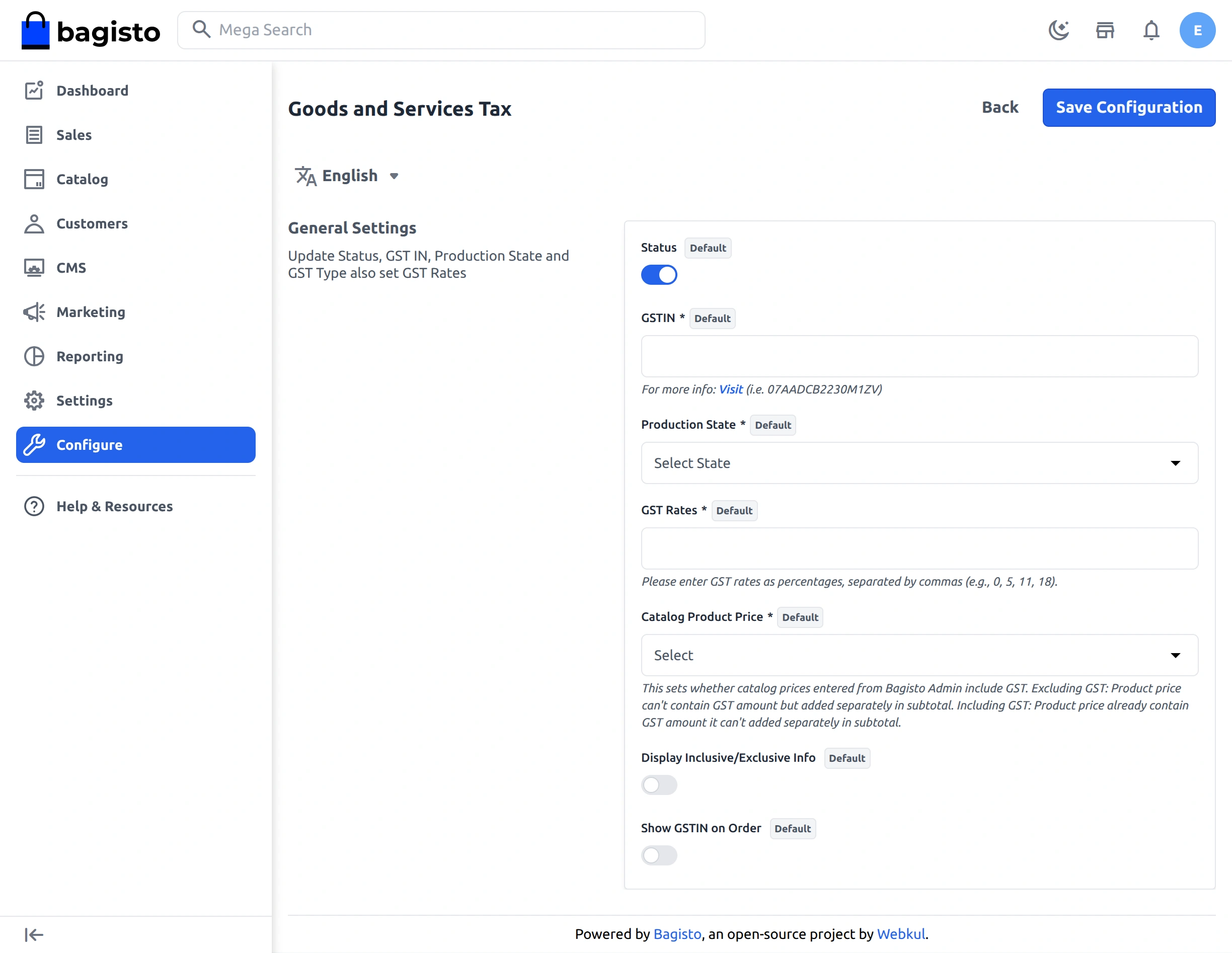
Admin configures the following options,
- Status: Enable or Disable the GST module.
- GSTIN: Field to enter the GSTIN Number.
- Production State: Select the Production state from dropdown menu.
- GST Rates: Enter required GST Rates as percentages, separated by commas (e.g., 0, 5, 12, 18).
- Catalog Product Price: Dropdown menu to set whether prices entered by admin includes GST, excludes GST or to be selected while adding/editing product.
- Display Inclusive/Exclusive Info: Button to enable or disable the displaying of GST exclusive/inclusive information on storefront.
- Show GSTIN on Order: Button to enable or disable the printing of the store’s GSTIN on the orders, invoices and order emails.
These settings are channel based, so the admin can keep a different GST setup for every channel of the store.
Add GST to Products
Now that the GST extension is configured, Admin can now add the Goods and Services Tax to products individually.
For this, they navigate to Catalog>Products and then add or edit their required product. Next, they navigate to the GST section. It’ll be visible as per the below image,

The following options are available for admin to configure GST per product,
- Button to enable or disable GST on product.
- Product Price: Dropdown menu to select if GST to be included or excluded from Price. This dropdown appears only when the Catalog Product Price configuration is set to Select when initialize, otherwise the configured value is used for the product.
- GST Rate: Select the GST rate for the product. The dropdown lists the rates entered in the GST Rates configuration.
- HSN Code: Enter the HSN Code of product.
The GST section is available for every product type except the Grouped and Bundle products, as those are billed through the products associated with them.
Manage and Import GST in Bulk
Setting the GST product by product is convenient for a few products, but not for a large catalog. For that, the admin navigates to Settings>GST, where every product having GST assigned to it is listed along with its GST rate, HSN code, GST type, product image, name, SKU, price and the date on which the record was created.
The listing can be searched, filtered, sorted and exported, which makes it easy to review the GST applied across the catalog.
To assign the GST to several products together, the admin uses the CSV Demo button to download the sample CSV file, fills it with their data and uploads it using the Import CSV file field, then clicks on the Import button.
The CSV file has to follow the format given below,
product_id,gst_rate,hsn_code,type
1,18,96081001,internal
2,5,96081001,external
Here is what every column of the CSV file holds,
- product_id: The Id of an existing product of the store.
- gst_rate: The GST rate for the product. It has to be one of the rates entered in the GST Rates configuration.
- hsn_code: The HSN code of the product.
- type: Either
internalfor the prices that already include GST, orexternalfor the prices on which GST is added separately.
The whole file is validated before anything is saved. If any row is incorrect, the import stops and the error is displayed, so a partially imported file is never left behind. For the products that already have GST assigned, the imported values replace the earlier ones.
The admin can also remove the GST of a product using the delete action of the listing, or remove it from several products together by selecting the records and using the mass delete action.
Access to this section is controlled by the roles of the store. From Settings>Roles, the admin can allow or restrict the GST, Import and Delete permissions for their sub admins.
GST Information on Storefront
The GST information is displayed on the Storefront if the Admin has enabled the Display Inclusive/Exclusive Info from configuration. If it is disabled, the GST information will not be displayed.
Below are the 2 ways in which GST Information is displayed,
1) When GST is Included in Price

2) When GST is excluded from price

GST Application on Checkout
The extension detects automatically when to apply IGST and when to apply SGST and CGST. It is applied as per below conditions,
1) If the transaction is happening Interstate, then IGST is applied. It is displayed in below image,

2) If the transaction is happening Intrastate, then CGST and SGST is applied. It is viewed in below image,

The comparison is done between the state of the billing address of the customer and the Production State selected in the configuration. GST is applied only when the billing address belongs to India, therefore the orders shipped to the other countries are calculated with the default tax setup of the store.
GST Details on Orders and Invoices
Once the order is placed, the GST applied on it is saved with the order, so the details remain the same even if the admin changes the GST setup later.
The SGST, CGST and IGST break-up is displayed in the summary of the order, invoice and refund of the admin panel, in the order view of the customer’s My Account section, in the order and invoice PDF, and in the order emails of both the admin and the customer.
Along with it, the HSN code of every purchased product is displayed with the ordered item, and the GSTIN of the store is printed as the GST Registration No. when the Show GSTIN on Order configuration is enabled.
Support
So that is much about the Laravel eCommerce GST Extension.
If you require any further assistance, you can email us directly on [email protected] or raise a ticket.
Current Product Version - 2.4.10
Supported Framework Version - Bagisto v2.4.10

Be the first to comment.