Introduction
Odoo Multichannel PrestaShop Connector connects your PrestaShop stores with Odoo. It keeps orders, products, and customer records in sync.
If you’re running your store on PrestaShop and your back office in Odoo, it can feel like you’re doing two separate jobs at the same time.
An update on one side rarely shows up on the other. That gap costs time and sales. Odoo Multichannel PrestaShop Connector closes that gap.
It moves catalogs, orders, stock, and customer data both ways. In this way, your team works from one unified source, saving time and increasing efficiency.
If you plan to retire your PrestaShop storefront, our PrestaShop to Odoo migration service covers that transition.
Prerequisites for using Odoo Multichannel PrestaShop Connector
Odoo Multichannel PrestaShop Connector works in conjunction with the following module:
You must install the above-mentioned module to use Odoo Multichannel PrestaShop Connector.
Features
- Imports categories, products, orders, customers, and shipping methods from PrestaShop to Odoo
- Exports categories and product templates from Odoo to PrestaShop.
- Syncs product quantities from Odoo to PrestaShop in real time.
- Updates order status, including canceled, shipped, invoiced, and paid, instantly
- Runs scheduled cron jobs for two-way import and export.
- Automatically skips duplicate records during every import.
- Filters imports by All, ID, or Since ID for precise control.
- Pushes real-time stock counts from Odoo back to PrestaShop.
- Brings in full order details: addresses, taxes, payment methods, and currencies.
- Maps order states between PrestaShop and Odoo to keep statuses consistent.
- Supports real-time order sync from PrestaShop through an additional patch.
- Logs every import and export in a Synchronization History tab.
- Displays a dashboard with clickable cards for tracking synced data.
- Keeps a Mapping tab with full sync history for audits.
- Supports bidirectional product and order tag sync between PrestaShop and Odoo, reusing existing tags and auto-creating new ones with case-insensitive matching.
Installation
- Once you purchase the App from the Webkul store, you will receive a link to download the module’s zip file.
- Extract the file on your system after the download finishes. As a result, you will be able to see a folder named ‘prestashop_odoo_bridge’.
- Copy and paste this folder into your Odoo Add-Ons path.
- Now, open the Odoo App and click on the Settings menu. Here, click on Activate Developer Mode.
- Then, open the Apps menu and click on ‘Update Modules List.’
- In the search bar, remove all the filters and search for ‘prestashop_odoo_bridge’.
- You will be able to see the module in the search results. Click on ‘Activate’ to install it.
Initial Setup of Odoo Multichannel PrestaShop Connector
Configure Prestashop Webservice (Prestashop Side)
- Log in to your PrestaShop backend.
- Go to Advanced Parameters > Webservice.
- Enable Webservice and activate CGI mode for PHP.
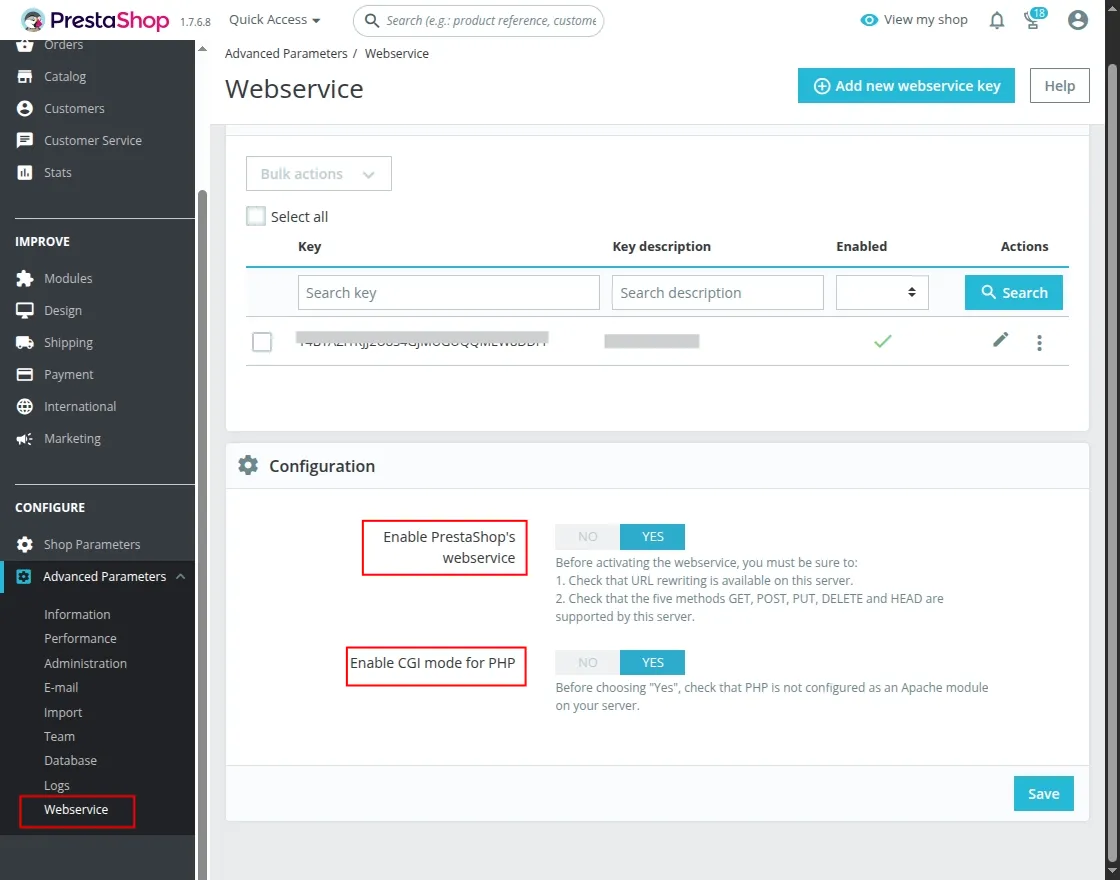
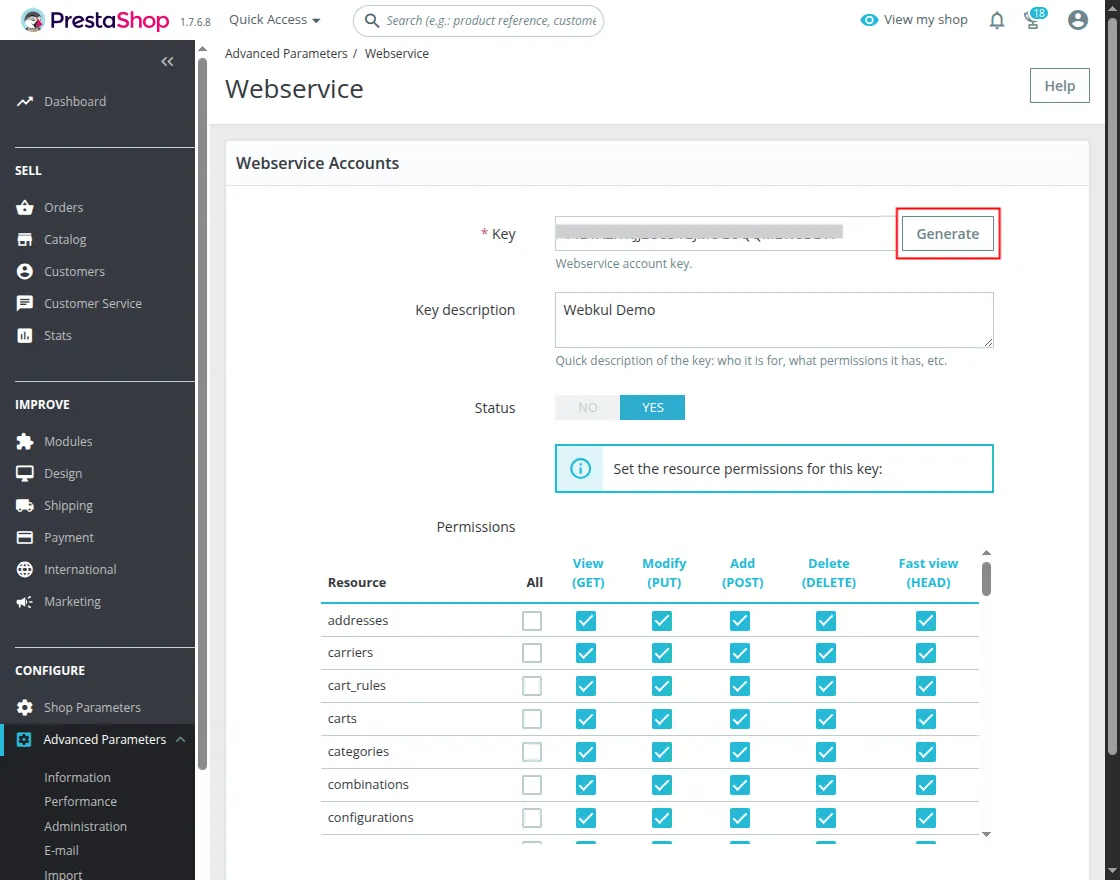
- Click Add New Webservice Key and generate an API key (required for Odoo connection).
Open the Multichannel Module in Odoo
- Log in to your Odoo database.
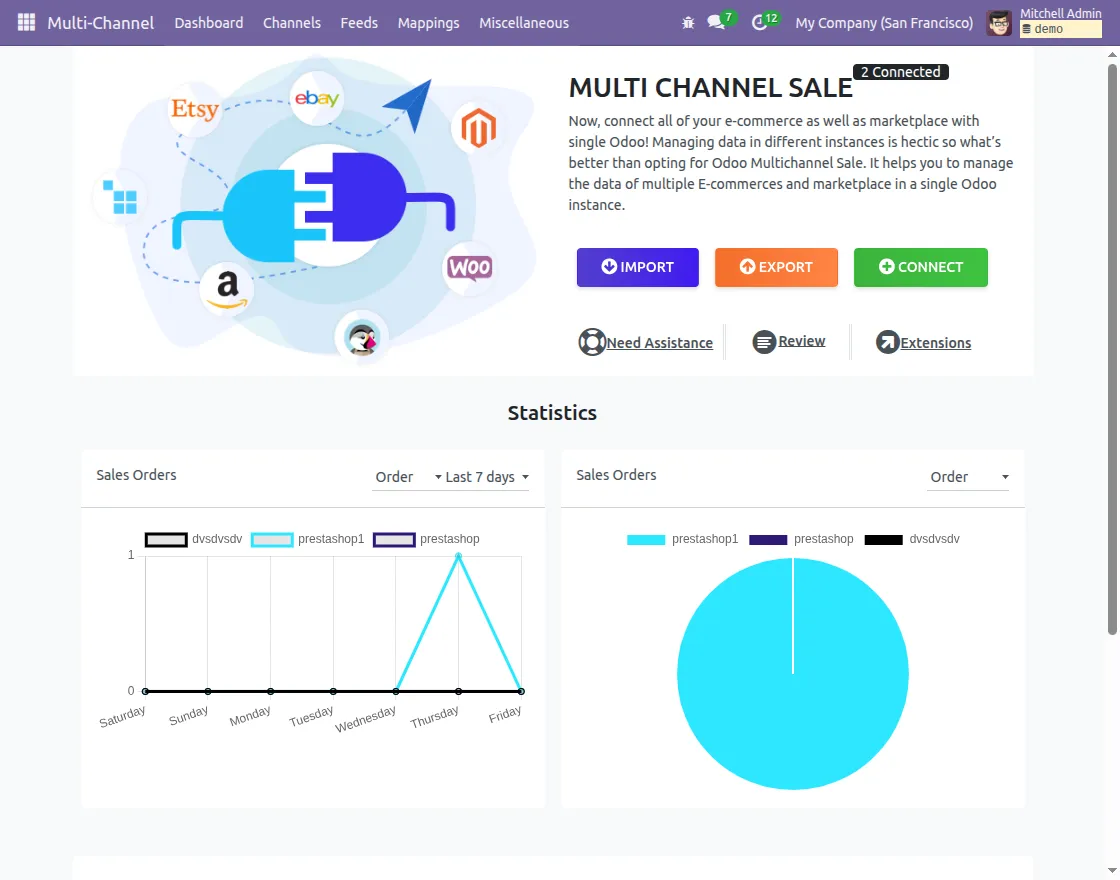
- Open Multichannel from the side menu.
Connect PrestaShop with Odoo
After configuring PrestaShop, configure Odoo Multichannel PrestaShop Connector.
- In the Multichannel dashboard, click Connect to add a new PrestaShop channel.
- Enter a Channel Name (for easy identification).
- Select Channel Type: PrestaShop.
- Enter the URL, Email, and API Key from the PrestaShop web service.
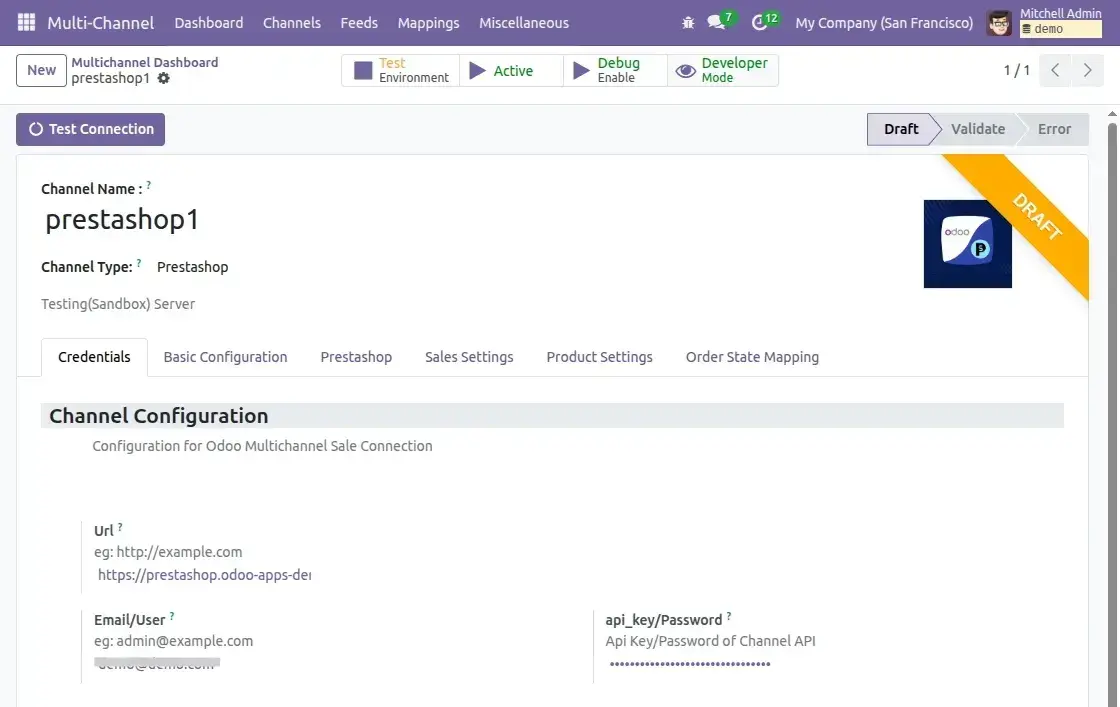
- After adding credentials, click Save.
- Then, click the Test Connection button.
- A confirmation message appears if the connection works.
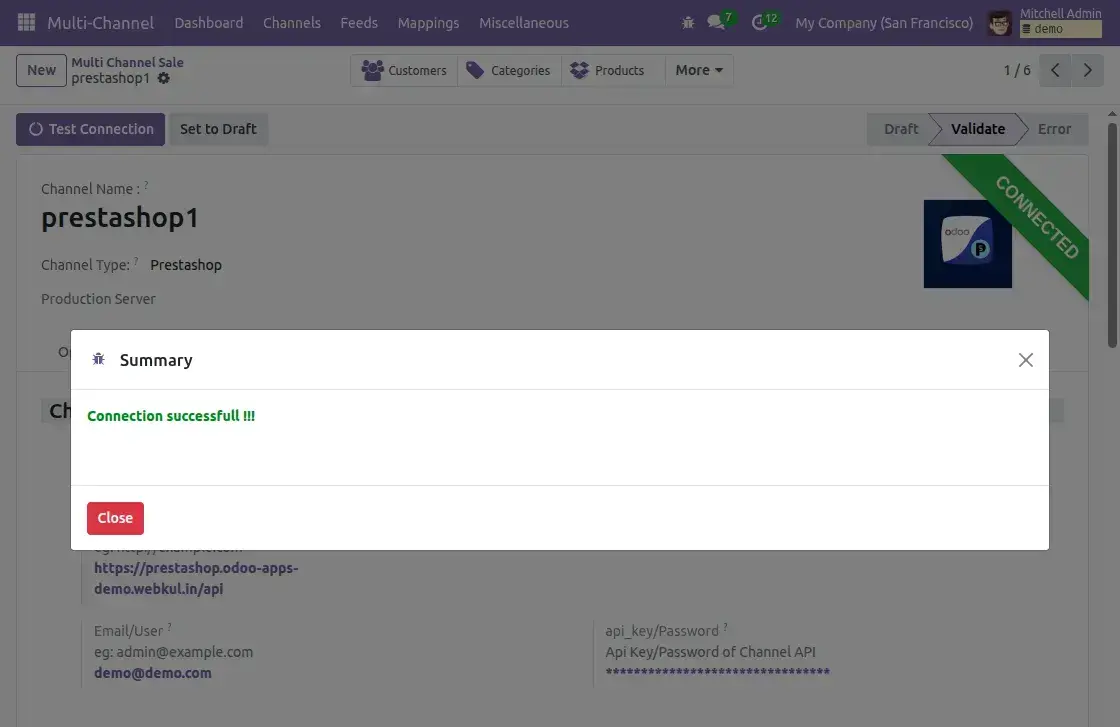
Configure PrestaShop Instance in Odoo
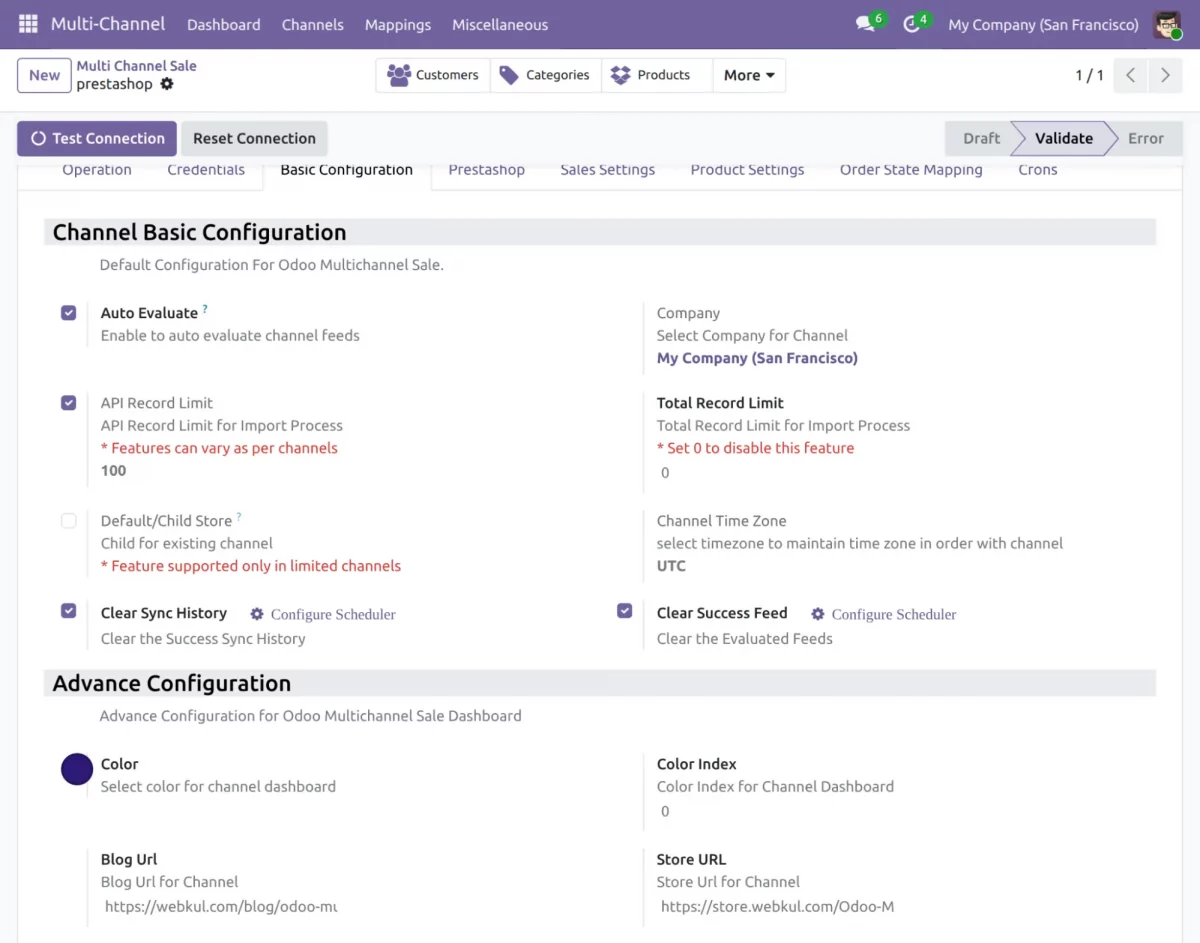
a) Basic Configuration
- Select the default Company to store imported data from PrestaShop in Odoo.
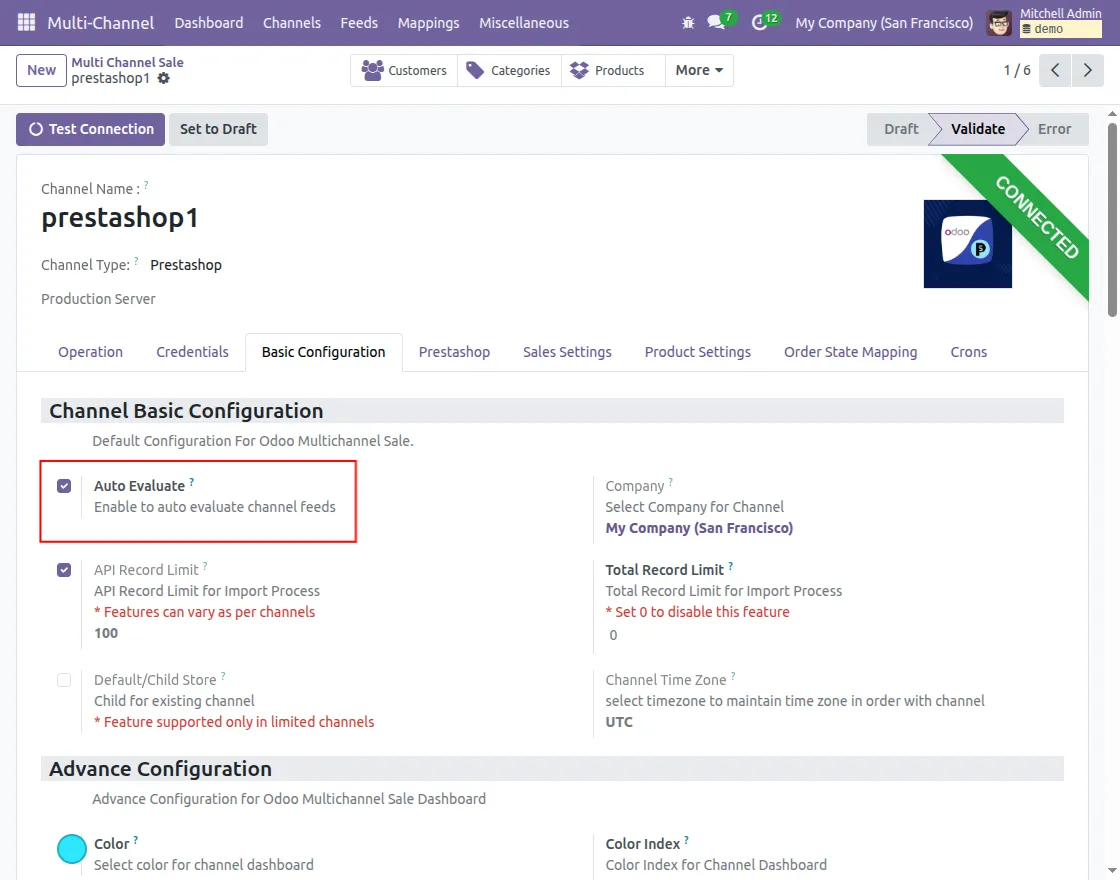
- Enable Auto Evaluate Feed to validate imported data feeds automatically without a human in the loop.
- Set API Record Limit and Total Record Limit to control batch import size.
- Choose the Channel Time Zone to keep order times accurate.
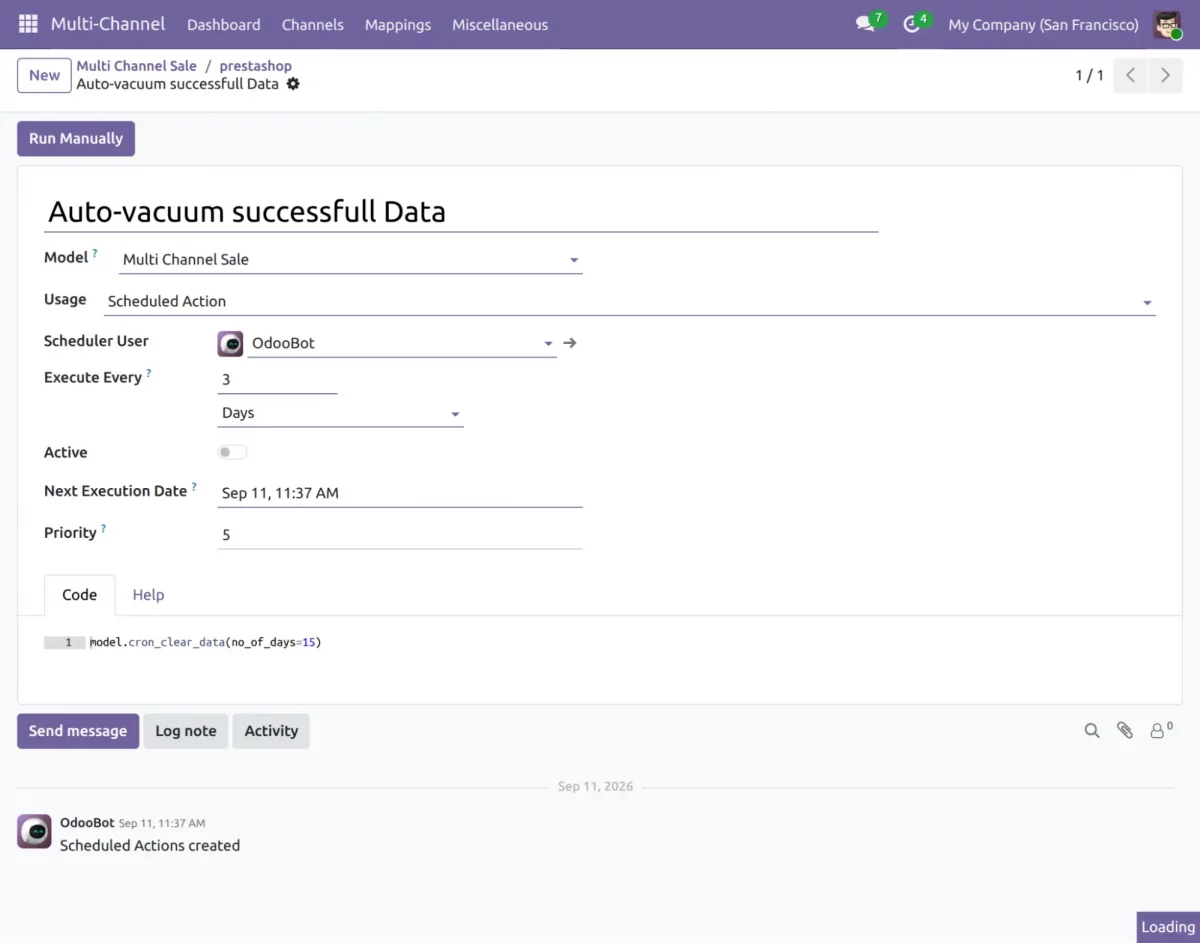
- Enable Clear Sync History to delete all the sync record logs.
- Enable Clear Success Feed to remove all evaluated feed records.
Important Note
API Record Limit controls how many records the connector pulls per API call. Total Record Limit, set higher than that, decides how many records are imported in one cron session.
Once the session hits that number, the job pauses and restarts fresh next time, so large imports happen safely in smaller batches.
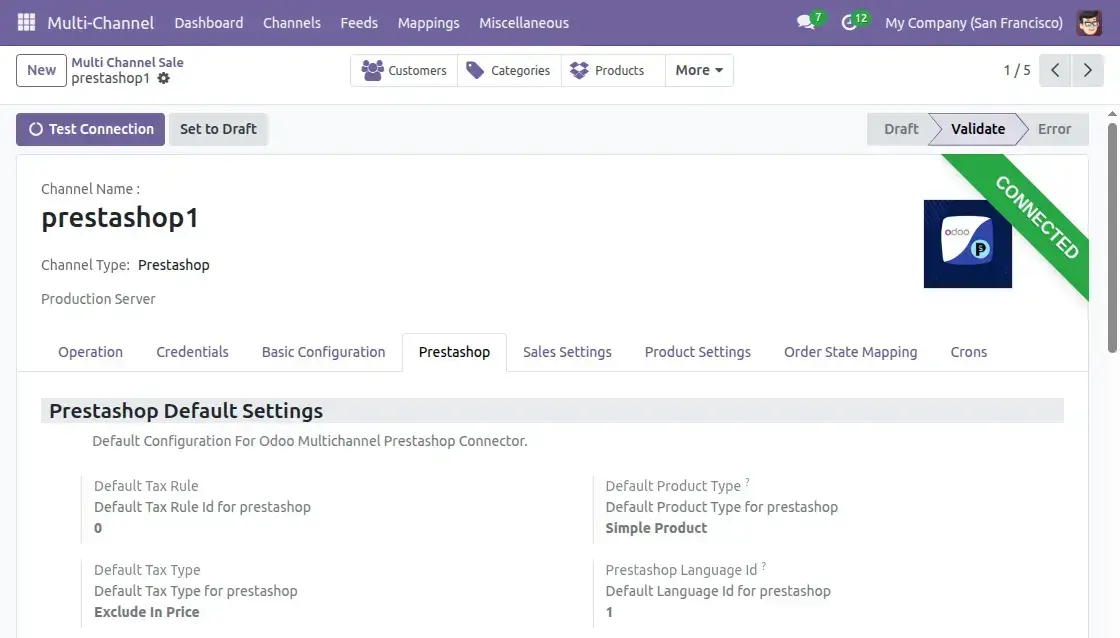
b) PrestaShop Settings
- Default Tax Rule & Tax Type: Apply consistent tax rules when syncing orders and products.
- Default Product Type: Select Simple or Configurable product type for imports and exports.
- PrestaShop Language ID: Set the correct language for product names and descriptions.
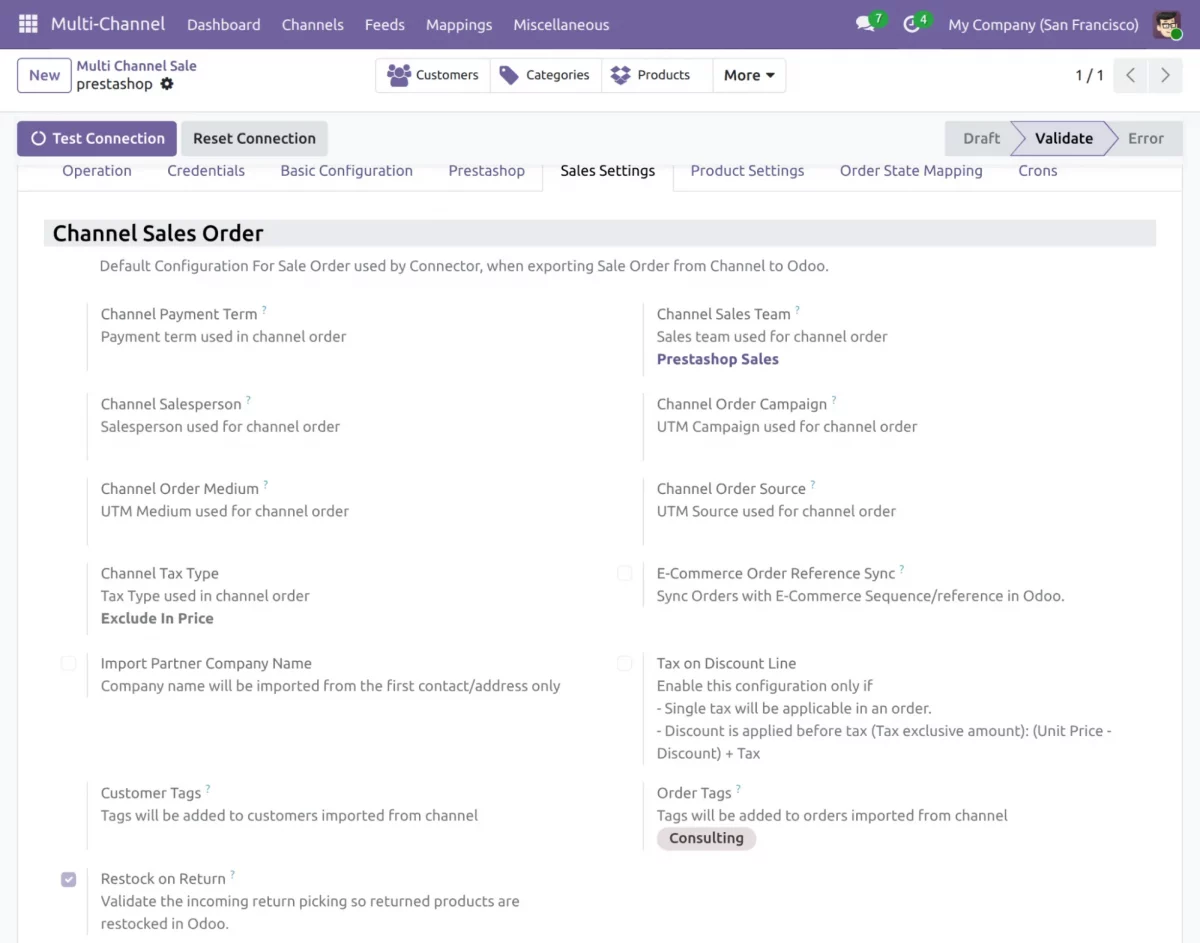
c) Sales Settings
- Payment Term: Set default payment terms for PrestaShop sales orders.
- Sales Team: Next, choose a sales team to manage and handle all PrestaShop orders efficiently.
- Salesperson: Then, assign a default salesperson to track and manage orders from PrestaShop in Odoo.
- Campaign, Medium, and Source: Configure the UTM Campaign for sales orders imported from PrestaShop to Odoo.
- Tax Type: After that, decide whether orders should be imported with tax included or excluded to keep tax data consistent.
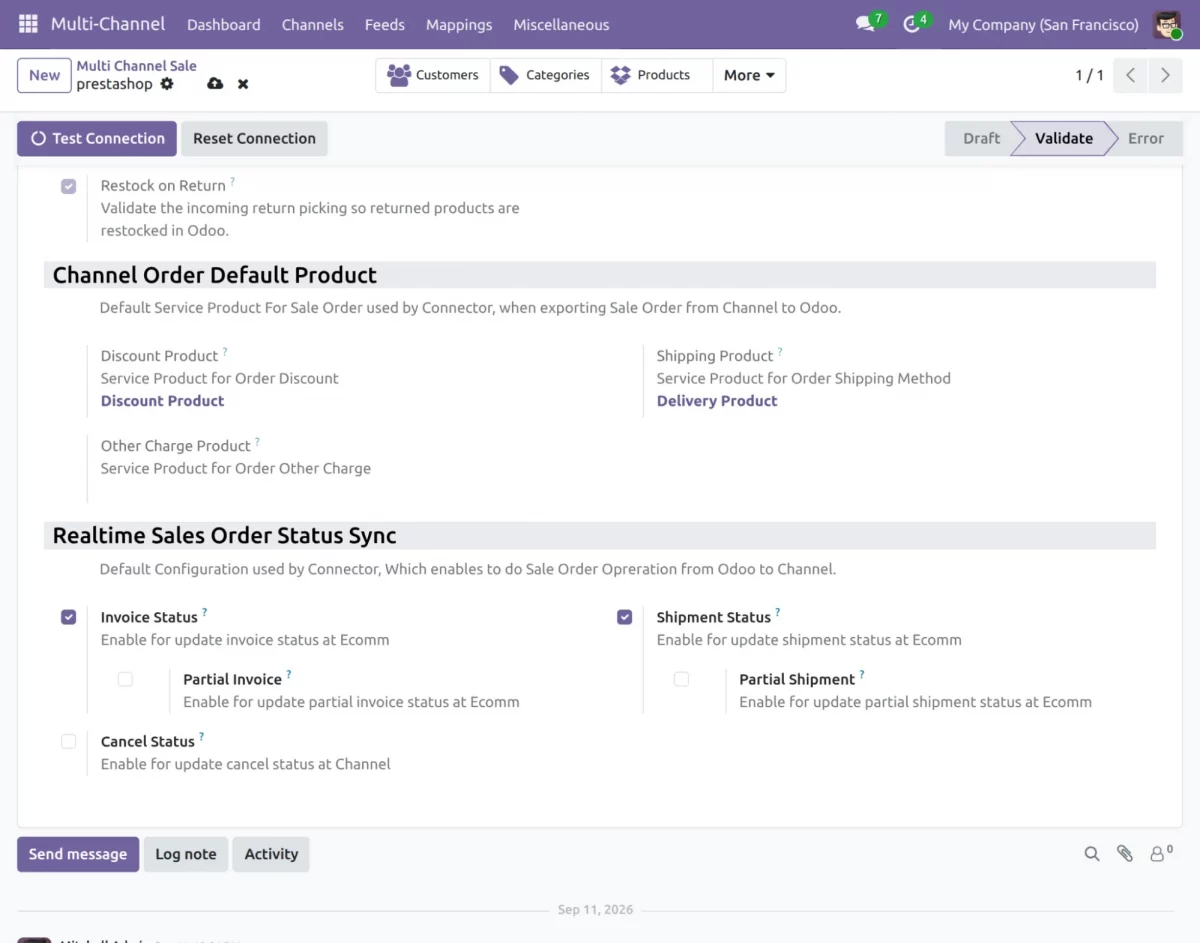
- Discount Product & Shipping Product: Additionally, assign products in Odoo to represent order discounts and shipping charges from PrestaShop orders.
- E-Commerce Order Reference Sync: Finally, enable this option to keep the same order reference number in Odoo as in PrestaShop, so order tracking is simple and clear.
- Customer & Order Tags: Add preferred tags to customer and order records imported from the channel.
- Discount Product: Configure a service product that represents Order Discounts on imported sales orders.
- Shipping Product: Configure a service product that represents Shipping Charges on imported sales orders.
- Real-time Sales Order Status Sync: Enable to automatically sync order statuses (Invoice, Shipment, Cancel) from Odoo to PrestaShop.
d) Product Settings Tab
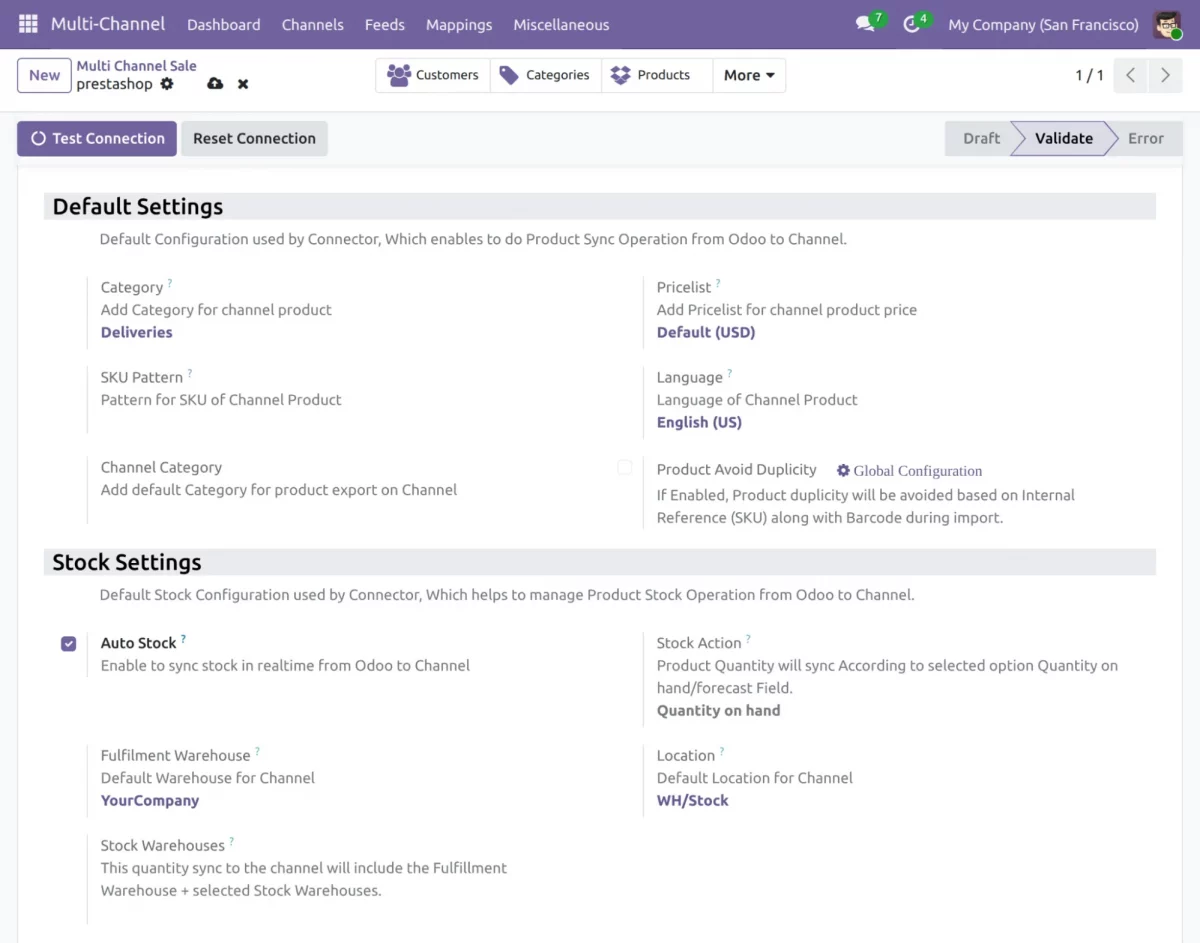
- Category: Configure the default category in which imported products will be stored in Odoo.
- Pricelist: Select the same currency pricelist as for the e-commerce store.
- Language: The selected language will be applied to synced products and other objects.
- Channel Category: While exporting products from Odoo to PrestaShop, they will be stored under the configured channel category.
- SKU Pattern: If a product does not have an SKU, the configured value will be used as its default SKU.
- Enable Avoid Duplicity to prevent duplicate records of products while importing them from PrestaShop to Odoo.
Further, under the stock setting options, configure product stock operations from Odoo to PrestaShop.
- Enable Auto Stock Sync for real-time inventory updates from Odoo to PrestaShop.
- Select Stock Action (Quantity on Hand / Forecasted).
- Set Warehouse and Location for inventory management.
- Enable Avoid Duplicity to prevent duplicate records of product while importing them from prestaShop to odoo.
e) Order State Mapping Configuration
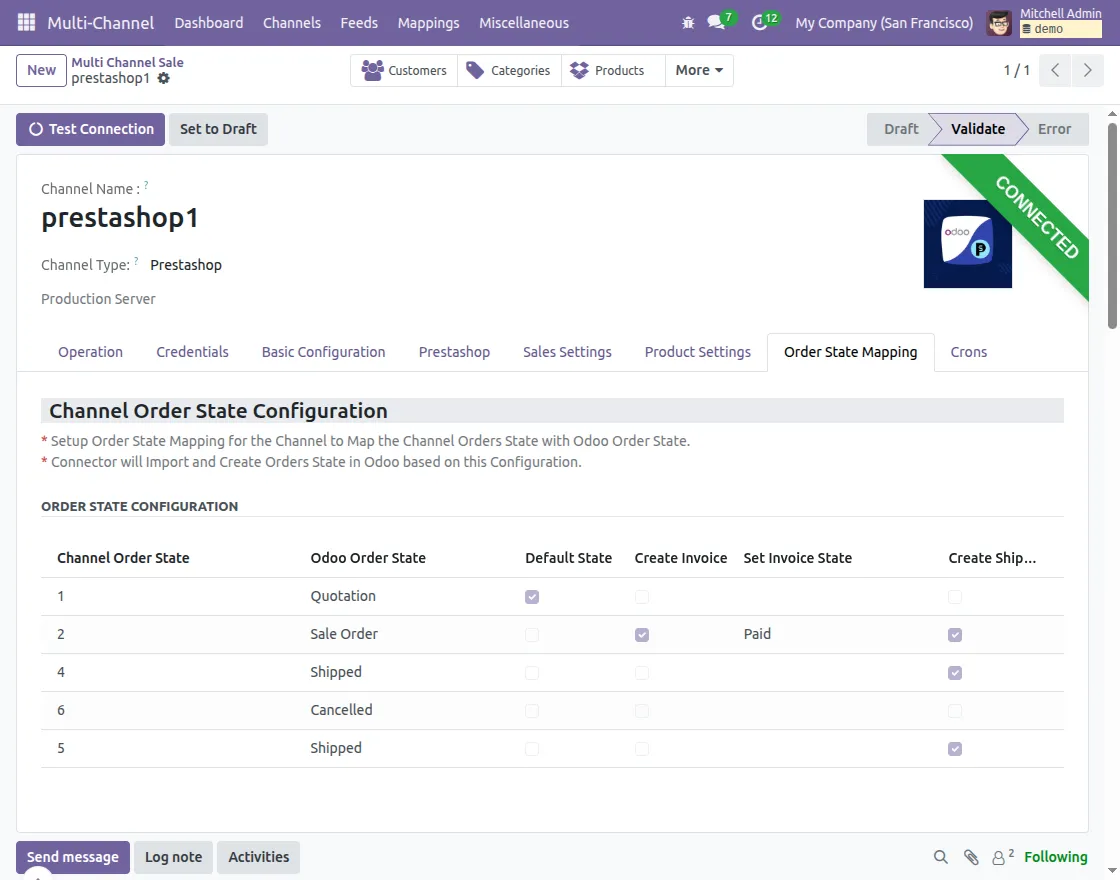
You can map PrestaShop order states with Odoo using the Order State Table. It maintains order flow aligned between both systems.
- Only one state can act as default at a time.
- When Create Invoice is enabled, Odoo will automatically generate an invoice once the order reaches that state.
- Invoice State can be either Open or Paid.
- When Create Shipment is enabled, Odoo automatically creates a shipment once the order moves to that state.
f) Cron Configuration
Cron Configuration tab allows you to schedule automated imports of data (Orders, Products, Customers, and Categories) from PrestaShop to Odoo at defined intervals.
It also enables you to schedule Product export Cron jobs from Odoo to PrestaShop. Click on Configuration in order to configure cron.
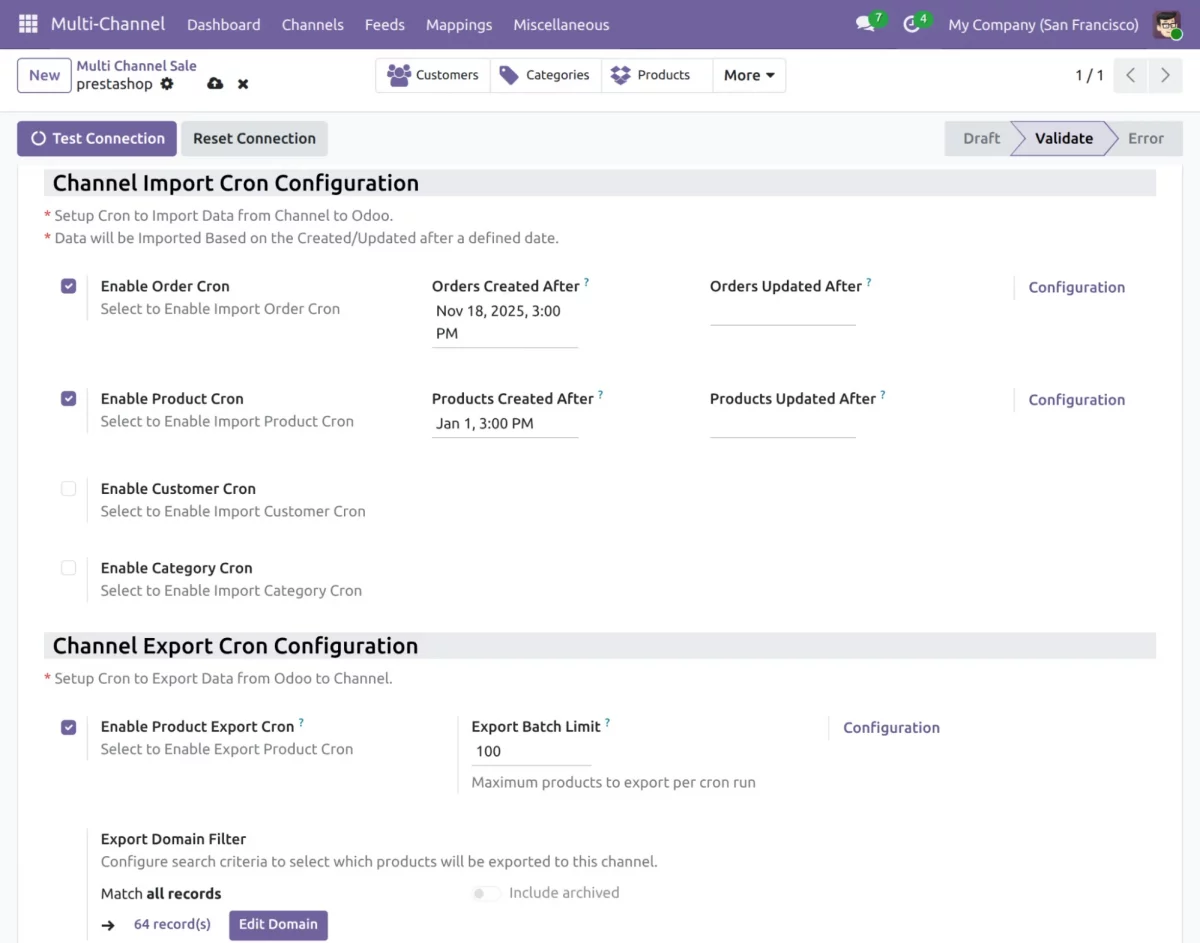
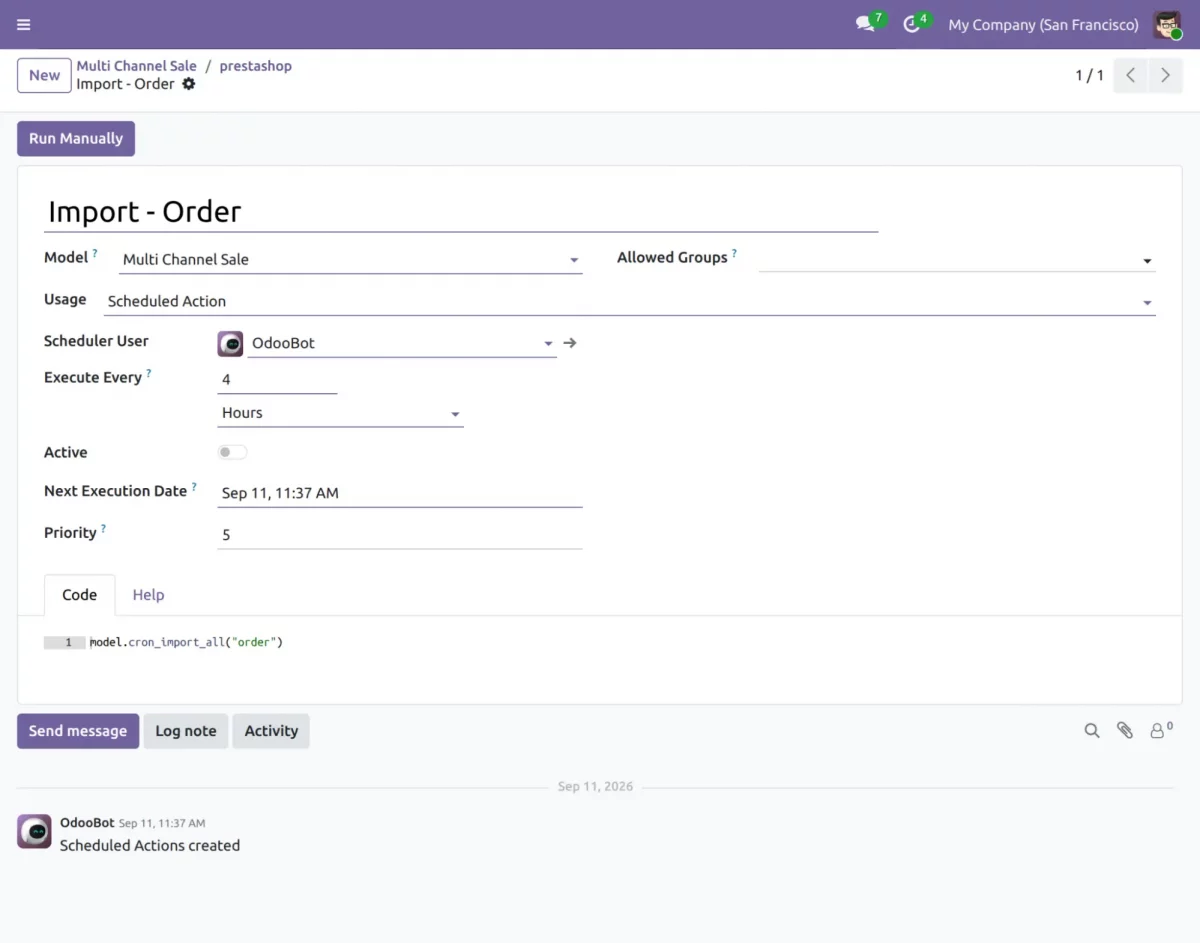
- Scheduler User: Odoo user under whose authority the cron job runs.
- Execute Every: Defines intervals between each execution (e.g., every 4 hours).
- Active: Toggle to activate/deactivate the cron job.
- Next Execution Date: Shows the date and time when cron will next run.
- Priority: Determines the execution order if multiple cron jobs overlap. Lower numbers mean higher priority.
- Created/Updated After: Set a start date to only import records created or updated after this date.
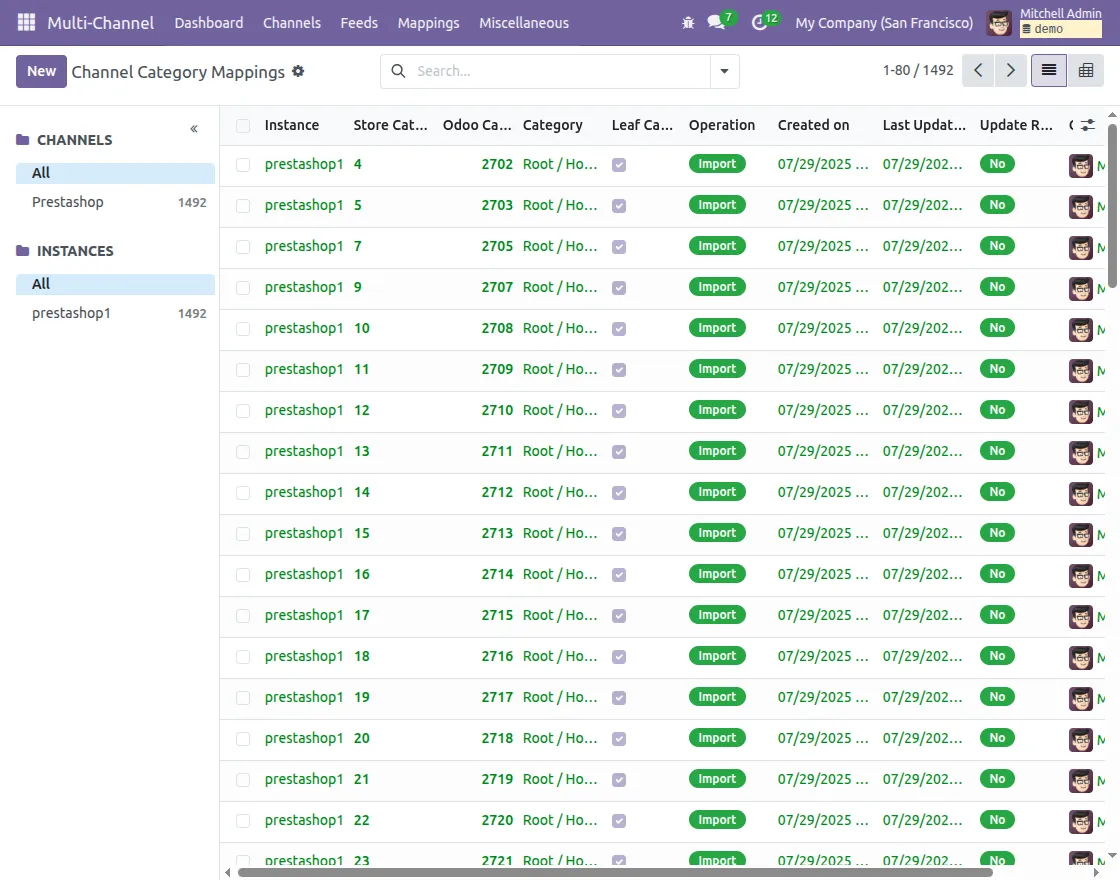
Mappings
- You can view mappings of all imported and exported data (products, categories, orders, customers, shipping methods) directly in Odoo.
- Each mapping page shows a list view, and clicking an entry displays detailed information about that specific mapping.
Feed Evaluation
When data (Products, Categories, Customers, Orders, Shipping Methods) is imported from PrestaShop, it first lands in Feeds.
These feeds act as a separate section before creating mapping records in Odoo. You can choose to evaluate them manually or automatically.
Manual Feed Evaluation
- Go to Multi-Channel> Feeds.
- Select the feed record (Category / Product / Partner / Order / Shipping) you want to process.
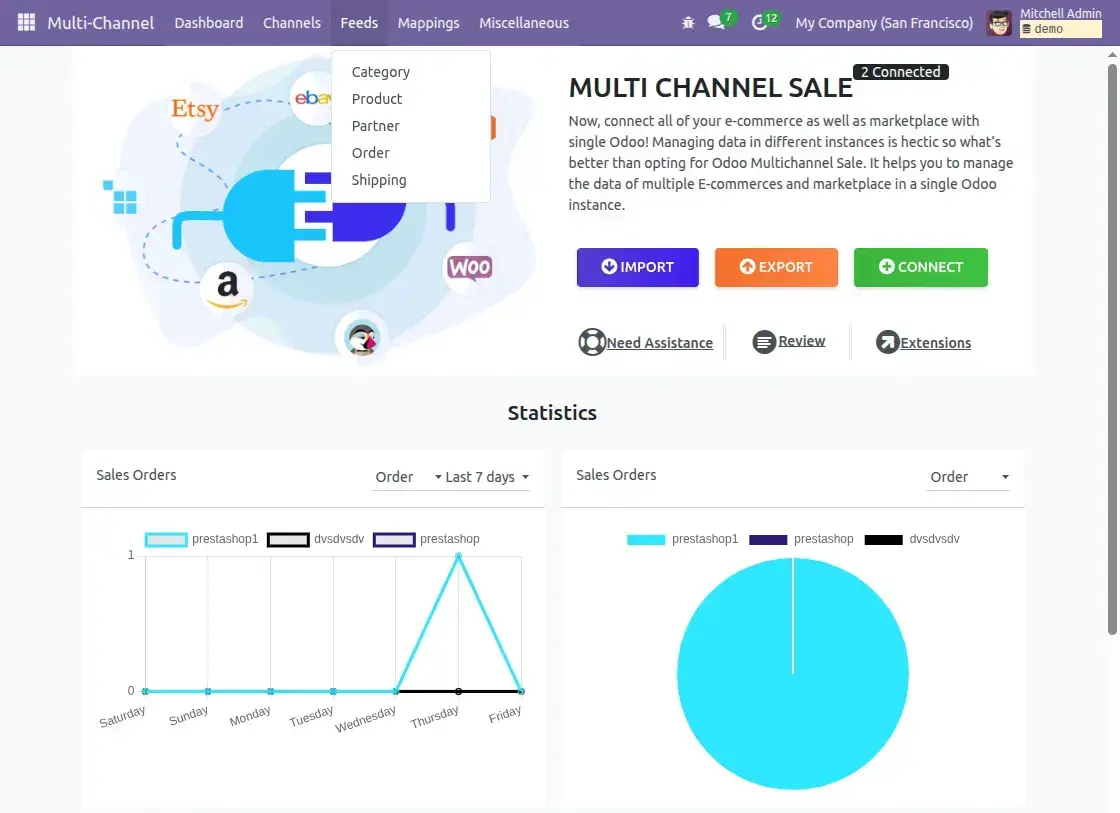
- Review the details (e.g., product attributes, order data, customer information).
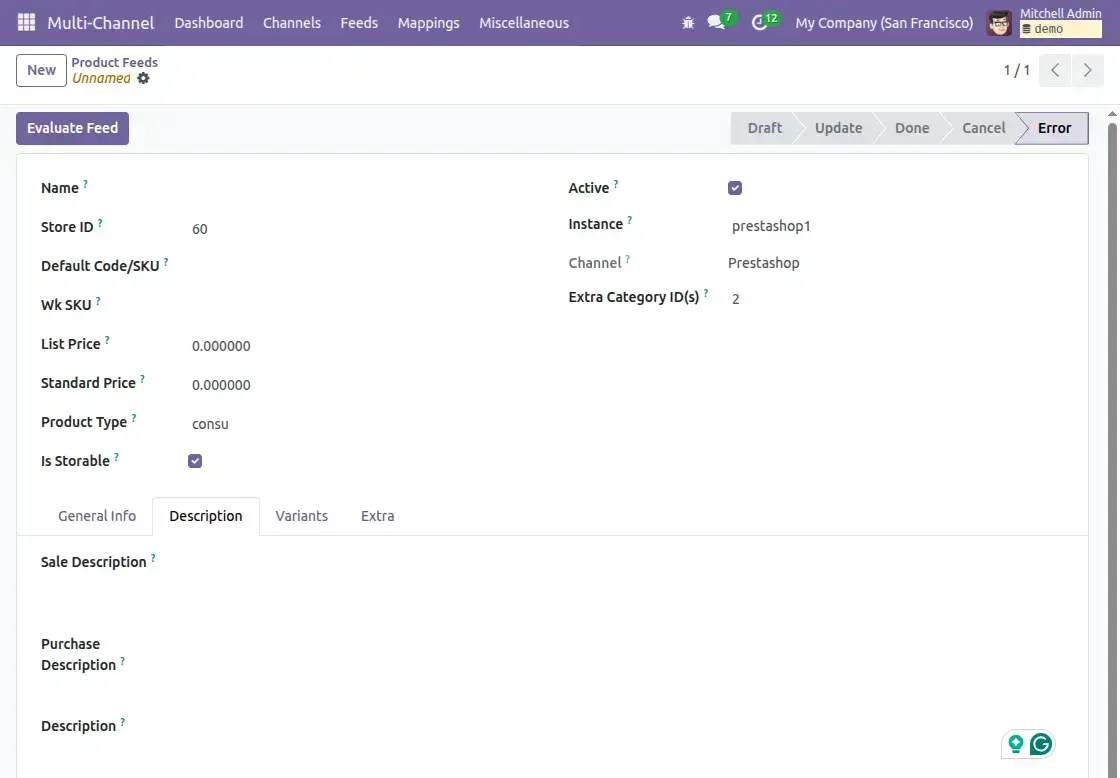
- Click Evaluate Feed to create a corresponding record in Odoo.
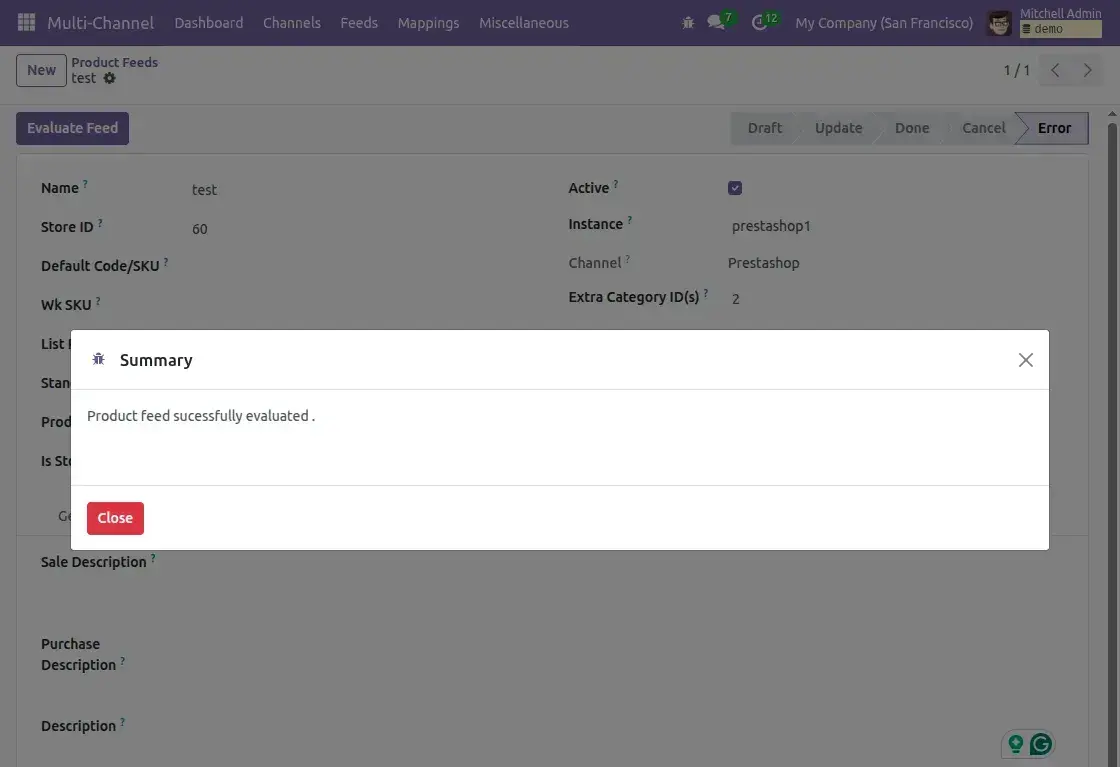
- Once evaluated, the feed will move to the mapping list for future synchronizations.

Automatic Feed Evaluation
- While configuring the PrestaShop instance, enable Auto Evaluate Feed in the Basic Configuration tab.
- Once enabled, every imported feed will be automatically validated and created in Odoo without manual approval.
Import Data Operations from PrestaShop
- Import Categories, Products, Customers, Orders, and Shipping Methods from the Connection’s Operation tab, then click on the import button on the dashboard.
- The import process follows a sequence: Categories, then Products, and then Orders. (Products require categories, and orders require products to be imported first).
- Imports can be filtered using options such as IDs, Since ID, or All, in order to choose whether to bring in specific records or the entire dataset.
- You need to select the Channel Instance, Object, and Filter Type in the import wizard.
Import Product
- To import product records from PrestaShop to Odoo, select the Operation tab.
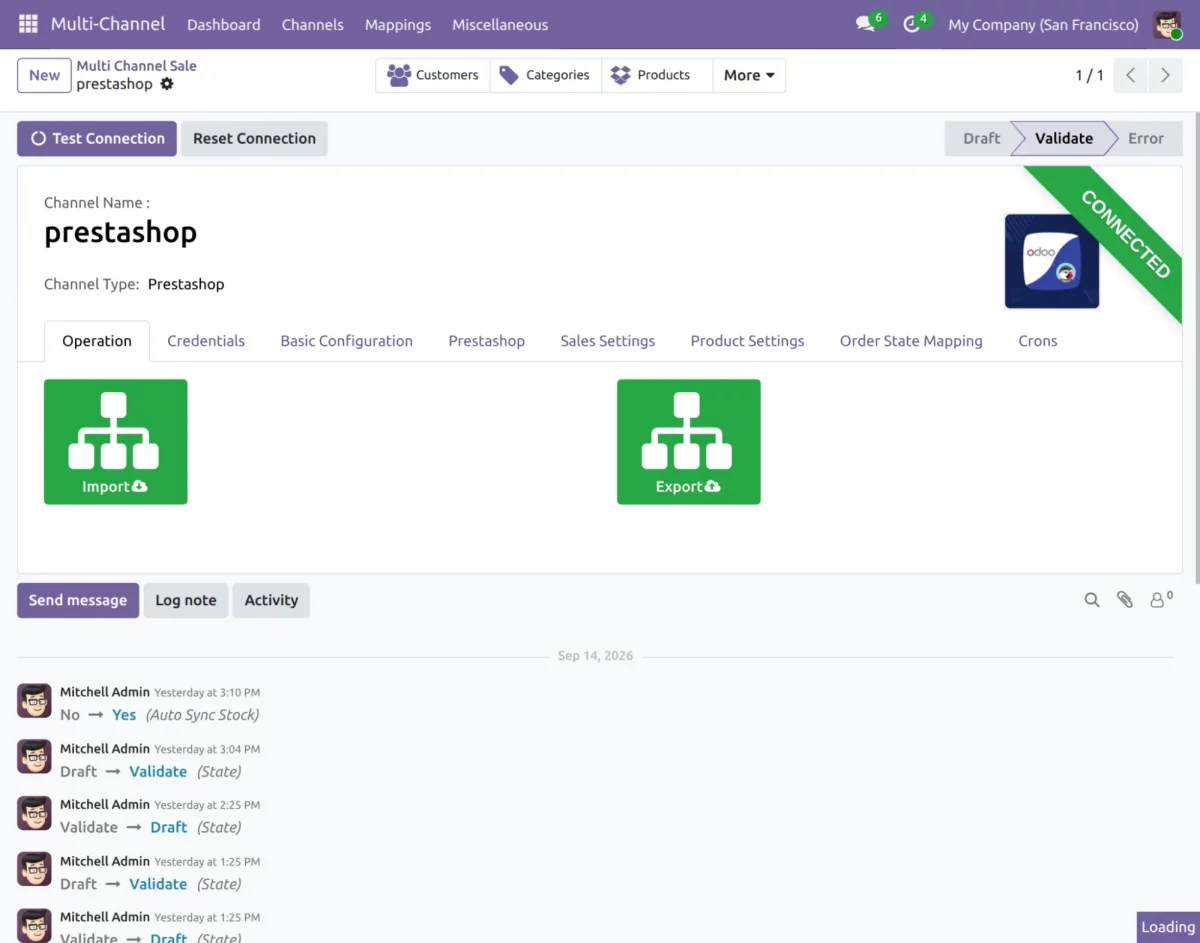
- Click on the Import button> Go to Object> Select Product and filter product records using IDs, since ID or All. Then, click on Confirm Import.
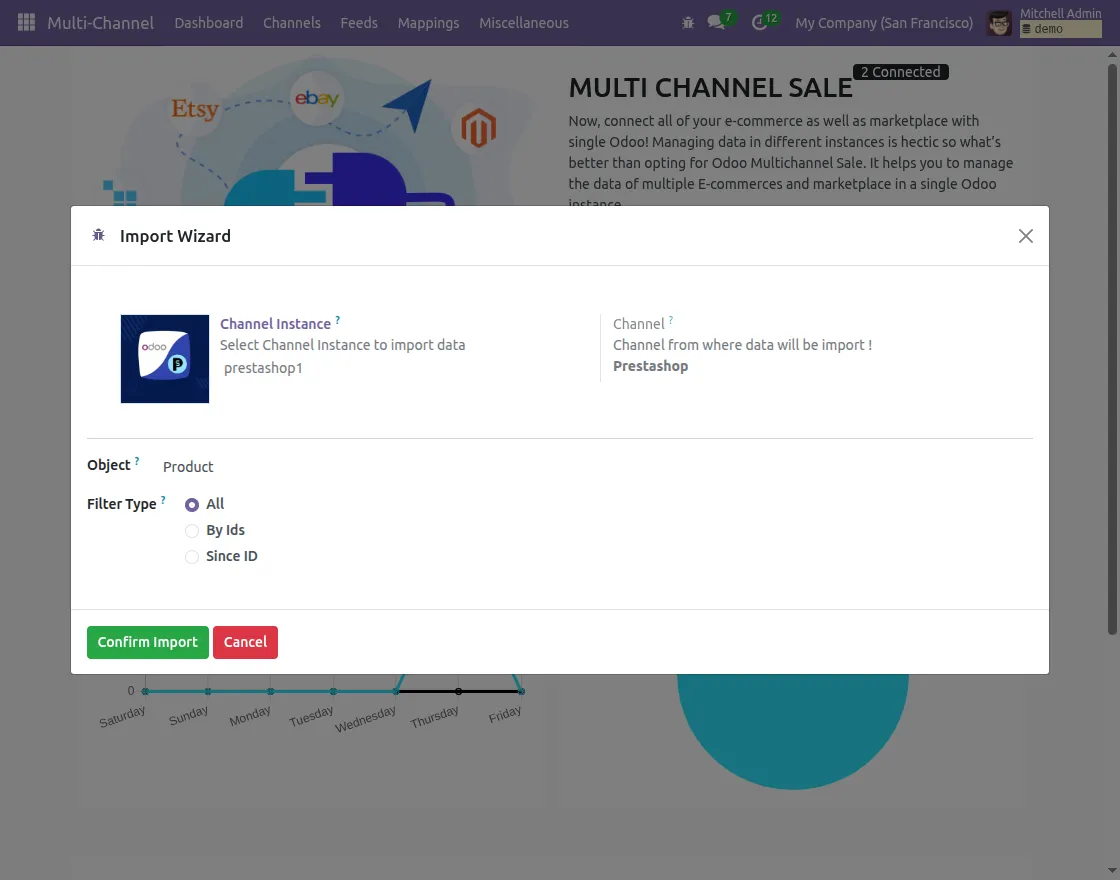
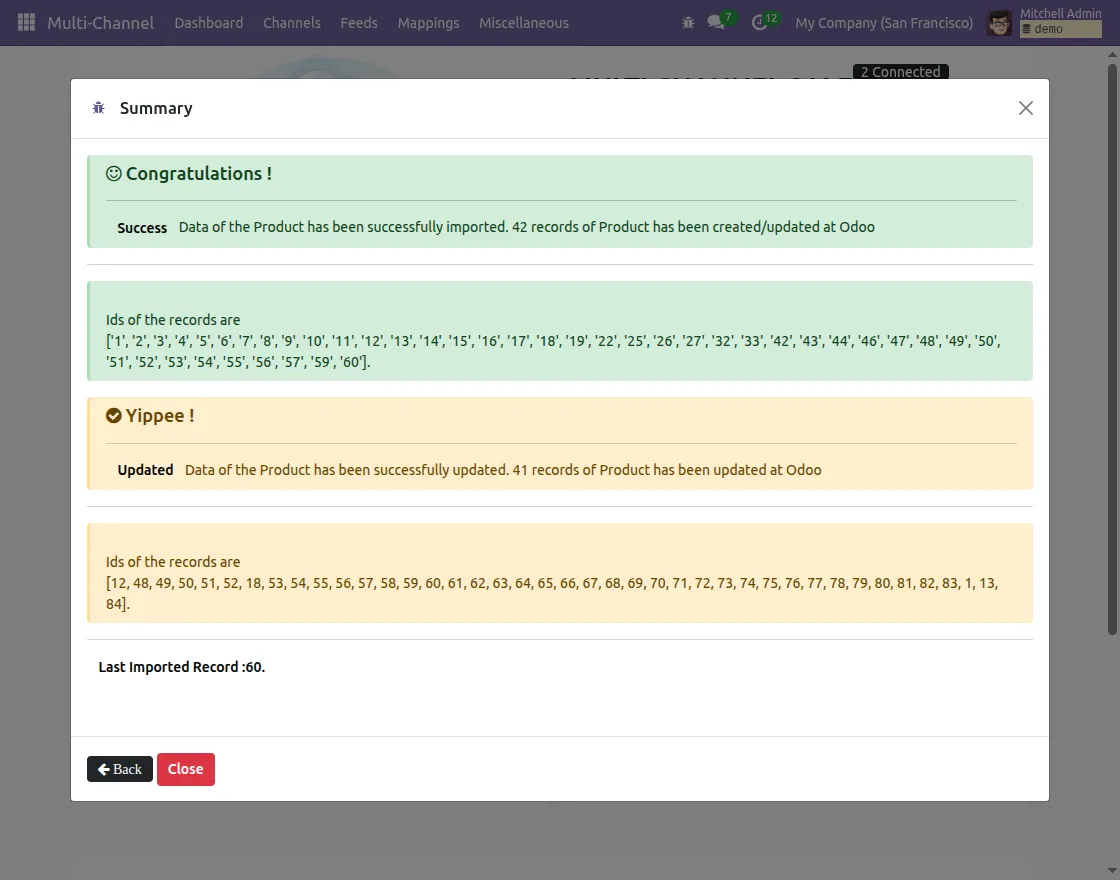
- After that, a successful pop-up message will be shown on your screen.
- To import customers, orders, categories, and shipping methods, follow the same process shown in the product object above.
Export/Update Data to PrestaShop
- Export Categories and Product templates from the Connection’s Operation tab, then click on the export button on the dashboard.
- You can also choose to update instead of exporting and creating a new product or category.
- Select the Channel ID, Object, and Operation in the export wizard.
Export Category
- To run the export and update operation for category records from Odoo to PrestaShop, select the Export button.
- Select update or export operation options, then select category and click on the confirm export button.
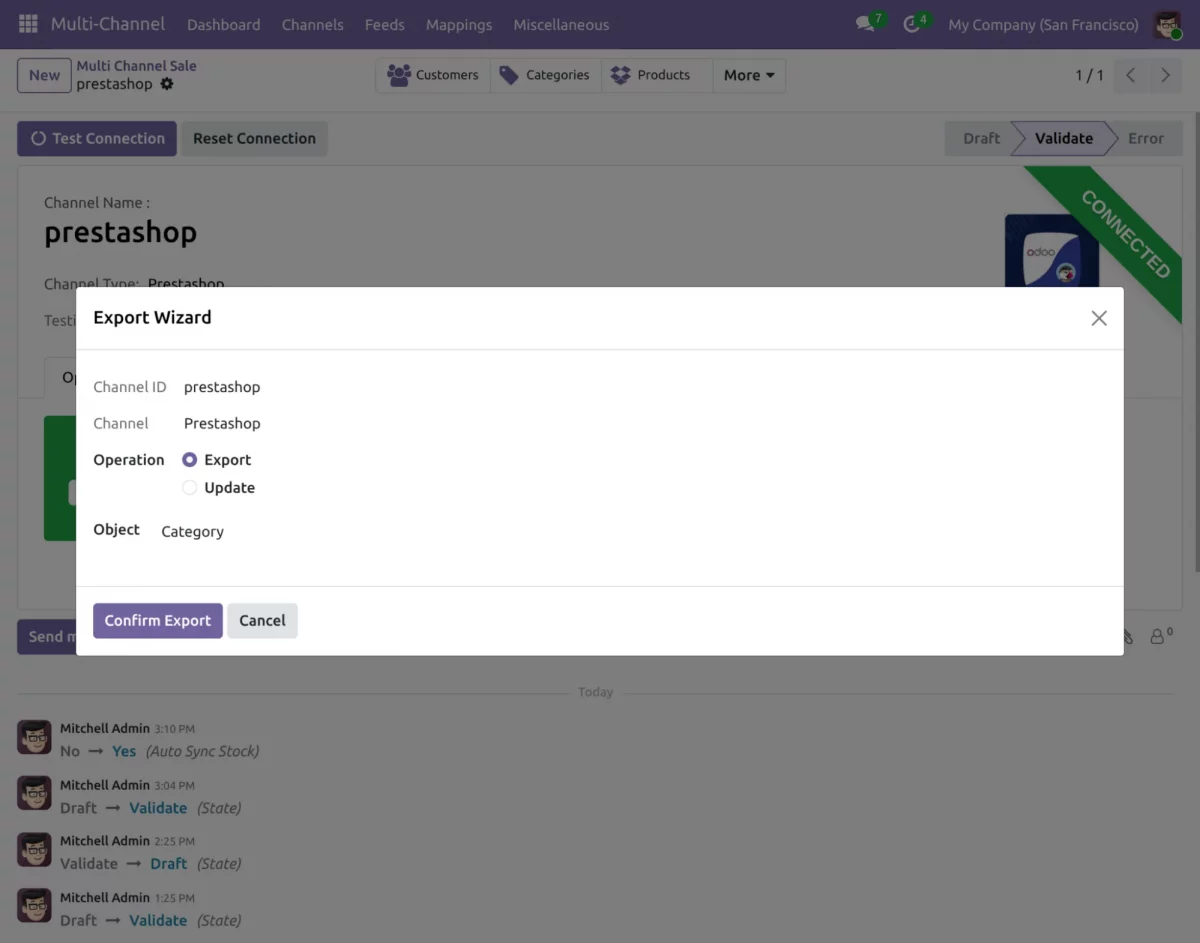
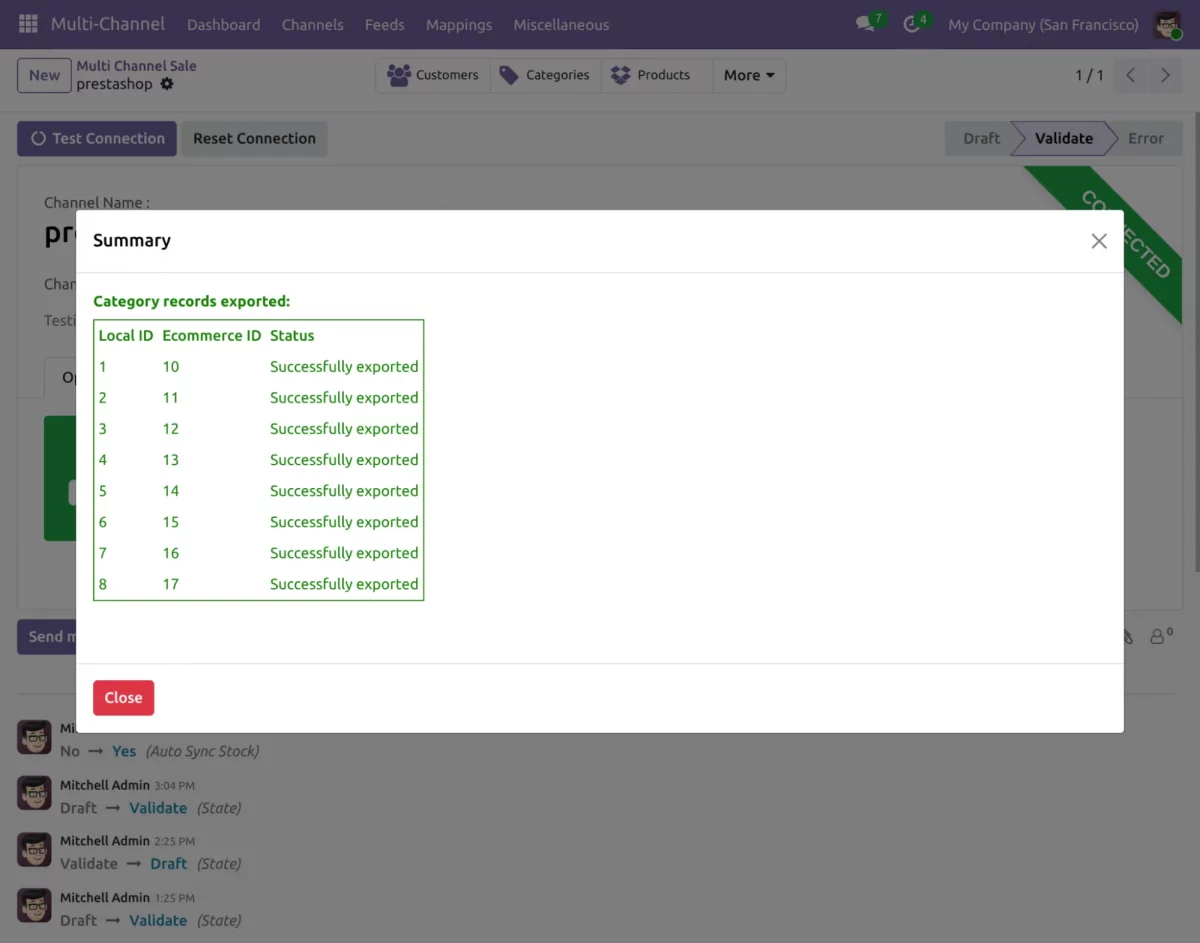
- After that, a successful pop-up message will be shown on your screen. Follow the same process for the Product Template object.
Manage Logs and Sync History
Access Sync History
- Go to the Multichannel module in Odoo.
- Navigate to the Miscellaneous tab> Synchronization History.
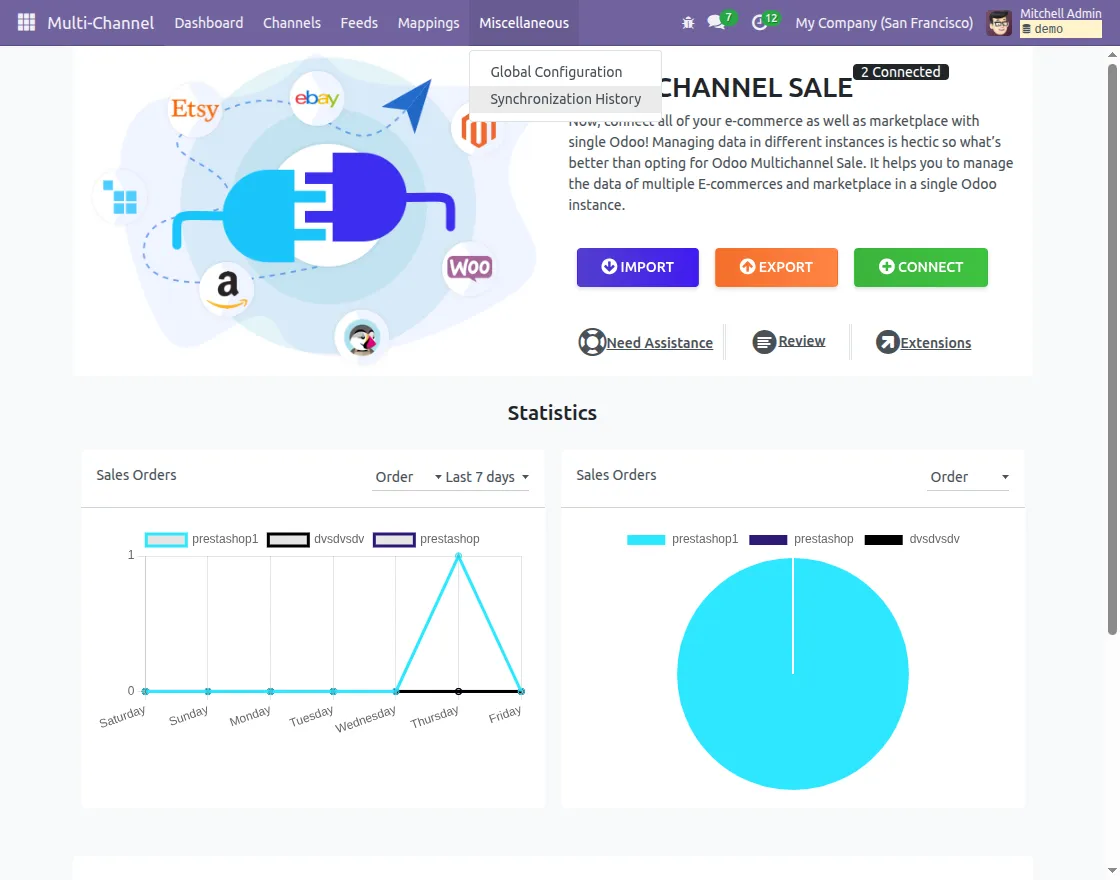
- Here, you can see complete log of all import, export, and synchronization activities.
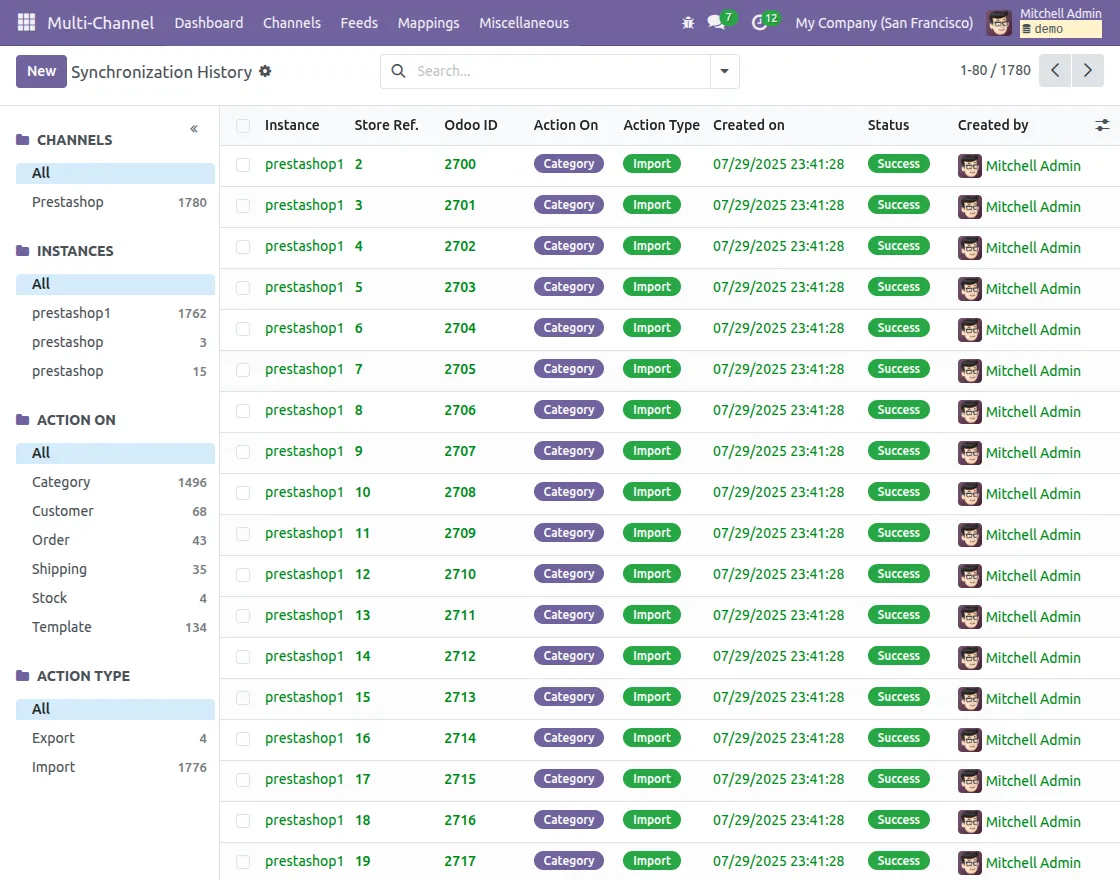
Clear Outdated Logs
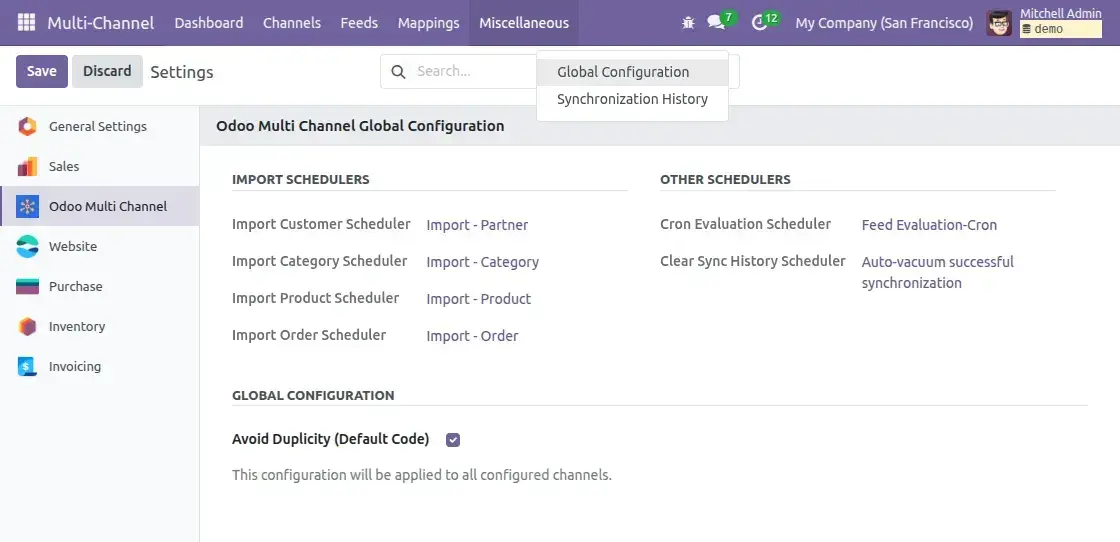
- Click on the Miscellaneous menu and select Global Configuration.
- Here, under the Other Schedulers option, you can schedule cron jobs to delete all the sync history records and evaluated feeds records.
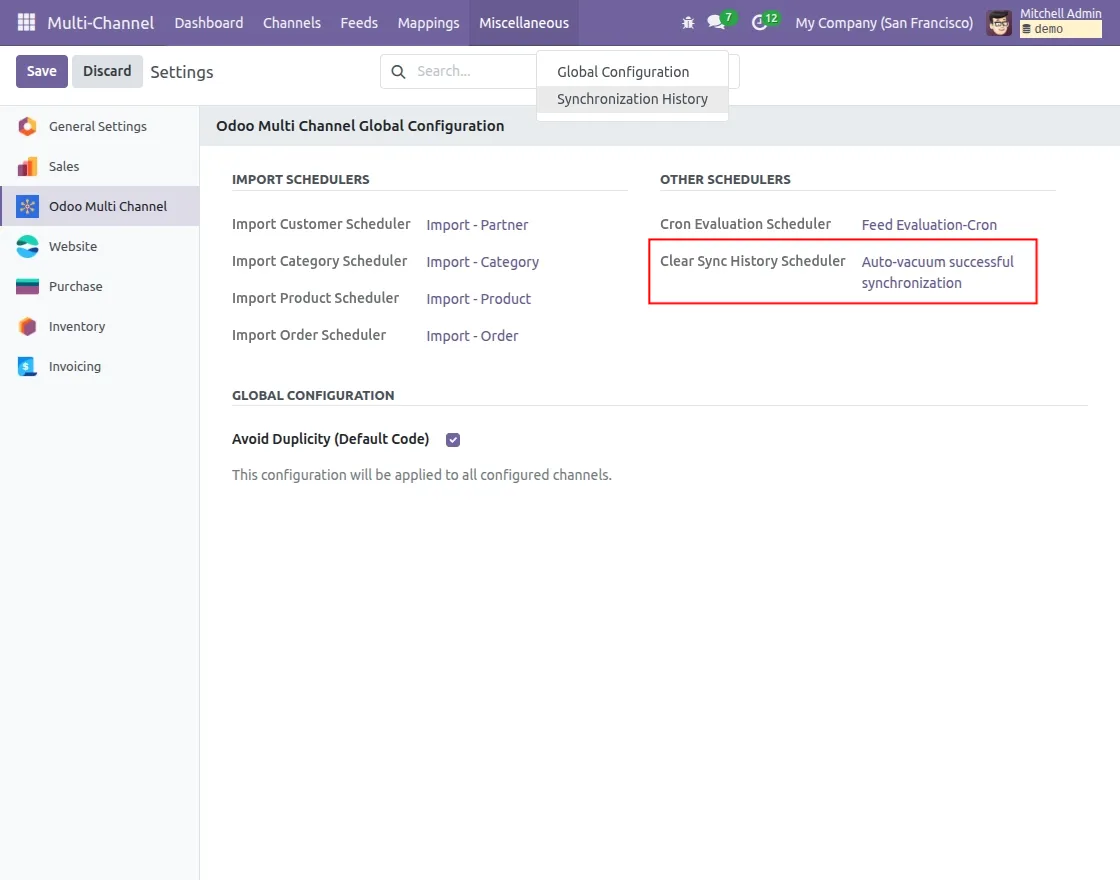
- Configure Clear Sync History Scheduler to schedule deletion of older logs at regular intervals. You can also access this feature directly from the Basic Configuration tab.
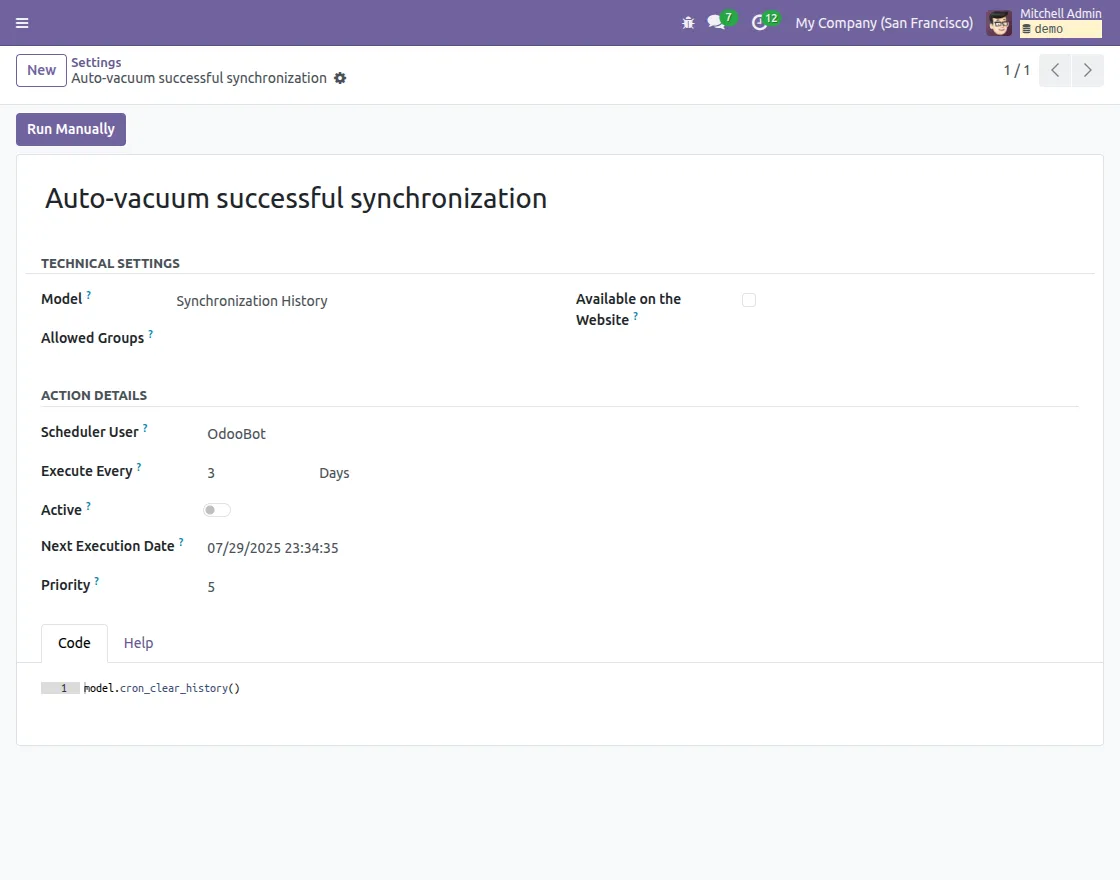
- Follow the same configuration process to schedule cron jobs for removing all the successfully evaluated feed records at regular intervals.
NEED HELP?
Hope you find the guide helpful! Please share your feedback in the comments below. If you still have any issues or queries, please raise a ticket.
For further queries, contact us at our support email: [email protected].
Current Product Version - 1.9.1
Supported Framework Version - Odoo V19, Odoo V18, Odoo V17, Odoo V16

Be the first to comment.