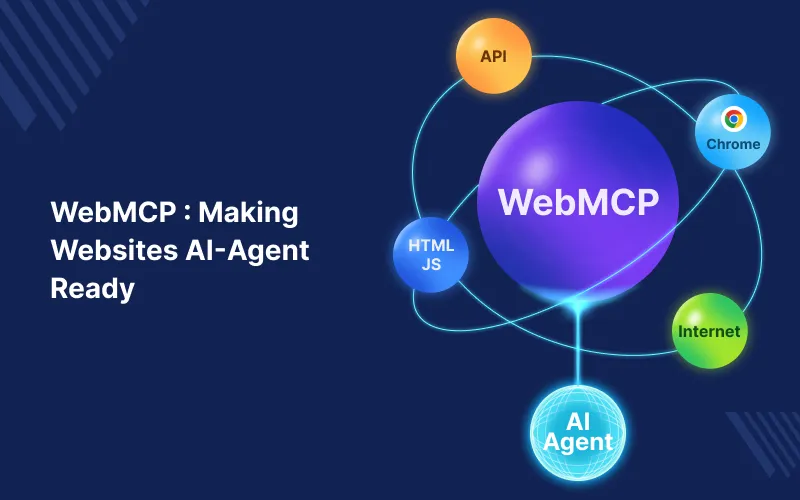
WebMCP (Web Model Context Protocol) is a web based interface which enables websites to unveil their functionality as formal tools.
The web primarily supports human interactions like clicking buttons, filling forms, and navigating pages. However, with the rapid rise of AI agents, this approach is becoming inefficient.
The current interaction between AI assistants and websites is through scraping HTML, parsing of DOM structures or mouse click simulation. It is a slow, cheap and hard process.
What is WebMCP?
WebMCP (Web Model Context Protocol) is a proposed web standard and browser API. It allows websites to provide structured “tools” directly to AI agents.
WebMCP offers machine-readable interface, instead of attempting to read a page by scraping or extracting screenshots, to perform operation.
Core Functionality
With WebMCP, developers can now specify tools and their capabilities that AI agents can discover. AI agents can discover these tools and invoke them to perform various functions.
Developers can integrate tools and their descriptions into existing HTML forms, and browsers convert them into schemas that AI agents can understand and submit.
When workflows become complex, developers can define custom JavaScript functions that agents can invoke directly using navigator.modelContext.registerTool().
Advantages of WebMCP
- Reliability: Since WebMCP has been introduced, scraping with fragile UI has to be used. AI agent can now also make and call function calls that are defined by a schema.
- Efficiency: It lowers the amount of computational overhead and tokens used by up to 67 percent.
- Security: Operations of the same-origin policy of the browser and assumes the active session and authentication of the user.
- BrowserNative Agent Integration: WebMCP operates in the browser environment, unlike the traditional MCP servers.
Applications
WebMCP allows websites to be agent-ready, via machine-readable actions. To complete complex tasks, AI assistants can rely on and do it effectively.
- Travel & Booking: AI agents are able to find, refine and book flights, hotels or car rentals. It lowers cost and greater efficiency.
- E-commerce & Retail: The agents are able to locate products, build certain options (such as size or color), and go through checkout processes without human participation.
- Customer Support: The websites may reveal products that enable the agents to complete technical specifications of support tickets. It guarantee accuracy and quicker process of resolution.
- Enterprise Dashboards (SaaS): Dashboards allow agents to now be able to convert natural language queries to the CRM Platforms into actions, including creating custom reports.
Conclusion
WebMCP marks a big leap toward an AI-native web, allowing developers to create webpages that both humans and intelligent agents can easily use.
WebMCP makes structured tools and machine-readable actions visible, which eliminates the use of delicate methods such as HTML scraping, DOM analysis, or vision-based automation.
Rather than creating complicated workarounds so that AI agents have a chance to learn how to read web interfaces, developers can specify explicit capabilities that agents can learn and utilize.
To developers, it implies easier integrations, more stable automation and lower costs of computation.
With new development of AI agents and their increasingly integration into the daily experience of digital world, such standards as WebMCP might transform the way applications are created in the web.
Additionally, WebMCP demonstrates the possibility of making internet an ecosystem where AI will be able to talk with services as readily as people do currently.vices as easily as humans do today.


Be the first to comment.