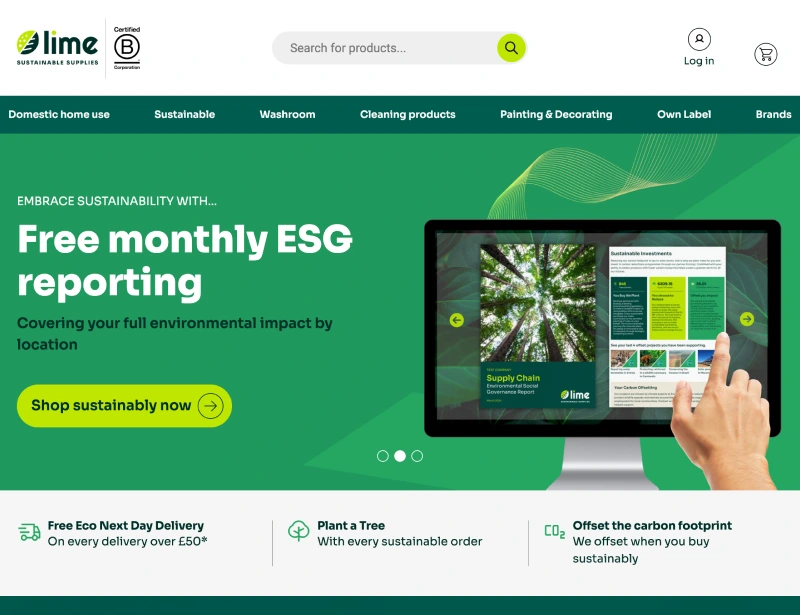
Lime Supply, a UK-based B2B-focused supplier of professional cleaning and facility management products, required a robust WooCommerce Salesforce integration. Their operations serve both business customers and individual buyers, requiring dynamic pricing, customer-specific catalogs, and precise order management across digital and CRM systems.
To support rapid growth and operational accuracy, Lime Supply relied on WooCommerce for online commerce and Salesforce for customer, pricing, and order management. However, as business complexity increased, they needed a deeply customized, bidirectional integration that could handle advanced pricing structures, B2B/B2C account models, and real-time order updates.
Business Challenges in WooCommerce Salesforce Integration
As Lime Supply scaled its operations, managing advanced B2B workflows across systems became increasingly complex.
Managing B2B Pricing & Salesforce Price Book Mapping
Multiple WooCommerce customer groups with unique pricing.
Salesforce Price Books are aligned with WooCommerce customer segmentation.
Bidirectional Order Sync Between WooCommerce and Salesforce
Two-way order updates for quantity, price, tax, and delivery
Accurate recalculation of totals after every modification
B2B & B2C Account Complexity in Salesforce
Person Accounts vs Business Accounts
Sub-accounts, parent-child relationships, and duplicate prevention
Webkul implemented a deeply customized eShopSync WooCommerce Salesforce integration tailored to Lime Supply’s enterprise B2B requirements.
Customer Group–Based Price Book Mapping
Mapped WooCommerce customer groups directly to Salesforce Price Books
Automated creation and update of custom Price Books whenever customer groups change
Created custom price fields on WooCommerce products for each customer group
Enabled bidirectional price synchronization between WooCommerce products and Salesforce Price Books
Advanced Bidirectional Order Management
Enabled two-way order editing from both WooCommerce and Salesforce:
Product quantity updates
Product addition and deletion
Line-level price changes
Dynamic delivery charge updates
Ensured order totals, taxes, and grand totals were recalculated after every update
Custom Tax & Charge Handling
Implemented separate tax mappings for:
Order Tax
Delivery Tax
Added a configurable tax picklist in Salesforce for future scalability
Synced WooCommerce metadata with the Salesforce Order Product “Order Type” field.
B2B & B2C Account Customization
Built custom Salesforce triggers to handle:
Person Accounts vs Business Accounts
Sub-accounts and parent account relationships
Implemented special logic for system users:-
Accounts synced successfully
Contacts intentionally not created
Resolved duplicate account errors, incorrect account mapping, and parent-child mismatches
Product & Variant Sync Enhancements
Synced product variants as individual products in Salesforce
Maintained proper parent–child relationships between products
Prevented Salesforce-to-Woo variant creation to avoid functional issues
Fixed attribute overwrite issues and improved HTML content handling using Rich Text fields
Resolved pricing issues where products were incorrectly syncing with zero value
Order Item & Sync Stability Improvements
Eliminated duplicate order line items caused by repeated trigger execution
Improved sync stability by:
Switching from Action Scheduler to WP-CRON
Adding advanced error handling for Salesforce automation and batch limits
Enhanced logging to reduce false error notifications
Custom Delivery Contact Flow
Implemented logic for accurate delivery contact mapping:
WooCommerce → Salesforce: Create/update delivery contact and link to order.
Salesforce → WooCommerce: Create a Woo user when a delivery contact exists.
Implementation & Deployment
Custom code deployed across Sandbox, Staging, and Production
SSH-based access and Forge environment used for secure development
Conducted multiple mass syncs and re-syncs post-deployment
Provided continuous optimization and production support as requirements evolved
Results
With eShopSync customization, Lime Supply achieved:
Accurate customer-specific pricing across systems
Fully synchronized bidirectional order management
Improved data consistency and automation stability
Reduced manual intervention in pricing, tax, and order updates
Scalable architecture ready for future pricing and customer expansion
Conclusion
By leveraging eShopSync’s flexible integration framework and Webkul’s customization expertise, Lime Supply transformed its WooCommerce–Salesforce integration into a robust, enterprise-ready commerce ecosystem. The solution not only solved immediate operational challenges but also laid a scalable foundation for future growth.
Disclaimer – Please note all the images and content used in this article belong to their respective copyright owners. If you have any issues or complaints related to this article, please send us an email at [email protected].