7 Best PHP-Based ERP Systems Compared
Businesses use ERP systems to manage core operations such as accounting, HR Management, inventory, sales, purchasing, and customer data from one platform.
Choosing an ERP is harder when similar feature lists hide differences in what each system includes and how much setup it needs.
To help you choose, this guide compares seven options, including Webkul’s PHP-based ERP system, Aureus ERP.
You’ll find key features, pros and cons, and use cases to help you shortlist an ERP that fits your daily work.

Comparison of Top 7 PHP-Based ERP Systems
The following table compares the top 7 PHP-based ERP systems based on their target users, key strengths, technology, and licensing.
It helps businesses quickly compare each ERP solution.
| ERP System | Best For | Key Strength | Technology | License |
|---|---|---|---|---|
| Aureus ERP | SMEs and growing businesses | Modern modular ERP | Laravel, PHP | MIT |
| Dolibarr ERP & CRM | Small and medium businesses | Modular ERP and CRM | PHP | GPL-3.0-or-later |
| webERP | Small businesses | Accounting and inventory | PHP | GPL v2 |
| FrontAccounting | Small businesses | Financial management | PHP | GPL v3 |
| Akaunting | Freelancers and small businesses | Accounting and invoicing | Laravel, PHP | BSL 1.1; source-available |
| LiteERP | Developers and small businesses | Lightweight ERP foundation | Laravel, PHP, React | MIT |
| NotrinosERP | Small and medium businesses | Accounting and operations; CRM and HR in 1.0 alpha | PHP, MySQL | GPL-3.0-or-later |
How We Compared These PHP-Based ERP Systems
We reviewed official documentation to compare each platform’s features, license terms, and business fit.
- Feature coverage: We checked which business functions each ERP supports and where its scope is limited.
- Included versus paid functions: We distinguished core features from paid apps and noted license or plan limits.
- Customization options: We reviewed the technology stack and how modules or extensions can support different workflows.
- Release maturity: We checked release notes and distinguished stable releases from alpha features intended for testing.
1. Aureus ERP — Modular ERP Built with Laravel and FilamentPHP
Aureus ERP is an open-source PHP ERP developed by Webkul, built with Laravel and FilamentPHP.
Its modular design lets you start with the tools your team needs and add more as daily work grows.


Key Features and Business Benefits
- Accounting and invoicing: Manage financial records, create invoices, and track payments within the ERP.
- Inventory and warehouses: Track stock across warehouses so teams can see where products are held.
- Sales and purchasing: Manage sales workflows and purchase orders alongside customer and supplier records.
- Manufacturing: Plan production with bills of materials, manufacturing orders, work orders, and work centers.
- Employee management: Keep employee records and manage recruitment, leave requests, and timesheets.
- Project management: Plan work and manage projects within the same platform as other business functions.
- Contacts and customer relationships: Maintain customer, vendor, and partner details for business follow-ups.
- Business reporting: Use analytics and reports to review operations and guide daily decisions.
- Role-based access: Set permissions so staff can access the records and actions their jobs require.
- Language and interface support: Localize the system and use its responsive interface on different screen sizes.
- Modular plugins: Install business modules as needed and extend them to match your workflows.
- API integrations: Developers can connect third-party services and build custom business workflows.
Pros
- MIT license allows commercial use and customization without software license fees.
- Built on Laravel and FilamentPHP, with access to Laravel’s large developer community, documentation, and training resources.
- Modules cover finance, operations, manufacturing, and HR within one platform.
- Custom plugins let developers extend the system around business needs.
- Responsive screens and role-based permissions support work across departments.
Cons
- Newer than some established PHP ERP platforms
- The available ecosystem is smaller than older ERP platforms
Who Should Choose Aureus ERP?
Choose Aureus ERP when your team needs more than invoicing and wants an ERP it can adapt as business needs change.
It is a practical fit for growing businesses with Laravel developers who can build and maintain custom plugins.
The MIT license gives you control over the code, while hosting and implementation still need a budget.
Before rollout, test your local accounting rules and required integrations against real business workflows.
Explore the Aureus ERP live demo to see how its modules fit your team’s daily work.
The official Aureus ERP GitHub repository documents its modules and options for extending the system.
2. Dolibarr ERP System & CRM
Dolibarr is an open-source CRM and ERP platform written in PHP. It uses a modular structure, allowing businesses to activate only the functions they need.

Key Features
- Customer, supplier, and contact management
- Product and service management
- Inventory and warehouse management
- Sales orders and quotations
- Purchase management
- Invoicing and payment management
- Accounting
- Project and time management
- Manufacturing and bill of materials
- Point of Sale
- REST API
- Multi-language and multi-currency support
Pros
- Open-source and highly customizable
- Modular architecture
- Supports ERP and CRM functions in one system
- Can be deployed on-premise or in the cloud
- Large selection of external modules
- Relatively simple to install and use
Cons
- Advanced business requirements may require additional modules or customization
- The large number of modules can make initial configuration time-consuming
- Some specialized enterprise functions may require third-party extensions
Who Should Choose Dolibarr?
Use Dolibarr when you need a PHP-based ERP with ERP and CRM functions, modular features, and flexible deployment options.
It is particularly suitable for businesses that want to start with basic modules and add more as their requirements grow.
3. WebERP
webERP is a web-based open-source ERP and accounting system written in PHP.
It focuses on accounting, inventory, purchasing, sales, and business management.

Key Features
- General ledger and accounting
- Accounts payable and receivable
- Inventory management
- Purchasing
- Sales management
- Customer and supplier management
- Manufacturing
- Multi-language support
- Web-based access
- Business reporting
- Customizable PHP codebase
Pros
- Free and open-source
- PHP-based and customizable
- Web-based access
- Covers core accounting and ERP functions
- Supports multiple languages
- Long development history
Cons
- Self-hosted installations need server administration and regular updates
- Advanced requirements may need custom development
- May require technical knowledge for deeper customization
Who Should Choose webERP?
Choose webERP if your business needs a PHP-based ERP focused on accounting, inventory, sales, and purchasing without the licensing costs of proprietary ERP software.
4. FrontAccounting
FrontAccounting is a free, open-source web-based accounting and ERP system designed mainly for small businesses.
It covers financial management along with purchasing, sales, inventory, and manufacturing.

Key Features
- General ledger
- Accounts payable and receivable
- Sales orders and invoices
- Purchase orders
- Supplier management
- Inventory and stock management
- Manufacturing with bills of materials and work orders
- Fixed asset management
- Multi-company support
- Multi-currency support
- Multi-language support
- Financial reporting
- Budget management
Pros
- Free and open-source
- Strong accounting functionality
- Covers core ERP operations
- Supports multiple companies
- Supports multiple currencies and languages
- Suitable for small businesses
Cons
- Primarily focused on accounting and financial operations
- User interface can feel dated
- Advanced ERP workflows may require customization
Who Should Choose FrontAccounting?
Use FrontAccounting when accounting is the main ERP requirement and you also need inventory, purchasing, sales, and manufacturing functions in the same system.
5. Akaunting
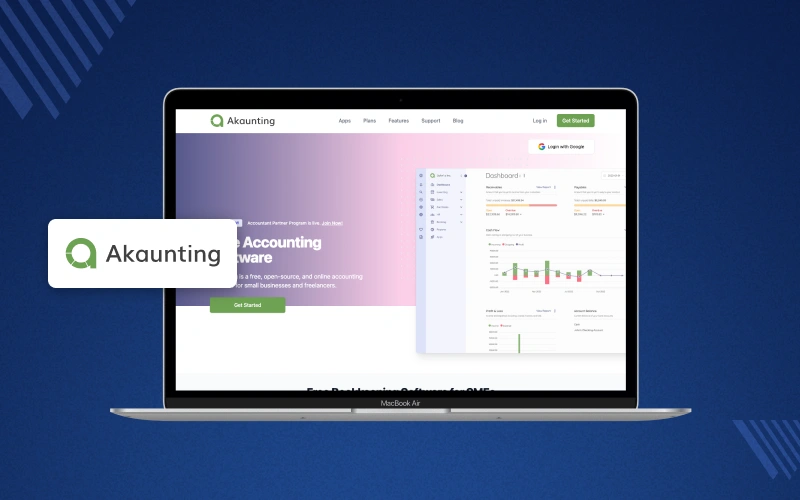
Akaunting is a PHP accounting platform built with Laravel, with source code available under BSL 1.1.
It is designed mainly for small businesses and freelancers, with functions centered on financial management.
Its BSL 1.1 license restricts production use before the stated change date for each version.
Each version moves to GPLv3 after four years, so check the license for the release you plan to use.
Key Features
- Invoicing
- Expense tracking
- Bank account management
- Customer management
- Vendor management
- Online payments
- Multi-company accounting on paid on-premise plans
- Multi-currency support
- Basic financial reports; double-entry accounting through a paid app
- Client portal
- Recurring transactions
- REST API
- Modular app structure
Pros
- Built with Laravel
- Source code available for inspection, with use governed by its license
- Easy-to-use interface
- Self-hosted option
- Modular architecture
- REST API support
- Suitable for small businesses
Cons
- More focused on accounting than full ERP operations
- Apps, including Double-Entry and Inventory, must be purchased separately from on-premise plans
- The free Standard On-Premise plan allows one company, one user plus one accountant, and 1,000 invoices
- Manufacturing and complex supply-chain functions are not its primary focus
Who Should Choose Akaunting?
Choose Akaunting when your main need is invoicing and expense tracking rather than a broad ERP suite.
Check its on-premise plans and app costs before relying on multi-company or double-entry accounting.
6. LiteERP
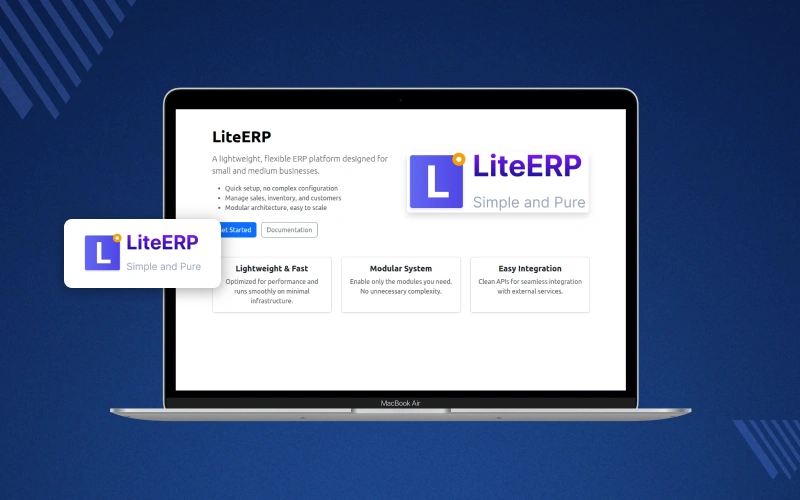
LiteERP is a PHP-based open-source ERP solution built with Laravel and React.
It is designed for small businesses that need core business management features in a lightweight system.
Key Features
- Sales management
- Purchase management
- Inventory management
- Customer management
- Supplier management
- Product management
- Operational invoice management, separate from accounting or statutory e-invoicing
- Accounting integrations through extensions
- Custom reporting and analytics through extensions
- User and role management
- Laravel-based architecture
Pros
- Open-source and customizable
- Uses the Laravel PHP framework
- Lightweight compared with large ERP platforms
- Suitable for small businesses
- Can be modified according to business requirements
Cons
- Smaller ecosystem than established ERP platforms
- Not a standalone accounting, tax-compliant invoicing, or government e-invoice system
- Advanced customization may require PHP development skills
Who Should Choose LiteERP?
Choose LiteERP for day-to-day stock and order workflows when you can handle accounting in a separate system.
Its official documentation places accounting integrations and custom reports in extensions rather than the core.
7. NotrinosERP
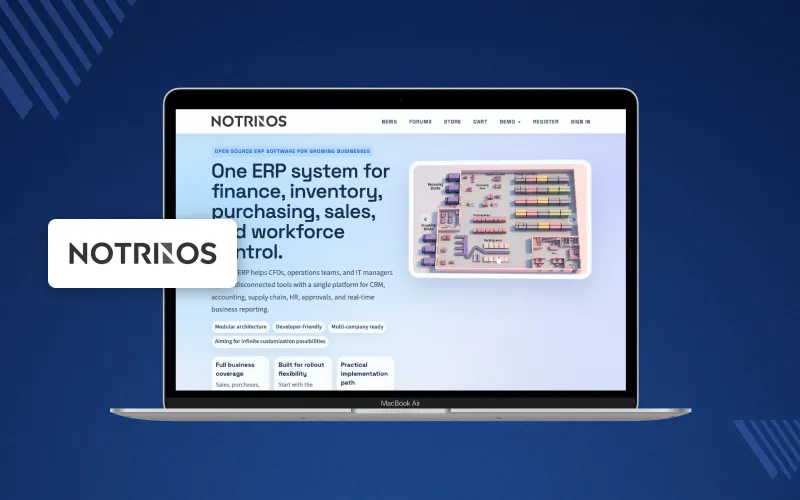
NotrinosERP is a PHP and MySQL-based open-source ERP designed for small and medium-sized businesses.
The 1.0 codebase adds CRM and HR tools, but its tagged release is an alpha intended for testing.
The features below describe that codebase; verify which are available in the release you choose.
Key Features
- Accounting and financial management
- CRM in the 1.0 alpha codebase
- Sales and purchasing
- Inventory and warehousing
- Manufacturing
- Payroll and HR in the 1.0 alpha codebase
- Multi-company support
- Multi-currency support
- Multi-language support
- Multi-level approval workflows in the 1.0 alpha codebase
- User management
- Self-hosted deployment
Pros
- Built with PHP and MySQL
- Open-source under GPL-3.0-or-later
- Covers several core ERP functions
- Supports multiple companies and currencies
- Self-hosted
- Tagged releases and source code are available on GitHub
Cons
- The 1.0.0 alpha is marked for testing only and may contain incomplete or unstable features
- Smaller ecosystem than established ERP platforms such as Dolibarr
- Advanced customization may require PHP development skills
- Businesses may need technical resources for implementation and maintenance
Who Should Choose NotrinosERP?
Consider NotrinosERP for self-hosted accounting and operations if your team can assess the release before rollout.
Review the official release notes before choosing a version; the 1.0 alpha is intended for testing.
Which PHP-Based ERP System Should You Choose?
PHP-based ERP systems help businesses manage accounting, inventory, sales, purchasing, projects, and other operations from a centralized platform.
The right ERP depends on business size, workflows, customization needs, and technical requirements.
Among these options, Aureus ERP is a suitable choice for businesses looking for a modern, modular, and customizable PHP-based ERP.
Built with Laravel and FilamentPHP, it supports core business functions while providing flexibility for further customization and integrations.