Creating Agentic Ecommerce in CS-Cart
Table of Content
Introduction
Agentic Commerce is transforming how modern ecommerce platforms like CS-Cart deliver intelligent, AI-powered shopping experiences by enabling autonomous agents to understand customer intent, automate workflows, and assist throughout the buying journey.
This shift is creating Agentic Commerce, where AI agents actively participate in the shopping journey instead of only answering customer questions.
In this blog, we will discuss:
- What are AI agents?
- What does Agentic Commerce mean?
- OpenAI’s Agentic Commerce Protocol (ACP)
- Google’s Universal Commerce Protocol (UCP)
- Why are E-commerce platforms suitable for agentic commerce?
- Building custom agents for CS-Cart
- CS-Cart AI addons that support agentic ecommerce
- New agent ideas for CS-Cart marketplaces
- The future impact of agent-driven ecommerce
What Are AI Agents?
An AI agent is a software system powered by AI models that can understand a goal, plan steps, use tools or APIs, and take action inside a real system.
Unlike a traditional chatbot, an agent can perform multi-step workflows.
In e-commerce, an AI agent can:
- Understand customer intent
- Reason through tasks
- Access tools and APIs
- Take actions autonomously
- Learn from context and feedback
An agent acts like a digital assistant that can interact with the e-commerce platform to complete useful tasks.
The agent should still follow business rules, permission boundaries, and customer confirmation requirements.
What Is Agentic Commerce?
Agentic commerce refers to e-commerce experiences where AI agents actively participate in the buying and selling process.

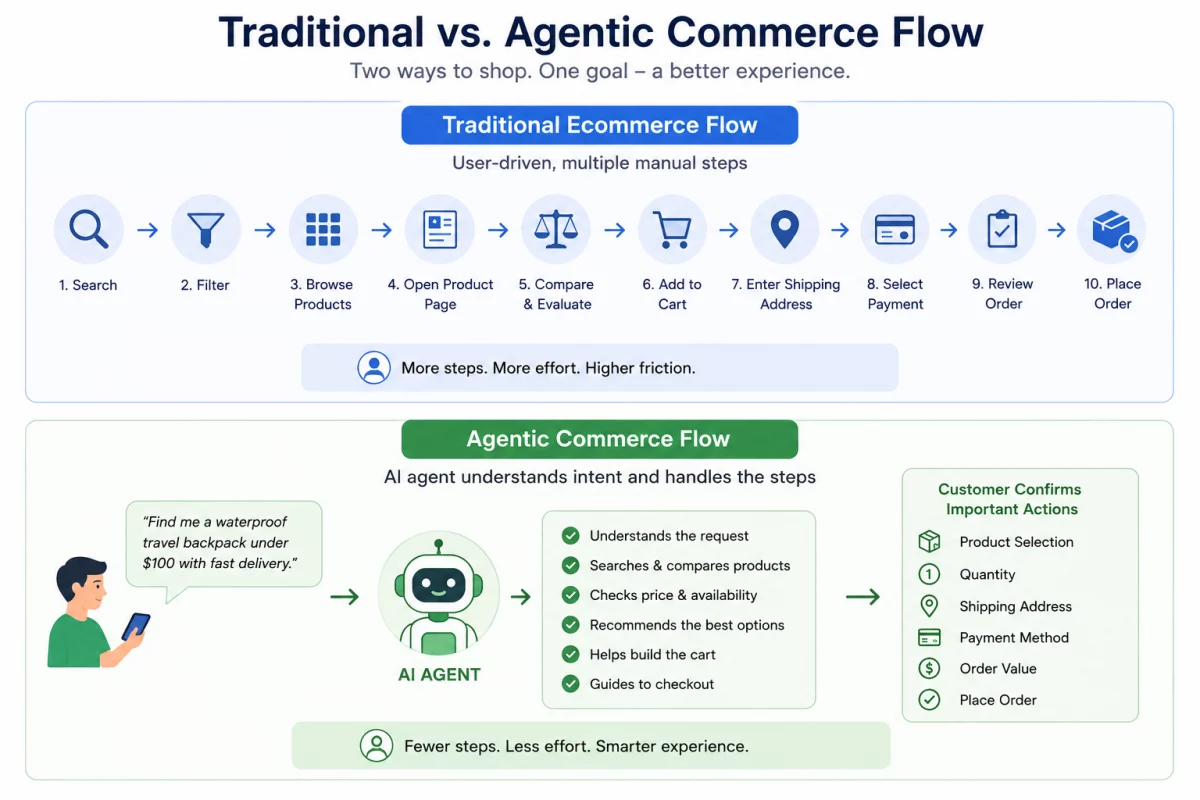
In a traditional ecommerce flow, the customer manually searches, filters products, opens product pages, compares details, adds items to the cart, and completes checkout.
In an agentic commerce flow, the customer can describe the shopping intent directly:
Find me a waterproof travel backpack under $100 with fast delivery.
The agent can:
- Understand the request
- Search the product catalog
- Check price and availability
- Recommend the best options
- Help build the cart
- Guide the customer toward checkout
This reduces friction in the shopping journey.
Agentic Commerce Standards
As agentic commerce grows, common standards are becoming important. AI agents, e-commerce platforms, marketplaces, payment systems, logistics providers, and business services need secure ways to exchange data and coordinate actions.
These standards aim to support:
- Interoperability between agents and platforms
- Secure tool and API access
- Shared commerce context
- Reliable transaction workflows
- Customer consent and trust
- Auditable agent actions
OpenAI ACP: Agentic Commerce Protocol
OpenAI has been working toward enabling AI agents to interact with transactional tools, storefronts, and external commercial systems. The Agentic Commerce Protocol, or ACP, provides a structured framework for agent-led commerce workflows.
ACP focuses on:
- Agent-to-agent communication: Standardizing communication between shopping agents, merchant agents, support agents, and logistics systems.
- Agent-to-tool interaction: Securing API calls and application access for checkout, payment, inventory, order, and support systems.
- Task delegation: Allowing agents to assign and complete commerce tasks such as product discovery, cart preparation, order updates, and support requests.
- Workflow orchestration: Defining multi-step commerce journeys from product discovery to checkout handoff and post-purchase support.
- Context sharing: Maintaining customer intent, cart state, product context, preferences, and order status across the purchase journey.
Benefits of ACP Integration
- Standardized integrations: Common interfaces and reusable modules across commerce platforms and AI agents.
- Better interoperability: Smoother interaction between buying agents, merchant systems, payment tools, and support services.
- Reduced development effort: Less custom code is required to connect agents with storefronts, carts, checkout, and order systems.
- Secure task execution: Controlled transactional actions, secure token handling, permission checks, and customer data protection.
- Better workflow continuity: Shared context across product discovery, cart building, checkout handoff, fulfillment, and support.
Source: OpenAI Instant Checkout
ACP for E-Commerce Platforms
For e-commerce platforms(e.g., CS-Cart), ACP can act as an interaction layer between an AI shopping assistant and the merchant store. Through this interaction layer, agents can:
- Access catalog services: Fetch product details, specifications, images, pricing, and availability.
- Retrieve inventory: Check live stock information to avoid overselling or showing unavailable products.
- Prepare checkout flows: Create checkout sessions, apply eligible discounts, and pass confirmed cart information.
- Process customer requests: Support order tracking, returns, service inquiries, refunds, and exchanges where allowed.
- Coordinate across systems: Pass data between storefronts, payment providers, shipping services, fulfillment systems, and support tools.
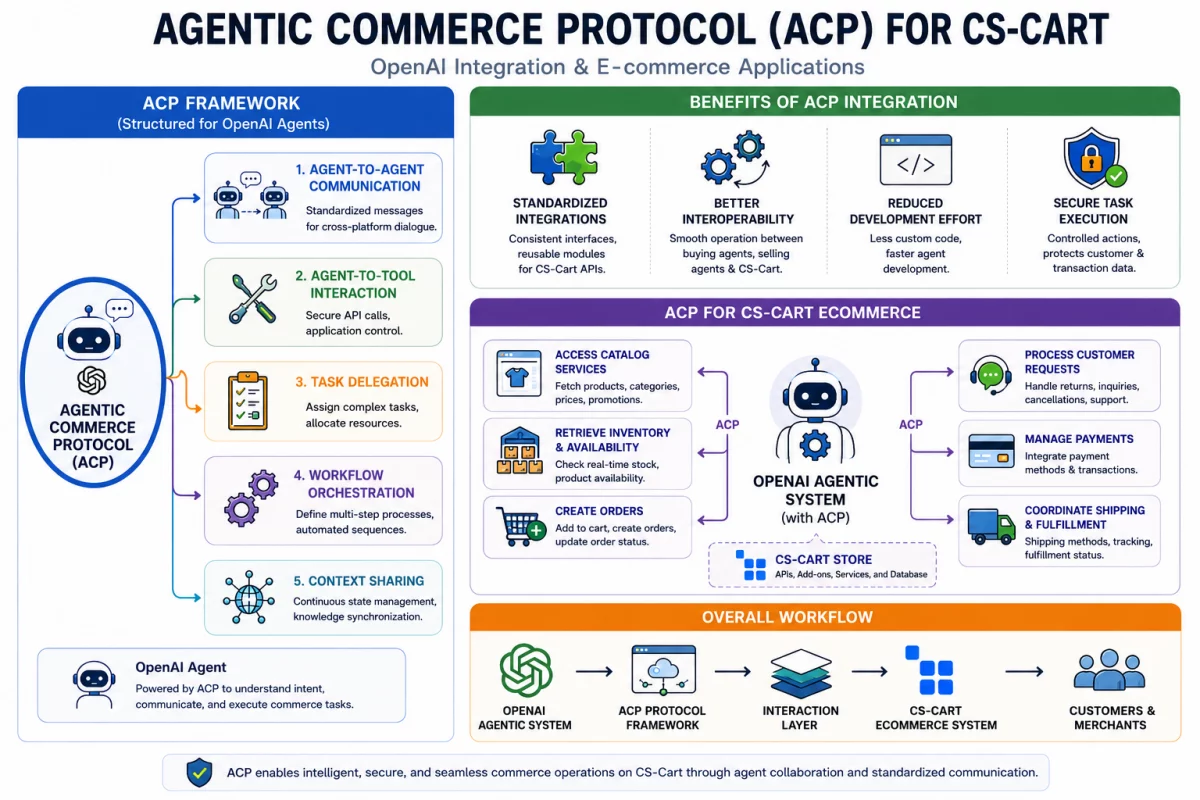
The end-to-end flow is:
- A customer asks the OpenAI shopping agent to find or buy a product.
- The agent discovers CS-Cart products through an ACP-compatible product feed.
- After the customer selects an item, the agent creates a checkout session through the ACP integration layer.
- CS-Cart returns authoritative product, price, stock, tax, shipping, promotion, and checkout information.
- The customer explicitly confirms the order, shipping details, and payment.
- The agent supplies a delegated payment token and submits the confirmed checkout.
- CS-Cart validates the request, processes payment through the configured provider, creates the order, and returns its status.
- Webhook and order-status updates keep the agent and customer informed while CS-Cart handles fulfillment, returns, and support.
The ACP integration layer therefore exposes product feeds, checkout-session endpoints, delegated-payment handling, order submission, and status updates.
Google UCP: Universal Commerce Protocol
Google’s Universal Commerce Protocol, or UCP, is an open standard that enables AI shopping surfaces, merchants, payment providers, and commerce services to communicate through common commerce capabilities.
UCP is designed around broader commerce interactions such as:
- Cross-platform interoperability through shared commerce schemas.
- Capability discovery through a merchant’s /.well-known/ucp profile.
- Standardized checkout, identity, order, fulfillment, discount, and payment interactions.
- Flexible integration through REST, MCP, A2A, or embedded transport bindings.
In a connected ecommerce ecosystem, UCP may support interactions between:
- Shopping services
- Logistics and fulfillment services
- Payment and credential providers
- Marketing and loyalty services
- Customer support and order-management services
These services exchange standardized commerce data while the merchant remains the Merchant of Record and its commerce platform remains the system of record.
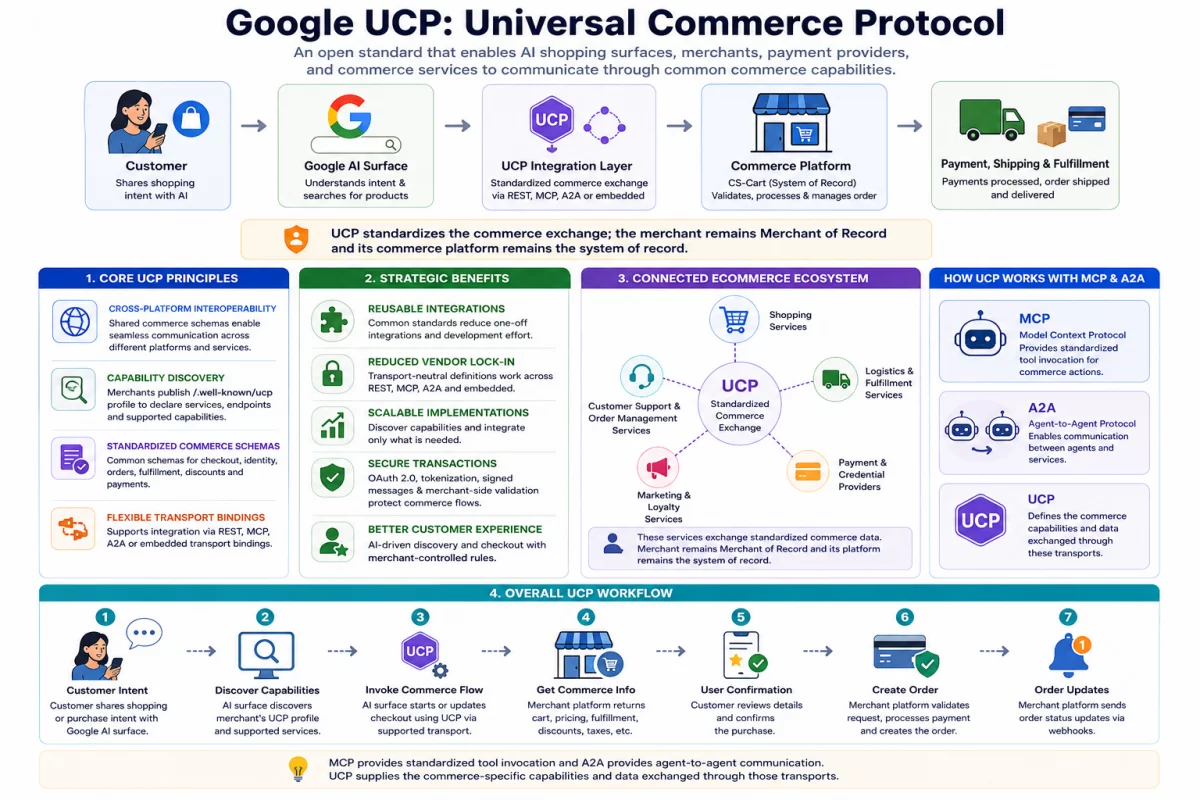
The UCP model can be understood through four connected areas:
- Core UCP principles: Common capabilities, merchant profile discovery, standardized commerce schemas, and flexible transport bindings.
- Strategic benefits: Reusable integrations, reduced vendor lock-in, scalable implementations, secure transactions, and smoother customer experiences.
- Connected ecommerce ecosystem: Shopping, logistics, payment, marketing, and support services can exchange consistent commerce information.
- Overall workflow: The AI surface understands the customer’s intent, discovers merchant capabilities, invokes the supported commerce flow, and receives checkout and order updates.
Difference Between ACP and UCP in Agentic Commerce
| Feature | OpenAI Agentic Commerce Protocol (ACP) | Google Universal Commerce Protocol (UCP) |
|---|---|---|
| Primary goal | Enable buyers, AI agents, and merchants to complete purchases through a standardized agentic checkout flow | Standardize interoperability between commerce platforms, businesses, payment providers, and AI shopping surfaces |
| Focus area | Product feeds, checkout sessions, order updates, and delegated payments | Checkout, identity linking, orders, payment token exchange, fulfillment, discounts, and capability discovery |
| Core purpose | Connect an AI shopping experience to the merchant product and checkout systems while keeping the merchant in control | Provide reusable commerce capabilities and schemas that different platforms and businesses can implement |
| Ecosystem | Buyers, AI shopping agents, merchants, commerce platforms, and payment providers | AI shopping surfaces, merchants, marketplaces, retailers, payment providers, credential providers, and fulfillment services |
| Communication model | The agent calls merchant checkout endpoints and exchanges structured checkout, payment, and order data | Platforms and businesses negotiate supported services and use REST, MCP, A2A, or embedded transport bindings |
| Discovery mechanism | Merchants provide a product feed and expose ACP-compatible commerce endpoints | A public /.well-known/ucp profile declares versions, services, capabilities, endpoints, payment handlers, and signing keys |
| Transaction support | Designed for product discovery, checkout session management, purchase completion, delegated payment, and order updates | Designed for end-to-end commerce capabilities including checkout, identity, payment, fulfillment, discounts, and order lifecycle updates |
| Context sharing | Exchanges the customer-approved product, cart, shipping, payment, and order context are required to complete a purchase | Uses standardized commerce payloads so participating systems interpret checkout and order state consistently |
| Security | Explicit customer confirmation, minimal data sharing, purpose-limited payment tokens, and merchant-side order validation | OAuth 2.0 identity linking, tokenized payments, signed messages, public keys, consent, and merchant validation |
| Typical use cases | AI product discovery, conversational checkout, delegated payment, purchase completion, and order-status updates | AI shopping, native or embedded checkout, account-linked experiences, fulfillment selection, discounts, and post-purchase order updates |
| CS-Cart integration example | Publish a CS-Cart product feed, create checkout sessions, accept delegated payment tokens, create orders, and return status updates | Publish a UCP profile and expose supported CS-Cart checkout, identity, fulfillment, discount, payment, and order capabilities |
| Scope | Focused on agent-assisted product discovery and purchase completion | Broader modular commerce standard covering multiple capabilities, extensions, and transport options |
| Industry impact | Makes merchant products and checkout available within compatible AI shopping experiences | Reduces one-off commerce integrations across retailers, marketplaces, AI surfaces, and service providers |
| Current status | Open specification covering product feeds, agentic checkout, and delegated payments, with Instant Checkout as an implementation | Evolving open standard: Google’s implementation begins with direct buying, while additional capabilities remain on its roadmap |
Why CS-Cart Is Ideal for Agentic Commerce
CS-Cart already provides many building blocks required for agentic ecommerce:
- Product management
- Seller or vendor management
- Inventory management
- Cart and checkout workflows
- Order management
- Extension or addon architecture
- REST API support
- Customization hooks and APIs
These capabilities make CS-Cart a strong backend for AI agents
Agents can use CS-Cart services to:
- Search products
- Manage cart flows
- Retrieve customer and order information
- Support vendors
- Generate reports
- Improve product content
- Guide customers through shopping and support workflows
With modular extension development, these features can be extended without changing the platform core.
Building Custom Agents in CS-Cart
Custom agents can be built around CS-Cart services and business workflows. For modern addon development, Scheme 4.0 is suitable because it supports service classes, controllers, hook handlers, and cleaner separation of business logic.
1. Product Discovery Agent
Purpose:
Help customers find products through natural language
Example:
Show me black running shoes under $100 with good ratings.
Agent actions:
- Parse customer requirements
- Search the CS-Cart catalog
- Apply filters
- Rank products
- Present recommendations
- Ask follow-up questions when needed
Benefits:
- Better product discovery
- Reduced search abandonment
- Faster customer decisions
- Higher conversion potential
2. Cart Optimization Agent
Purpose:
Increase average order value and help customers build better carts.
Agent actions:
- Analyze cart contents
- Recommend accessories
- Suggest related products
- Apply eligible coupons
- Suggest bundles or alternatives
Example:
The customer adds a camera.
The agent suggests:
- Memory card
- Camera bag
- Tripod
- Lens cleaner
3. Customer Support Agent
Purpose:
Automate common customer support operations
Capabilities:
- Product questions
- Order tracking
- Return policy answers
- Refund status
- FAQ responses
- Warranty information
CS-Cart integration:
- Orders
- Customers
- Shipments
- Product data
- Store policies
- Return workflows where available
4. Vendor Assistant Agent
Purpose:
Help CS-Cart Multi-Vendor sellers manage product and order work.
Capabilities:
- Improve product titles
- Rewrite product descriptions
- Suggest missing attributes
- Translate product content
- Highlight low-stock products
- Summarize recent orders
- Recommend listing improvements
Example:
Help me improve this product listing before publishing it.
5. Admin Reporting Agent
Purpose:
Assist store admins and marketplace owners with business insights
Capabilities:
- Sales analysis
- Product performance summaries
- Vendor performance summaries
- Customer behavior insights
- Search and recommendation performance
- Operational reports
Example:
Which products are getting attention but not enough sales?
The agent can summarize possible issues such as weak images, poor descriptions, high prices, missing attributes, or low stock.
6. Multilingual Catalog Agent
Purpose:
Help merchants prepare product data for multiple storefront languages.
Capabilities:
- Translate product titles
- Translate descriptions
- Localize product content
- Preserve technical terms
- Improve multilingual product discovery
Example:
Translate these product descriptions for my Hindi storefront and keep technical words accurate.
Custom AI Add-ons and Solutions We Have Built for CS-Cart
CS-Cart Semantic Search helps shoppers find products by meaning instead of only exact keyword matching, making product discovery faster and more accurate.
Capabilities:
- Intent-based product search
- Natural language queries
- Attribute-based filtering
- ChromaDB-based semantic results
- Configurable result limit
- Adjustable distance value for accuracy
- Bulk product sync for embeddings
CS-Cart AI Image Search allows shoppers to upload an image and find visually similar products in the CS-Cart catalog.
Capabilities:
- Search using images
- Visual similarity matching
- Product identification
- Image-based product discovery
- Embedding similarity search
- Camera icon upload flow
- Bulk image sync
- Multi-vendor product support
CS-Cart AI Reporting helps admins and vendors generate reports by asking questions in natural language.
Capabilities:
- Natural language to SQL reporting
- GenAI, Gemini, OpenAI, and Vanna AI support
- Product, order, customer, vendor, review, and category reports
- Admin and vendor report access
- Sync Schema for accurate SQL generation
- Faster business insights
CS-Cart Product Recommendation System displays AI-driven product suggestions based on product attributes and customer behavior.
Capabilities:
- AI-powered product recommendations
- Browsing behavior analysis
- Product attribute matching
- ChromaDB vector storage
- Real-time recommendation updates
- Configurable recommendation count
- Distance value for accuracy control
- Bulk sync support for large stores
- Product page recommendation block
CS-Cart Translate Product Data helps merchants translate catalog content for multilingual storefronts.
Capabilities:
- Product title translation
- Product description translation
- Product content localization
- Multilingual catalog support
- Better product understanding across languages
CS-Cart Chat Bot adds conversational support to the storefront and helps customers interact with the store through a chat interface.
Capabilities:
- Natural language customer interaction
- Product search from the chat interface
- Hot Deals display
- Track Order service
- Customer query submission
- Query reference ID
- Your Queries section
- Clear Chat option
- Custom fallback message
- Dialogflow integration
- Custom chatbot UI
- Multilingual support
New Agent Ideas for CS-Cart
Store Operations Assistant
An internal AI assistant for CS-Cart administrators can provide business insights, analytics, operational reports, and answers to store-related questions.
Capabilities:
- Natural language querying of CS-Cart data
- Sales and revenue analysis
- Vendor performance summaries
- Product performance summaries
- Inventory and order analytics
Smart Purchasing Agent
A customer-side agent can help shoppers monitor and act on product conditions
Capabilities:
- Track stock availability
- Monitor price changes
- Create wishlists automatically
- Recommend the best time to buy
- Prepare carts when conditions are met
Dynamic Pricing Agent
This agent can help admins review pricing opportunities.
Capabilities:
- Analyze product demand
- Review sales trends
- Recommend price adjustments
- Identify slow-moving products
- Suggest promotional opportunities
Fraud Review Agent
This agent can help admins identify risky activity
Capabilities:
- Analyze order patterns
- Flag suspicious behavior
- Highlight unusual customer activity
- Support manual review workflows
Multi-Vendor Management Agent
For CS-Cart Multi-Vendor marketplaces, this agent can help admins manage vendor operations.
Capabilities:
- Monitor vendor performance
- Identify delayed orders
- Highlight missing product data
- Suggest vendor communication
- Summarize vendor issues
Technical Architecture
A typical CS-Cart agentic commerce architecture may look like:
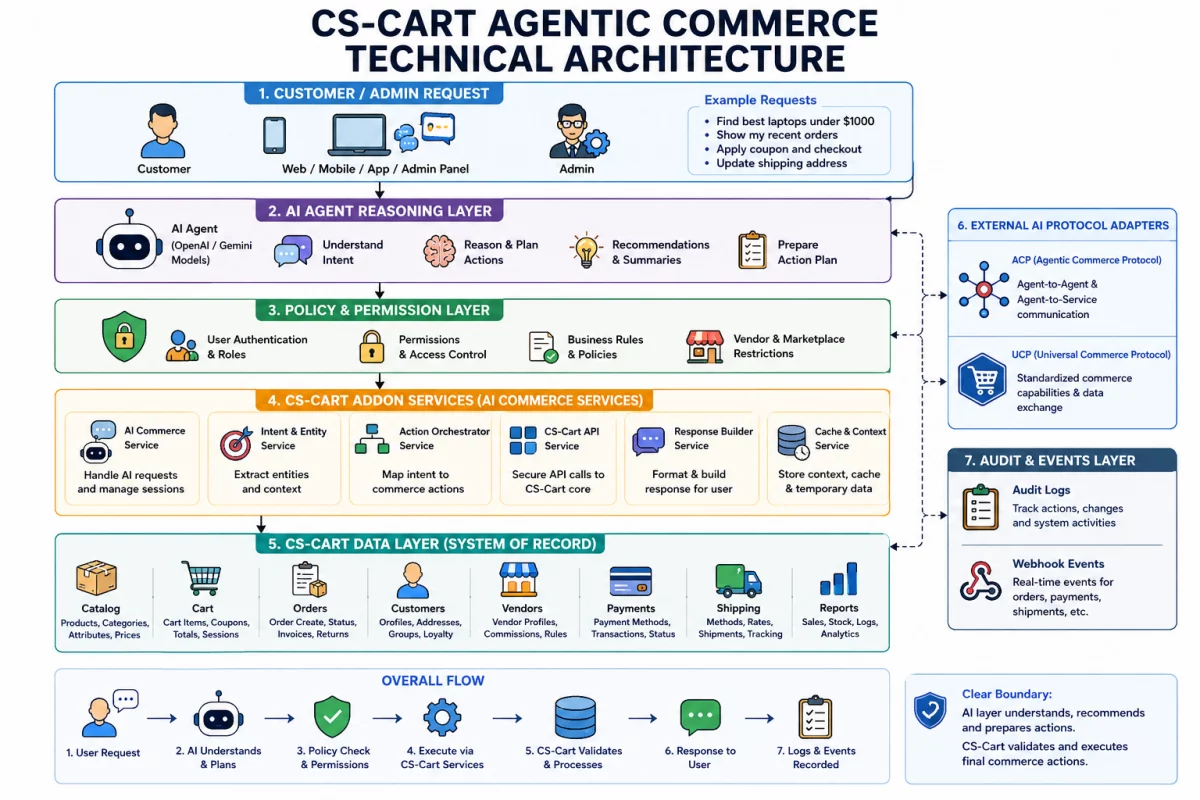
The architecture should maintain clear boundaries between AI reasoning and commerce execution.
Impact of Agentic Commerce
For Customers
- Faster product discovery
- Personalized recommendations
- Lower shopping effort
- Better support experiences
- Easier image-based product search
- Better multilingual shopping experience
For Merchants
- Higher conversion potential
- Increased average order value
- Lower repetitive support workload
- Better catalog quality
- Faster reporting and decision-making
- More intelligent product recommendations
For Vendors
- Better listing support
- Faster product content improvement
- Easier translation workflows
- Better understanding of product performance
- More support for marketplace operations
For Developers
- New CS-Cart addon opportunities
- AI-powered business workflows
- Reusable service layers
- Protocol adapters for ACP and UCP
- Modular agent ecosystems
Future of CS-Cart and Agentic Commerce
The next generation of ecommerce will likely be driven by AI agents that can handle more complex shopping and business workflows.
As protocols such as ACP and UCP continue to mature, CS-Cart stores will be able to participate in broader agent ecosystems, where AI systems interact seamlessly with storefronts, marketplaces, payment providers, logistics partners, customer support systems, and marketing tools.
Businesses that adopt agentic commerce early will be better prepared to deliver personalized, efficient, and intelligent shopping experiences.
Conclusion
Agentic commerce is a major evolution in e-commerce. Instead of customers manually navigating stores and merchants handling every repetitive workflow, AI agents can support both sides of the marketplace.
CS-Cart already provides the commerce foundation needed for this transformation. With its product management, vendor workflows, cart and order systems, add-on architecture, and API capabilities, CS-Cart can support intelligent agent-driven shopping experiences.
The future of ecommerce is not only AI-assisted. It is becoming agent-driven.
Support
Looking to build AI-powered shopping experiences or custom ecommerce solutions?
Explore our CS-Cart Development Services to develop custom add-ons, AI integrations, marketplace solutions, headless commerce, PWA, POS, and third-party integrations tailored to your business needs.
Discover more powerful CS-Cart extensions to enhance your store’s functionality!