WooCommerce Salesforce Integration for The Last Green Valley
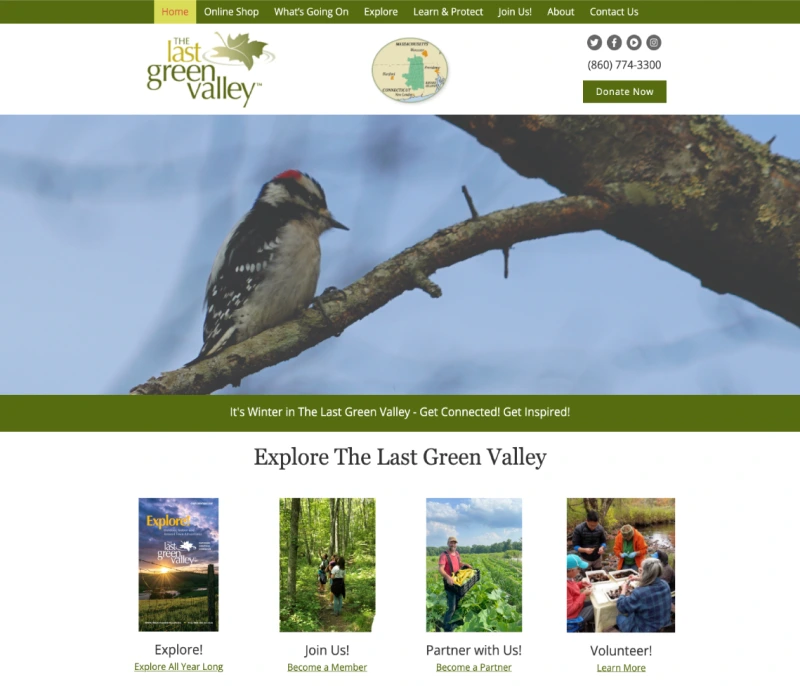
The Last Green Valley
The Last Green Valley, a nonprofit organization, leveraged WooCommerce–Salesforce integration to streamline digital commerce and data management across systems.
It actively preserves and promotes the unique rural heritage of the National Heritage Corridor. To advance this mission, the organization uses digital commerce to manage publications, drive donations, and support product-based initiatives.
To keep these efforts running smoothly, The Last Green Valley ensures accurate data flow, clean reporting, and efficient system operations by tightly integrating WooCommerce with Salesforce—supporting both day-to-day operations and long-term sustainability.
Business Challenges in WooCommerce–Salesforce Integration
However, while using WooCommerce alongside Salesforce, The Last Green Valley encountered several operational and technical challenges:
- WooCommerce orders often contained products from multiple categories, each requiring separate tracking in Salesforce for accurate reporting.
- Salesforce was configured with Nonprofit Success Pack (NPSP), which automatically manages Accounts, making standard connector logic unsuitable.
- A single WooCommerce order needed to create multiple Salesforce Opportunities based on product category segmentation.
- Opportunity data had to be mapped accurately to specific Opportunity Record Types.
- There was a need to evaluate the feasibility of syncing additional order line item data from third-party WooCommerce add-ons.
- Additionally, the WooCommerce site used multiple plugins, requiring careful debugging, validation, and compatibility checks during integration.
The eShopSync Solution for WooCommerce–Salesforce Integration
To address these challenges, eShopSync delivered a customized WooCommerce–Salesforce integration designed specifically for the nonprofit operating model of The Last Green Valley.

1. WooCommerce–Salesforce Integration with NPSP-Compatible Account Handling
First, to align with Salesforce NPSP behavior, the team customized the connector to stop Account creation from WooCommerce.
Instead:
- WooCommerce creates only Contacts.
- Salesforce NPSP automatically generates and links the related Accounts.
As a result, this approach ensures data consistency, prevents duplicate Accounts, and allows Salesforce to manage nonprofit relationships as intended.
Next, to support accurate revenue segmentation:
- The integration maps WooCommerce Product Categories to corresponding Opportunity Record Types in Salesforce.
Additionally, custom logic ensures that:
- If an order contains products from different categories, the system creates multiple Opportunities.
- If multiple products belong to the same category, the system creates a single Opportunity with multiple Opportunity Line Items.
Consequently, this structure improves financial reporting, enhances visibility, and aligns perfectly with Salesforce data models.
3. WooCommerce–Salesforce Integration for Opportunity Line Item Synchronization
To ensure seamless Opportunity creation:
- WooCommerce products were synced to Salesforce before being added as Opportunity Line Items.
- Standard Price Book dependencies were handled carefully to prevent sync failures.
- Product sync logic was fully aligned with Opportunity creation requirements.
Therefore, Opportunities were created smoothly and accurately without any manual intervention.
4. Connector Setup, Testing & Validation
Meanwhile, the WooCommerce Salesforce Connector (v4.1) was:
- Connected to the client’s Salesforce Sandbox environment.
- Thoroughly validated through end-to-end testing of:
- Products
- Categories
- Orders
- Users
Moreover, real-world order scenarios were tested to ensure data accuracy, correct logic handling, and system stability before final deployment.
5. Feasibility Assessment for Advanced WooCommerce Add-ons
In addition, the client requested syncing extra order line item fields generated by a third-party WooCommerce add-on.
eShopSync:
- Analyzed technical feasibility
- Verified availability of required WooCommerce order data
- Proposed a dynamic field-mapping approach for future customization
This enhancement was documented and kept implementation-ready, pending client approval.
Results & Impact of WooCommerce–Salesforce Integration
With the customized integration in place, The Last Green Valley achieved:
- Accurate Salesforce Opportunities from complex WooCommerce orders
- Seamless compatibility with Salesforce NPSP
- Automated revenue segmentation by product category
- Reduced manual effort and eliminated duplicate data
- A scalable, future-ready WooCommerce–Salesforce integration framework
Conclusion: WooCommerce–Salesforce Integration for Nonprofits
Ultimately, by tailoring the WooCommerce–Salesforce integration to nonprofit-specific requirements, eShopSync transformed Salesforce into a reliable operational and reporting hub for The Last Green Valley.
The solution delivered clean data, automation, and clarity, allowing the organization to focus more on its mission and less on system complexity.
Yes, reach out fast at support@webkul.com or raise a ticket